PostgreSQL 18 Trends: What Actually Matters in Practice
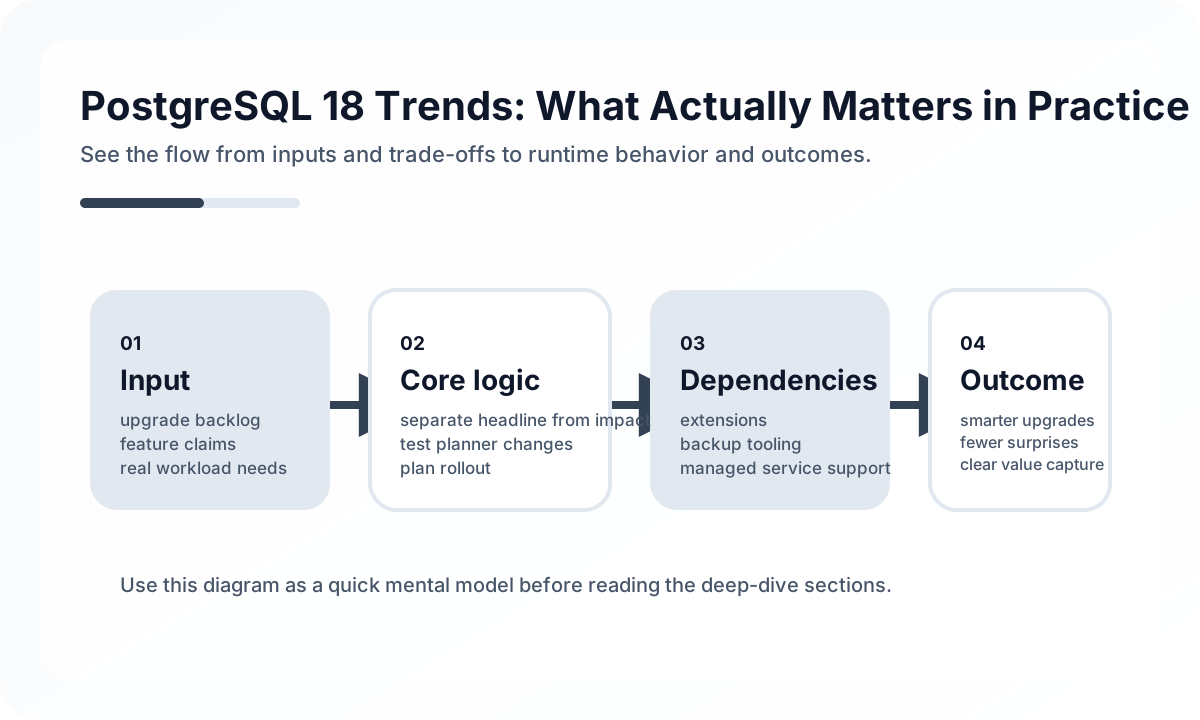
- better I/O performance
- less painful major upgrades
- stronger developer and security ergonomics
That makes PostgreSQL 18 best understood not as a feature parade, but as a cost-reduction release for real operations.
1. AIO is more than a speed tweak
The official press kit highlights the new asynchronous I/O subsystem first, and that ordering matters. PostgreSQL can now issue multiple I/O requests concurrently for some operations, including sequential scans, bitmap heap scans, and vacuum. The project reports performance gains of up to 3x in some scenarios.
The larger meaning is:
- PostgreSQL is taking a more active role in I/O behavior instead of relying only on OS readahead
- storage-rich environments may expose less database-side bottlenecking
- some of the traditionally expensive maintenance and scan paths are being redefined
The practical caution is equally important. The new io_method setting means one more operational boundary now deserves testing. The trend is not just faster storage reads. It is more database-level control over I/O policy.
2. The real MVP may be upgrade pain reduction
In production, major upgrades are often painful not because binaries change, but because planner statistics disappear and performance becomes unstable until the database settles again. PostgreSQL 18 addresses that directly by preserving planner statistics across major version upgrades.
The pg_upgrade improvements matter too. Parallelized checks and the new --swap option make upgrades less punishing for instances with many objects.
That tells us something important about current PostgreSQL direction: the project is not only racing on query speed. It is also investing in lower-friction lifecycle management.
For many teams, that is more valuable than any new SQL convenience.
3. Skip scan should change how teams think about indexes
PostgreSQL 18 adds skip scan support for multicolumn B-tree indexes. That means some queries can use an index more effectively even when equality conditions are missing on prefix columns.
This should not be overhyped, but it should not be ignored either:
- some existing indexes may become useful in more query shapes
- index decisions deserve re-testing before adding more structures
- old rules of thumb about multicolumn indexes become less absolute
The trend in 2026 is not “create more indexes.” It is re-evaluate index design because the planner got smarter.
4. Developer-facing changes are operationally relevant too
PostgreSQL 18 brings virtual generated columns, uuidv7(), simultaneous OLD and NEW access in RETURNING, and temporal constraints. Those may look like developer niceties, but they directly affect how systems get modeled.
uuidv7() is a good example:
- its timestamp ordering improves locality compared with purely random UUID patterns
- it can simplify ordering and event-tracing conventions
- it gives teams a more practical middle ground between integer sequences and random UUIDs
Virtual generated columns also change modeling choices. Teams can revisit what should be stored versus computed without pushing every decision into application code.
5. Security direction matters just as much as performance direction
OAuth 2.0 authentication, FIPS validation work, TLS 1.3 cipher configuration, and the deprecation path for md5 authentication all point in the same direction. PostgreSQL is no longer evolving under the assumption that it only lives deep inside a trusted private network.
This especially matters for:
- organizations aligning infrastructure with SSO
- teams facing stronger audit and compliance pressure
- platforms trying to separate database identity more cleanly from application identity
In other words, database trends in 2026 are not just about faster queries. Authentication choices are now part of the operating model.
What Teams Should Do Right Now
The highest-value evaluation points around PostgreSQL 18 are:
- test how much upgrade pain can be removed by preserved planner statistics and the new
pg_upgradeworkflow - benchmark AIO behavior against your storage profile before changing defaults
- revisit multicolumn index strategy in light of skip scan
- evaluate
uuidv7()for new services and write-heavy tables - plan migration toward stronger authentication paths such as OAuth and SCRAM
This order matters because using many new features is less valuable than reducing the expensive parts of database operations first.
Closing Judgment
PostgreSQL 18 is not a release to remember for one flashy headline. Its significance comes from better I/O utilization, less disruptive major upgrades, more flexible modeling choices, and a more modern security posture. The right way to read the trend is not “what got added?” but “which operational pains got smaller?”
Official References
- PostgreSQL 18 Press Kit (2025-09-25): https://www.postgresql.org/about/press/presskit18/en/
- PostgreSQL site release news (checked 2026-04-21): https://www.postgresql.org/
Continue Reading
Related posts
How Small Models Are Changing Product Architecture
An important AI product trend is not only bigger models, but better decisions about where smaller models belong in the system.
📈 TrendsThe Next Stage of AI Coding Agents Is Bounded Execution
Coding agents are moving beyond autocomplete toward execution environments with explicit limits, permissions, and safety rails.
🗄️ DatabaseA Guide to Zero-Downtime Schema Migration
A practical guide to schema evolution in production using expand-migrate-contract patterns, compatibility windows, and operational safeguards.
🗄️ DatabaseA Practical Database Index Design Playbook
A production-oriented playbook for index design that covers read/write tradeoffs, composite indexes, covering indexes, cardinality, execution plans, anti-patterns, and an operational review workflow.
Next Path