Designing a Spring Boot REST API That Holds Up in Production
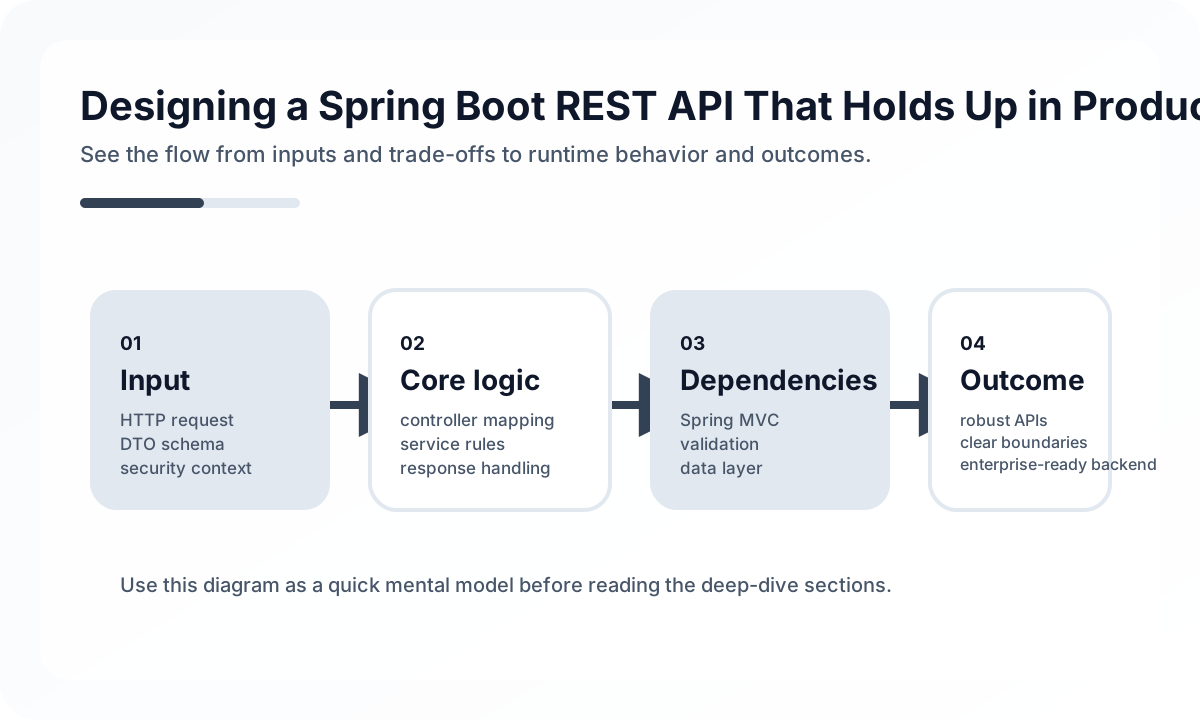
A good Spring Boot API is therefore not just one that responds correctly. It is one whose boundaries still make sense months later under real change pressure.
Start With Contract Ownership
The first design question is not which annotation to use. It is who owns the API contract and how stable that contract needs to remain.
Healthy teams treat DTOs as deliberate external contracts:
- requests define what clients may send
- responses define what the API promises back
- validation at the boundary protects the application core
- entities remain internal implementation details
The moment entities leak directly into the API surface, persistence detail starts shaping client behavior. That is how “simple CRUD” becomes long-term coupling.
Controllers Should Translate HTTP, Not Own Use Cases
Controllers should remain responsible for:
- HTTP input parsing
- status code and header decisions
- invoking the right application use case
- mapping application results to response DTOs
They should not quietly become the home for:
- business policy
- transaction rules
- authorization nuance
- orchestration across repositories
When controllers grow too smart, the codebase becomes harder to test and harder to change without breaking edge behavior.
A Layered Structure Works Only if Each Layer Has a Real Job
The classic structure still works:
src/main/java/com/example/
├─ controller/
├─ service/
├─ repository/
├─ domain/
├─ dto/
└─ config/
But the folders are not the architecture. The responsibility boundaries are.
- controllers own transport concerns
- services own use cases and transaction coordination
- repositories own persistence access
- domain objects protect business meaning
If the layers exist only as folders while responsibilities are mixed freely, the structure adds ceremony without clarity.
Example: A Thin Controller Boundary
@RestController
@RequestMapping("/api/users")
@RequiredArgsConstructor
public class UserController {
    private final UserService userService;

    @PostMapping
    public ResponseEntity<UserResponse> create(@Valid @RequestBody CreateUserRequest request) {
        UserResponse response = userService.createUser(request);
        return ResponseEntity.status(HttpStatus.CREATED).body(response);
    }
}
The important point is not that the controller is short. It is that the controller does not own business meaning beyond HTTP translation.
DTO Separation Protects the API From Persistence Drift
Using dedicated DTOs is not about ceremony. It is about protecting the client contract from internal evolution.
public record CreateUserRequest(
    @NotBlank String email,
    @NotBlank String name
) {}

public record UserResponse(
    Long id,
    String email,
    String name,
    LocalDateTime createdAt
) {}
This separation makes several things easier:
- validation evolves independently of persistence fields
- internal columns can change without breaking clients
- read models can differ from write models cleanly
- security-sensitive fields are less likely to leak by accident
For production APIs, this is a stability feature, not a stylistic preference.
Services Own Transactions and Use Cases
The service layer is where business operations should become explicit.
That includes:
- transaction boundaries
- orchestration across repositories or external systems
- domain validation beyond syntactic request validation
- decisions about idempotency, retries, and side effects
If transaction boundaries are spread between controllers, repositories, and event publishers, the API can still pass tests while behaving unpredictably under failure.
Validation and Error Handling Need Early Standardization
Teams often postpone error format standardization because it feels cosmetic. In production, it is not cosmetic at all.
A healthy API defines:
- one consistent error envelope
- machine-readable error codes
- meaningful field-level validation responses
- correlation or request IDs for diagnosis
This becomes even more important when mobile clients, frontend teams, and external integrators depend on the same API. Consistency reduces support cost.
Reads and Writes Should Not Be Treated Symmetrically
One of the most helpful production distinctions is separating read optimization from write safety.
Write endpoints care about:
- rule enforcement
- transaction correctness
- side-effect ordering
Read endpoints often care more about:
- response shape
- projection efficiency
- pagination stability
- caching strategy
Treating both paths identically usually produces endpoints that are correct but expensive, or fast but poorly governed.
Example Operational Questions
Before calling a Spring Boot API “production-ready,” teams should be able to answer:
- how request IDs are propagated
- how slow endpoints are detected
- which exceptions map to which client-facing codes
- where transaction time and lock risk are concentrated
- how retries interact with side effects
These are architecture questions disguised as operations questions.
Common Anti-Patterns
- exposing entities directly from controllers
- placing business rules inside controllers
- mixing input validation and domain validation without distinction
- returning ad hoc error formats per endpoint
- using one transaction style for every endpoint regardless of read/write behavior
These patterns usually emerge because the API grows incrementally without a stable boundary model.
Review Checklist
- Does the controller handle HTTP concerns only?
- Are DTOs protecting the client contract from internal change?
- Are transaction boundaries visible in services?
- Is the error model consistent and diagnosable?
- Are read and write paths intentionally optimized for different concerns?
Closing Judgment
The real test of a Spring Boot REST API is not whether it starts quickly. It is whether its boundaries remain understandable as traffic, team size, and product scope grow. Thin controllers, stable contracts, explicit transaction ownership, and operationally sane error handling are what make the API hold up.
Continue Reading
Related posts
A Guide to Designing Real-Time Communication with WebSocket
This guide covers connection lifecycle, message modeling, authentication, delivery guarantees, and scale-out concerns when designing Spring Boot WebSocket systems.
⚙️ BackendBuilding a REST API Quickly with Python FastAPI
This guide takes FastAPI beyond demo code and focuses on schema separation, dependency boundaries, authentication, exception policy, and production checkpoints.
🧪 TestSpring Boot Test Slices: @WebMvcTest and @DataJpaTest
A practical guide to Spring Boot test slices from the perspective of test-pyramid design and execution cost. Covers when to use @WebMvcTest, @DataJpaTest, @JsonTest, @RestClientTest, and when @SpringBootTest is the better choice.
🧪 TestREST Assured API Testing Strategy Guide
A practical guide to testing Java-based APIs with REST Assured. Focuses on contract validation, authentication flows, test data, and integration-test boundaries rather than just request examples.
Next Path