Vue 3 Component Communication Design Guide
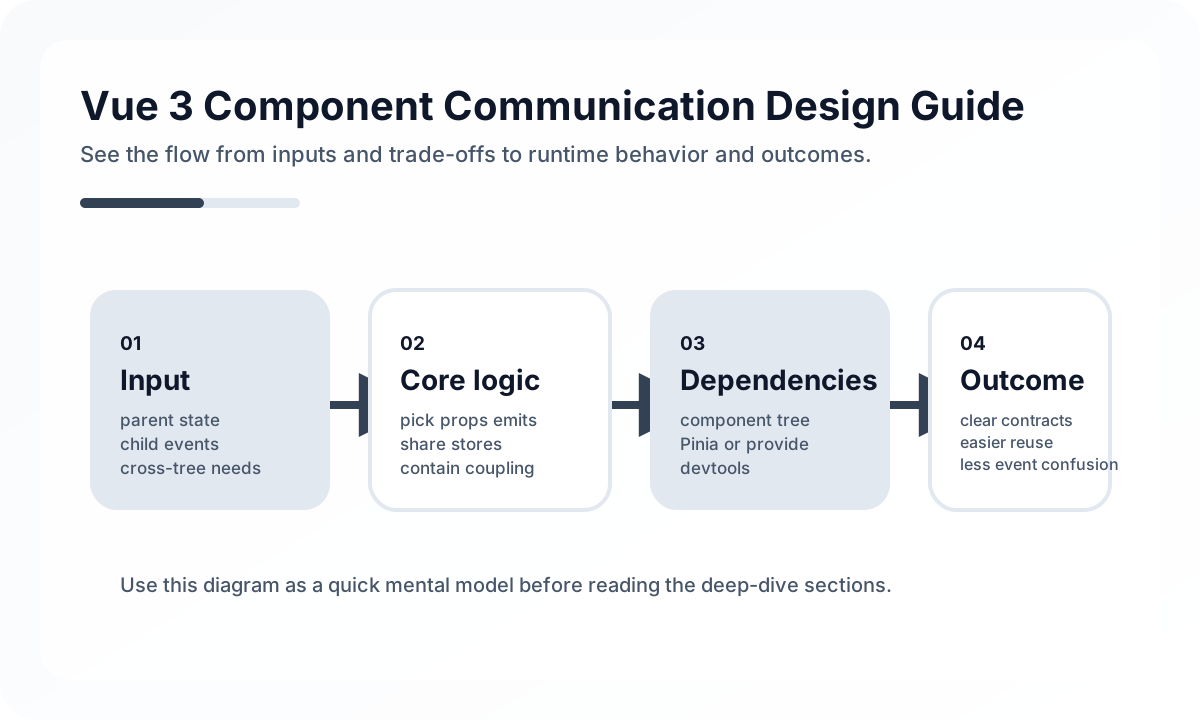
The default principle is one-way data flow
The easiest structure to read is when the parent passes data down and the child signals intent through events. If this principle holds, component responsibilities stay clear and testing becomes easier.
Props are a data contract
Props are not just a way to pass values. They are a reusable interface. It is better for a child component to receive only the minimum information it really needs. Too many props can signal that the parent knows too much about the child’s internal model.
emit should communicate intent, not mutate state
Event names like submit, close, and select work well because they describe user intent. Names like updateValue or setParentState reveal too much about the parent implementation and increase coupling.
Use provide/inject selectively in deep trees
provide/inject is useful for passing shared context through deep component trees. But if you use it like a substitute for global state, it becomes hard to track where values come from. It works best when the scope is clear, such as themes, form context, or read-only configuration.
Use a store only for state that truly needs to be shared
Stores are a natural fit for broad-scope data like authentication state, user preferences, or a shopping cart that multiple screens need. But if you push state into a store that is only used inside one page, you usually add complexity without getting much back.
Common mistakes
Many teams jump straight to a store just to avoid props drilling, or go to the opposite extreme and force every deep handoff through props alone. The important thing is not the tool itself, but whether the scope of the state is clearly defined.
Wrap-up
The core of Vue 3 component communication is not knowing which API exists, but keeping data flow simple. Props, emit, provide/inject, and stores are not competing tools. Each fits a different scope. If the boundaries are clear, communication stops being a source of complexity and starts explaining the structure of the application.
What Gets Hard in Production
- Component communication stops being simple when data ownership is ambiguous across props, emits, provide/inject, stores, and route state.
- The hardest bugs often come from two-way coordination spread across too many mechanisms.
- Communication patterns need consistency more than variety.
Architecture Decisions That Matter
- Use props and emits for explicit parent-child contracts first.
- Reserve provide/inject for dependency flow and stable shared services, not hidden state mutation.
- Escalate to a store only when state is shared broadly enough to justify it.
Practical Example
A clean parent-child contract stays explicit about input and output:
<ChildForm
  :model-value="draft"
  @update:model-value="draft = $event"
  @submit="saveDraft"
/>
Anti-Patterns to Avoid
- Mixing local mutation, emits, and store writes for the same piece of state.
- Using provide/inject to bypass component API design.
- Promoting temporary UI coordination to global state too early.
Operational Checklist
- Document preferred communication patterns by scope.
- Review whether two-way bindings preserve clear ownership.
- Keep event names semantic and domain-focused.
- Refactor when communication paths multiply faster than features.
Final Judgment
Good component communication is mostly about clear ownership. The mechanism matters less than whether the team can explain where state lives and how it changes.
Continue Reading
Related posts
Vue Router 4 Design Guide
This guide looks at Vue Router 4 not just as a routing tool, but as a way to design page transitions and authorization flow. It covers nested routes, guards, lazy loading, and URL design principles.
🖥️ FrontendVue 3 Composition API Complete Guide
This practical guide goes beyond Composition API syntax to cover logic composition, composable design, the boundary between ref and reactive, and maintainability in real projects.
💬 LanguageTypeScript Utility Types: A Practical Guide
A production-focused guide to TypeScript utility types. Learn how to model DTOs, update payloads, selectors, and derived types without making your type layer harder to read.
💬 LanguageModern JavaScript Syntax Through ES2024
A practical guide to modern JavaScript syntax through an engineering lens. Learn which ES2024-era features genuinely improve code quality and which ones still need restraint.
Next Path