2026 Agent Platform Trends: What Changes After MCP
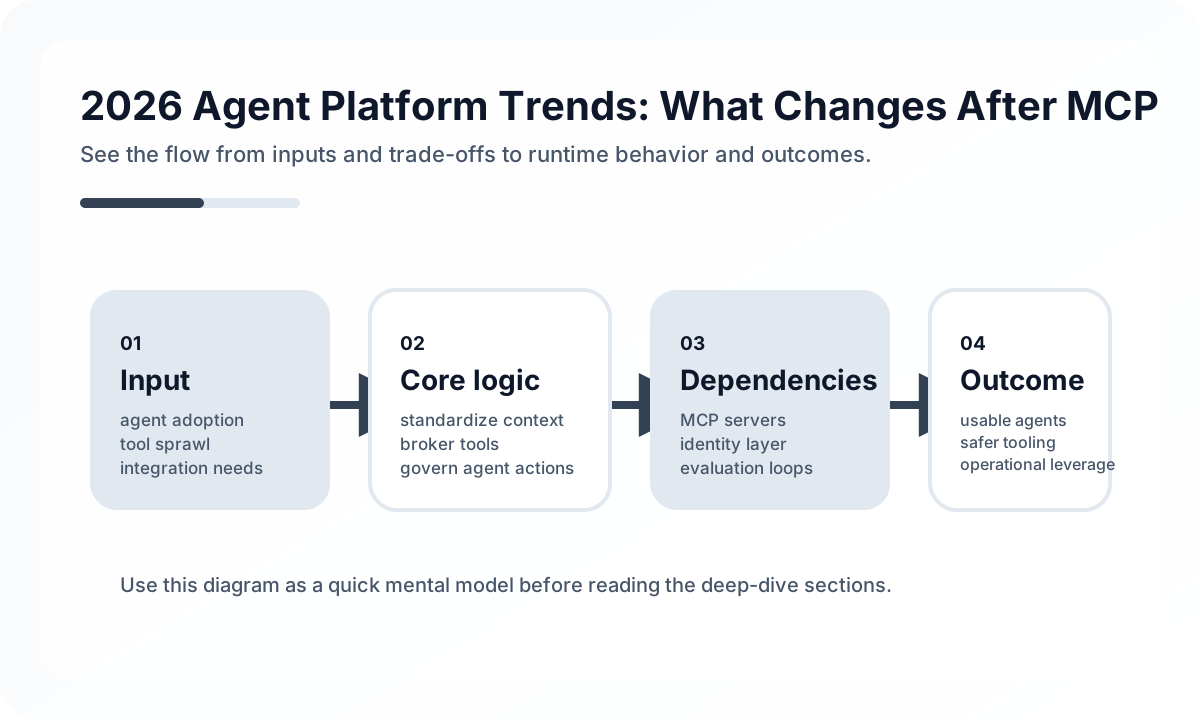
The official MCP specification published a revision on November 25, 2025, and the draft changelog has already moved the conversation toward extensions and OpenTelemetry trace-context conventions. That matters because the market has moved beyond toy demos. Agent systems now need security, governance, and diagnosable operations.
What Actually Matters in 2026
The recent MCP changes may look like a feature list, but their architectural meaning is larger:
- tools, resources, and prompts are being treated as first-class protocol concepts
- authorization and consent flows are becoming part of platform design instead of ad hoc glue
- servers are evolving beyond single-shot function calls toward longer-lived work
- observability is moving closer to the protocol ecosystem itself
So the real 2026 trend is not “more tools.” It is more trustworthy tool execution.
Why MCP Is Moving Beyond Experimental Integrations
Early agent systems often shipped with one-off adapters for each tool. That works for demos and then breaks down.
- every tool gets modeled differently
- approval and scope rules become inconsistent
- tracing the full request path gets difficult
- changing hosts or replacing servers becomes expensive
MCP addresses this by introducing a shared integration layer. Once tools, read-only resources, prompt templates, filesystem roots, and elicitation all live in one vocabulary, platform teams gain leverage over composition rather than depending on bespoke wrappers everywhere.
The 2026 Signals Worth Paying Attention To
1. Authorization is no longer a side topic
The November 25, 2025 revision strengthened OpenID Connect discovery and OAuth-related mechanisms for a reason: agent systems are now being connected to real business systems. Calendars, file stores, ticketing systems, internal knowledge bases, and transaction-adjacent workflows all require cleaner trust boundaries.
That changes the key platform questions:
- what exact scope does a server get
- when must a user approve
- how are tokens and scopes reflected across the call chain
- where can failures be diagnosed if access is denied
In 2026, the most dangerous agent platform is not the least capable one. It is the one with vague trust boundaries.
2. Servers are becoming durable work units
Experimental task support in the changelog is a strong signal. Real agent workflows often do not fit the shape of “one request in, one result out.”
- long-running document analysis
- multi-system approval workflows
- async polling and deferred results
- operations that pause for human input
That means serious agent platforms are shifting from plain tool invocation toward durable orchestration models.
3. Observability is now a design requirement
The draft changelog’s focus on trace context is not cosmetic. Agent systems have long execution chains, mixed human/model decision points, and many potential failure boundaries. Logs alone are rarely enough.
Teams need to know:
- which user request touched which MCP servers
- where elicitation inserted human input
- which tool call failed or retried
- whether latency came from the model, the server, or an external dependency
In 2026, prompt quality still matters, but traceable workflows matter more for production safety.
Practical Platform Rules
Adopting MCP well is mostly about drawing good boundaries.
Separate host responsibility from server responsibility
The host application should own user experience, approvals, policy enforcement, and server coordination. Servers should expose domain capabilities. When that line blurs, security and product behavior both become harder to reason about.
Resources often matter before tools
Many teams start with tool execution, but well-structured read-only resources often create more value first. They improve context quality and reduce unnecessary tool calls.
Treat approval UX as a product surface
Approval cannot be an afterthought pop-up. Users need to understand:
- which server is asking
- why the action or data is needed
- what changes if they refuse
- how this request differs from previous approvals
Weak approval UX destroys trust even when the protocol layer is technically sound.
2026 Anti-Patterns
- treating MCP as a simple tool marketplace
- postponing scope and authorization design until after integration work
- assuming every server deserves the same trust level
- believing approval and tracing can be “added later”
- forcing long-running workflows into synchronous tool calls
These patterns speed up demos and slow down real deployment.
Which Teams Should Move First
MCP deserves faster evaluation if you are:
- a developer platform team with many internal tools
- a productivity team connecting code, docs, tickets, and collaboration systems
- an operations or support organization with action-heavy workflows
- an enterprise IT group integrating multiple SaaS and internal systems
If your use case is still limited to search and summarization, it is often better to strengthen resource structure and approval UX before expanding server count.
Closing Judgment
The 2026 competition in agent platforms is not decided by model benchmarks alone. It is being shaped by standardized tool access, clearer trust boundaries, safer handling of long-running work, and end-to-end observability. MCP sits at the center of that shift, but the lasting advantage will come from how teams operationalize the protocol, not from merely adopting it.
Official References
- Model Context Protocol Specification 2025-11-25: https://modelcontextprotocol.io/specification/2025-11-25/basic
- MCP Key Changes 2025-11-25: https://modelcontextprotocol.io/specification/2025-11-25/changelog
- MCP Draft Changelog: https://modelcontextprotocol.io/specification/draft/changelog
- Understanding MCP Clients: https://modelcontextprotocol.io/docs/learn/client-concepts
- Understanding MCP Servers: https://modelcontextprotocol.io/docs/learn/server-concepts
Continue Reading
Related posts
How Small Models Are Changing Product Architecture
An important AI product trend is not only bigger models, but better decisions about where smaller models belong in the system.
📈 TrendsThe Next Stage of AI Coding Agents Is Bounded Execution
Coding agents are moving beyond autocomplete toward execution environments with explicit limits, permissions, and safety rails.
🤖 AI / LLMOpsOpenAI Responses API Agent Architecture Playbook
A practical guide to designing agent systems around the OpenAI Responses API, built-in tools, conversation state, and operational guardrails.
🤖 AI / LLMOpsAn Agent Approval UX Playbook
Strong agents do not only automate more. They show clearly when a human should step in. This guide explains approval UX in practical terms.
Next Path