2026 Kubernetes Platform Trends: What Operators See After v1.35
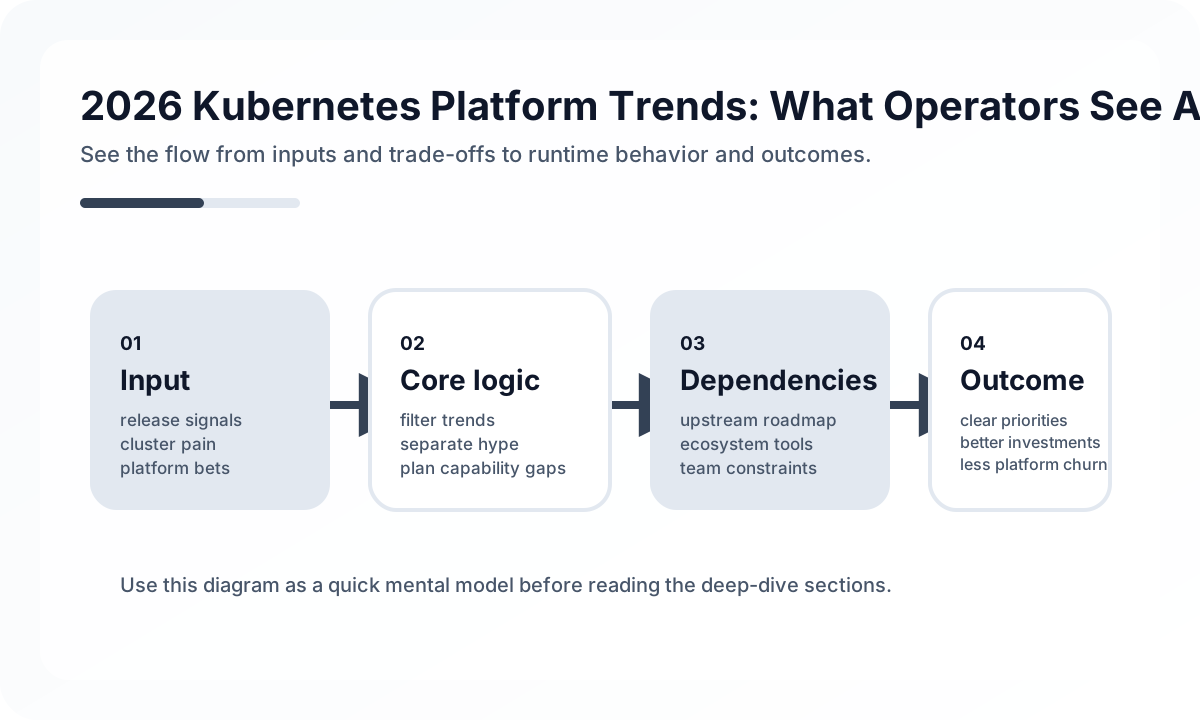
In other words, what platform teams want from Kubernetes in 2026 is not abstract innovation. It is lower operational friction.
How to Read the Trend Correctly
The common mistake is to read each release as a feature catalog. Operators should read it through different questions:
- does this reduce restart-heavy operational work
- does this simplify node and workload variation
- does this improve stability relative to cost
- does this help platform teams standardize safely
Viewed that way, the 2026 direction is fairly clear.
1. Non-disruptive elasticity is becoming more important
The graduation of In-Place Pod Resize to GA in v1.35 is highly symbolic. Previously, changing CPU and memory requests or limits usually meant recreating Pods. That is expensive for stateful services and latency-sensitive workloads.
This matters for more than convenience:
- it lowers the operational cost of resizing stateful workloads
- it makes vertical adjustment more realistic
- it loosens the coupling between resource tuning and deployment events
- it creates room to reduce over-provisioned buffers
One of the key 2026 platform themes is less disruptive elasticity. Resource adjustments are becoming less deployment-like and more operationally normal.
2. Node configuration is shifting toward base policy plus safe variation
The GA status of the kubelet configuration drop-in directory is another meaningful signal. Large clusters already contain heterogeneous node pools, and a single global kubelet policy is often too blunt for mixed workloads.
The message is simple:
- node config can no longer be treated as one monolithic file
- platform teams need a shared baseline plus safe per-node-group variation
- standardization is not the removal of all exceptions, but the structured handling of exceptions
That is a very 2026 platform-engineering theme: not more YAML, but safer variability management.
3. Maintenance strategy matters more than raw release speed
Kubernetes still moves quickly, but operators increasingly care less about “Is there a new minor release?” and more about “Can we live inside a sustainable support window?”
Because the project officially maintains only the most recent three minors, upgrade strategy is now basic platform hygiene. The practical mindset looks like this:
- treat upgrades as operational rhythm, not isolated projects
- continuously watch API usage and deprecations
- include CNI, CSI, ingress, admission, and policy compatibility in the plan
- budget for stabilization after the upgrade, not just the upgrade event itself
The strongest teams are not necessarily the earliest adopters. They are the ones with a repeatable upgrade cadence.
4. Platform value is moving from cluster creation to productized operations
The biggest 2026 shift is that building a cluster is no longer enough to claim a platform.
Internal users now expect:
- standardized delivery paths
- predictable resource policy
- self-service boundaries by team
- built-in observability
- low-friction upgrades and policy changes
So the differentiator is increasingly the platform experience around Kubernetes, not Kubernetes alone.
2026 Anti-Patterns
- fast adoption of new releases without operational standards
- treating resizing and resource changes as restart-heavy events forever
- leaving node-specific configuration in shell scripts and manual runbooks
- postponing upgrades into one large risky project
- keeping platform teams trapped in pure cluster-admin work
These teams may appear technically busy while their internal developer experience keeps getting worse.
Who Gains the Most Right Now
- organizations with many teams sharing one platform
- teams running both stateful and batch-heavy workloads
- environments with heterogeneous node pools
- organizations whose main scaling problem is platform consistency, not raw cluster count
For them, current Kubernetes trends are not just release notes. They are clues about how to redesign the operating model.
Closing Judgment
The 2026 Kubernetes trend is not about looking more “cloud native.” It is about reducing restart cost, structuring configuration variation safely, and making upgrades a routine operational motion. Using the newest version matters, but the real edge comes from absorbing those capabilities into a cleaner platform model.
Official References
- Kubernetes Releases (checked on 2026-04-21): https://kubernetes.io/releases
- Kubernetes 1.35 release page: https://kubernetes.io/releases/1.35/
- Kubernetes v1.35 release announcement (2025-12-17): https://kubernetes.io/blog/2025/12/17/kubernetes-v1-35-release/
- In-Place Pod Resize GA (2025-12-19): https://kubernetes.io/blog/2025/12/19/kubernetes-v1-35-in-place-pod-resize-ga/
- Kubelet config drop-in GA (2025-12-22): https://kubernetes.io/blog/2025/12/22/kubernetes-v1-35-kubelet-config-drop-in-directory-ga/
Continue Reading
Related posts
Kubernetes v1.34: What Platform Teams Should Actually Watch
A practical reading of Kubernetes v1.34 for platform teams, focusing on the changes that most affect operations, workload design, and cluster governance.
📈 TrendsWhy Kubernetes User Namespaces by Default Matters
The shift toward user namespaces being enabled by default is more than a small Kubernetes option change. It signals stronger container isolation expectations.
🚀 DevOpsKubernetes Advanced Operations — HPA, Resource Management, and Pod Scheduling
This article explains Kubernetes operations not as a collection of settings but from the perspective of resource placement and resilience. It covers when and how to use requests/limits, HPA, affinity, taints, PDBs, and probes in real environments.
📚 IT StoriesHow Containers and Kubernetes Changed the Feeling of Deployment
Deployment once felt like a tense event. Containers and Kubernetes helped turn it into something more repeatable, automated, and systematized.
Next Path