JDK 25 Trends: How to Read LTS Adoption in Practice
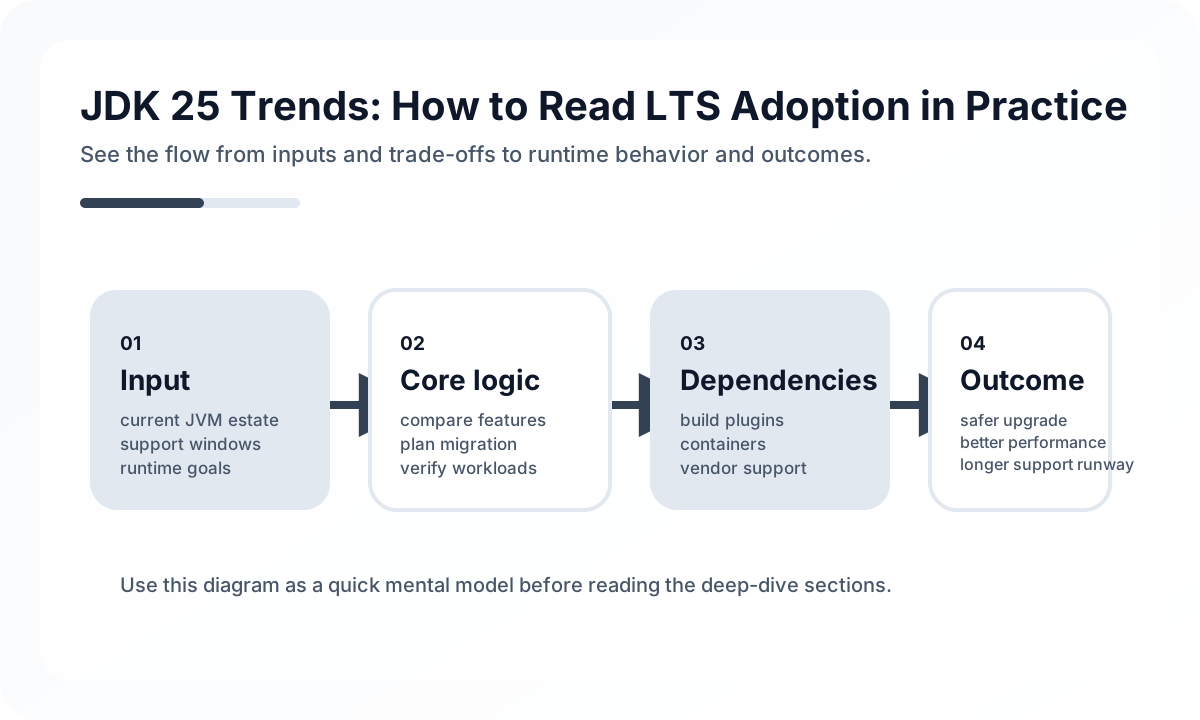
There are really three storylines:
- concurrency and context propagation are getting more structured
- the VM keeps pushing harder on runtime efficiency
- language and tooling continue to reduce entry cost
So the current JDK 25 trend is not “a few new language tricks.” It is the Java platform trying to strengthen large-scale backend reliability and modern developer ergonomics at the same time.
1. This is no longer only about virtual threads
JDK 25 includes Scoped Values as a permanent feature, while Structured Concurrency continues in its fifth preview. That tells us something important: Java is not stopping at lightweight threads. It is trying to make the broader concurrency model safer and more understandable.
The practical reading is:
- virtual threads make units of work cheaper
- Scoped Values offer context propagation that is often easier to reason about than thread locals
- Structured Concurrency aims to improve cancellation, failure propagation, and task lifetimes
So the 2026 Java trend is not merely “we can spawn more threads.” It is a more structured concurrency stack.
2. Stable Values points toward safer lazy initialization patterns
One of the notable JDK 25 additions is preview Stable Values. The official API documentation describes StableValue as a holder that can be set at most once, allowing the JVM to optimize later reads more aggressively.
The broader signal is interesting:
- Java wants to bridge the gap between lazy initialization and constant-like optimization
- common “compute exactly once” patterns are moving closer to platform support
- high-performance server-side caching patterns may become more standardized
The fact that it is still preview matters. This is better read as a direction to track seriously, especially for framework and library authors, rather than an automatic enterprise standard on day one.
3. Runtime efficiency is still a first-class priority
JDK 25 also includes Compact Object Headers, Generational Shenandoah, Ahead-of-Time profiling and ergonomics work, plus more JFR investment. Together, these changes show that Java is still focused on very practical operational concerns:
- reducing memory overhead
- improving GC behavior
- shrinking startup and warmup costs
- strengthening production diagnostics
That is one reason Java remains hard to dismiss in large backend systems. The platform continues to improve developer-facing features without giving up runtime seriousness.
4. Java is also trying to feel lighter
Features such as Module Import Declarations and Compact Source Files with Instance Main Methods may look minor in enterprise settings, but they still reveal intent:
- make examples and small programs cheaper to write
- improve the script-like and CLI-like experience
- reduce the “heavy language” perception for newcomers
These changes may not rewrite enterprise coding standards immediately, but they do show that Java is trying to lower friction at the edges.
5. A Better Production Reading of JDK 25
The healthiest way to approach JDK 25 is to sort features into layers.
Worth serious near-term evaluation
- Scoped Values
- JFR improvements
- VM and GC changes
- security-related APIs
These can create value relatively quickly in platform or infrastructure contexts.
Worth controlled experimentation
- Structured Concurrency
- Stable Values
- Compact Object Headers
These features have strong directionality, but teams should evaluate framework maturity, vendor support, and operational impact first.
Not urgent as platform standards
- educational or lightweight-source enhancements
- features that are still clearly experimental for your environment
Useful does not always mean strategically urgent.
2026 Java Team Anti-Patterns
- treating every JDK 25 JEP as equally important
- deploying preview features broadly without lifecycle rules
- adopting virtual threads while keeping context propagation and cancellation design unchanged
- focusing only on syntax while ignoring VM, GC, and JFR changes
- failing to align JDK adoption with vendor distribution and upgrade policy
These mistakes make teams feel current without making them more effective.
Closing Judgment
JDK 25 shows that Java is not a platform standing still. Its concurrency model is becoming more structured, the runtime is pushing harder on efficiency, and the language experience is getting lighter at the edges. But production adoption should still be filtered by the only question that matters: which changes actually reduce operating and maintenance cost for your team?
Official References
- OpenJDK JDK 25 page: https://openjdk.org/projects/jdk/25/
- Java 25 / JDK 25 GA announcement (2025-09-16): https://mail.openjdk.org/pipermail/announce/2025-September/000360.html
- StableValue API docs: https://docs.oracle.com/en/java/javase/25/docs/api/java.base/java/lang/StableValue.html
- Significant Changes in JDK 25: https://docs.oracle.com/en/java/javase/25/migrate/significant-changes-jdk-25.html
Continue Reading
Related posts
How Small Models Are Changing Product Architecture
An important AI product trend is not only bigger models, but better decisions about where smaller models belong in the system.
📈 TrendsThe Next Stage of AI Coding Agents Is Bounded Execution
Coding agents are moving beyond autocomplete toward execution environments with explicit limits, permissions, and safety rails.
💬 LanguageOperating JDK LTS Upgrade Waves
A JDK upgrade is not just a version bump. It is an organizational rollout across services, tooling, and runtime assumptions.
💬 LanguageKotlin Basics for Java Developers
A practical guide to Kotlin for Java developers through a production lens. Learn what Kotlin changes in team habits, not just in syntax, especially around null safety, state modeling, and coroutines.
Next Path