Postman Practical Guide: API Testing, Automation, and Team Collaboration
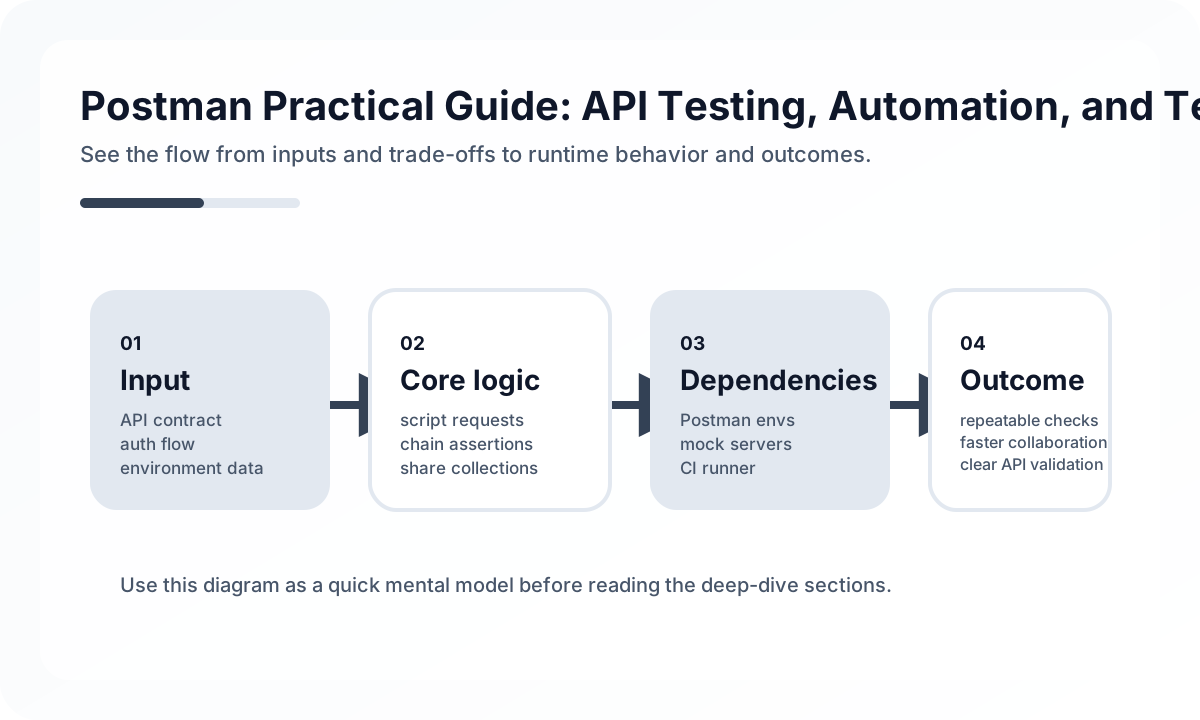
The practical goal is to use Postman where it creates team leverage and stop before it becomes a maintenance burden.
What Postman Is Good At
Postman is especially useful for:
- exploring new endpoints quickly
- sharing example request flows across frontend, backend, QA, and product
- managing environment-specific variables
- validating happy paths and key error cases
- running lightweight collection checks in CI through Newman
It is not just a request sender. Done well, a collection becomes operational knowledge for how the API is supposed to behave.
Collection Structure Matters More Than Raw Request Count
Many teams accumulate dozens of ad hoc requests in personal workspaces. That is not shared testing. It is private memory.
A maintainable collection structure usually groups requests by:
- business domain
- authentication requirements
- environment assumptions
- setup flow versus validation flow
For example, an order API collection should not only contain POST /orders. It should reflect an actual journey:
login -> create cart -> submit order -> verify order status -> cancel orderWhen requests are organized around workflows, the collection becomes useful outside the original author.
Environment Discipline Prevents Expensive Confusion
One of the biggest sources of Postman chaos is weak environment handling.
Practical rules:
- separate local, staging, and production-like environments clearly
- never store real secrets directly in shared collections
- keep naming consistent for tokens, base URLs, tenant IDs, and test users
- document which requests require which environment state
Most “Postman is flaky” complaints are really environment-governance complaints.
Pre-Request and Test Scripts Should Stay Focused
Postman scripts are useful, but teams can overbuild them quickly.
Good use cases:
- generating auth tokens
- setting correlation IDs
- checking status codes and required fields
- validating simple business expectations
Example:
pm.test("status is 200", function () {
  pm.response.to.have.status(200);
});

pm.test("contains orderId", function () {
  const json = pm.response.json();
  pm.expect(json.orderId).to.exist;
});
Bad use cases:
- building an entire test framework inside Postman
- writing large shared script logic no one wants to debug
- hiding business-critical assertions in opaque snippets
Once the test logic becomes too complex, code-based API tests are usually the better home.
Postman and Code-Based Tests Should Divide Responsibility
Strong teams do not force one tool to do everything.
A practical split looks like this:
- Postman for exploration, examples, onboarding, and lightweight regression flows
- code-based tests for deep assertions, broader automation, and long-term maintainability
This boundary matters. When Postman collections become too large, they often stop being readable and stop being maintained.
Newman in CI Is Useful, but It Should Stay Targeted
Running Postman collections in CI can be valuable, especially for smoke tests and shared API contracts. But teams should keep it lightweight.
Good candidates for Newman:
- authentication flow validation
- health checks for critical business paths
- partner-facing API examples
- environment sanity checks after deployment
Poor candidates:
- huge regression suites better expressed in code
- highly stateful scenarios with many fragile dependencies
The purpose of Newman is usually fast confidence, not total test ownership.
Common Failure Modes
- requests live only in personal workspaces
- environment variables are inconsistent or undocumented
- collections reflect endpoint lists instead of business flows
- sensitive data leaks into shared environments
- Postman scripts grow until nobody trusts them
Postman succeeds when it is treated as shared operational documentation with executable checks.
Team Checklist
- Can a new teammate use the collection to understand the API flow?
- Are environments clearly separated and safely managed?
- Are the most important business flows represented, not just endpoints?
- Are Postman tests lightweight enough to stay readable?
- Is Newman used for targeted confidence rather than test-suite sprawl?
Closing Judgment
Postman delivers the most value when it captures reproducible API workflows and keeps them shareable across roles. It becomes weak when teams confuse it with a full replacement for code-based testing. Use it as a collaboration layer, an exploration layer, and a smoke-validation layer. That is where it stays practical.
Continue Reading
Related posts
Designing Search Architecture for Engineering Docs
As documentation grows, the problem shifts from writing to finding. This guide explains how to design search-friendly engineering documentation.
🔧 ToolsRunning an Engineering Handbook as Code
Team rules decay quickly when they live only in a wiki. A useful handbook should evolve alongside development work.
⚙️ BackendJob Status Patterns for Long-Running Bulk APIs
Treating long-running backend work as a synchronous API problem usually hurts both user experience and operational stability. Here is a practical job-status pattern.
📚 IT StoriesWhy Developers Fell in Love with the CLI
Even in an age of polished GUIs, developers keep returning to the terminal. This story explains why the CLI became a cultural center of engineering.
Next Path