Choosing Monorepo Build Tooling: A Practical Playbook
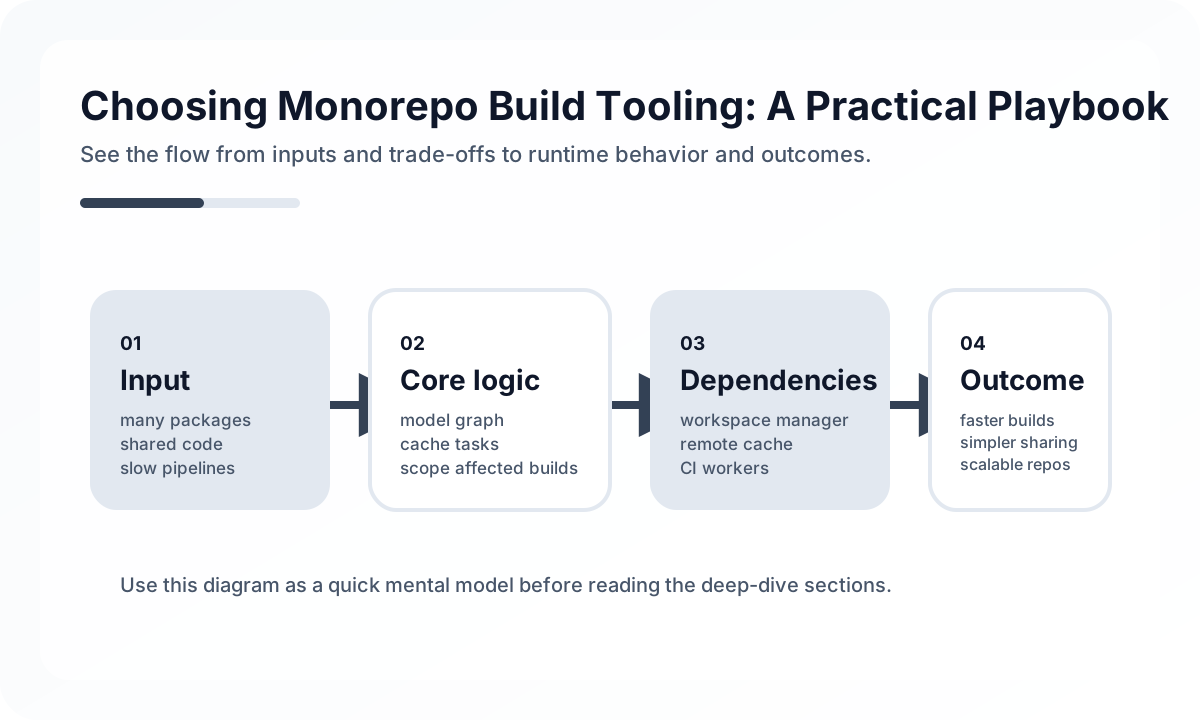
The right tool is not the one with the longest checklist. It is the one that helps the team keep scale understandable.
What Changes Once the Repository Grows
At small scale, plain workspaces may feel sufficient. As the repository expands, the pressure points become more obvious:
- every affected and unaffected project gets rebuilt together
- task ordering becomes implicit human knowledge
- dependency boundaries weaken
- CI cost rises faster than change volume
- local feedback slows enough that engineers stop trusting the setup
Monorepo tooling matters when these costs become structural instead of occasional.
Basic Workspaces Are a Starting Point, Not Always an End State
pnpm workspaces or npm workspaces can be enough for smaller repositories, especially when:
- the number of apps and packages is still modest
- dependency boundaries are socially manageable
- CI cost is not yet painful
- the team prefers less tooling ceremony
The limitation appears when the repository needs more than installation grouping. Once graph awareness, affected-task execution, remote cache reuse, and policy enforcement become important, basic workspaces alone often stop carrying enough weight.
What to Evaluate in Real Teams
Teams often compare Nx, Turborepo, and workspace-only setups. The better evaluation questions are:
- how many projects exist now, and how fast will that count grow
- how mixed the repository is across apps, services, and shared packages
- how sensitive the team is to CI wait time and cost
- whether the team needs code generation or boundary enforcement
- how much tooling complexity the team is willing to operate responsibly
Nx tends to be stronger when graph policy, code generation, and rule enforcement matter a lot. Turborepo is often attractive when the team wants a lighter execution model with strong caching. Workspace-only approaches stay simpler, but they leave more operating discipline up to humans.
Caching Is Not a Nice-to-Have at Scale
Without strong caching, monorepos become emotionally expensive. Developers start to associate small edits with long waits, and confidence in the repository architecture drops.
Useful caching should:
- reuse work when inputs are unchanged
- behave consistently in local and CI environments
- make cache hits and misses explainable
- support remote reuse across the team
Caching is not only about speed. It protects development rhythm.
Dependency Boundaries Need Enforcement, Not Just Intent
One of the most common monorepo failures is that everything slowly starts importing everything else. Once that happens, the repository may still be physically unified, but conceptually it has become tangled.
Teams usually need guardrails such as:
- rules about which packages apps may import
- layer boundaries enforced by lint or graph policies
- ownership over shared packages
- visibility into why something is considered affected
Documentation helps, but without tool-backed enforcement, boundary drift usually wins.
CI Should Follow Affected Change Scope
If every pull request builds and tests the whole repository, scale punishes the team quickly. A healthier model is:
changed files -> affected packages -> affected apps -> targeted build/test/deployThis is where better tooling pays off materially. It lowers cost and shortens feedback loops at the same time.
Tooling Cannot Replace Team Agreements
Even excellent tooling does not remove the need for operational agreement. Teams still need to define:
- naming rules for scripts and packages
- ownership and review expectations
- when new packages should be created
- release and versioning policy
- what belongs in shared libraries versus app-local code
The tool amplifies discipline. It does not invent it.
Common Failure Modes
- adopting heavy tooling before the repository actually needs it
- sticking to minimal tooling long after scale has changed
- allowing shared packages to become dumping grounds
- failing to explain why tasks were affected or skipped
- making the graph more complex while ownership stays unclear
The healthiest monorepo is not the most sophisticated one. It is the one whose scale remains legible.
Team Checklist
- Does the current repository size justify stronger graph and cache tooling?
- Are affected builds reducing CI cost materially?
- Are package boundaries enforced automatically rather than socially?
- Can engineers understand why a task runs?
- Does the tool reduce operational ambiguity instead of introducing new ritual?
Closing Judgment
Monorepo build tooling should be chosen as an operating decision, not a trend decision. The winning setup is the one that keeps build cost, dependency boundaries, and developer feedback understandable as the repository grows. Scale is not the enemy by itself. Opaque scale is.
Continue Reading
Related posts
Operating AI Coding Workspace Guardrails
Teams adopting AI coding tools need more than productivity. They need clear write boundaries, approval flows, and workspace guardrails.
🔧 ToolsDev Container Reproducible Workspace Guide
How to use dev containers to standardize local environments, onboarding, tooling, and CI parity without making developer workflows heavier than they need to be.
📚 IT StoriesWhy Developers Fell in Love with the CLI
Even in an age of polished GUIs, developers keep returning to the terminal. This story explains why the CLI became a cultural center of engineering.
🚀 DevOpsKubernetes Advanced Operations — HPA, Resource Management, and Pod Scheduling
This article explains Kubernetes operations not as a collection of settings but from the perspective of resource placement and resilience. It covers when and how to use requests/limits, HPA, affinity, taints, PDBs, and probes in real environments.
Next Path