A Team Developer Workflow Automation Playbook
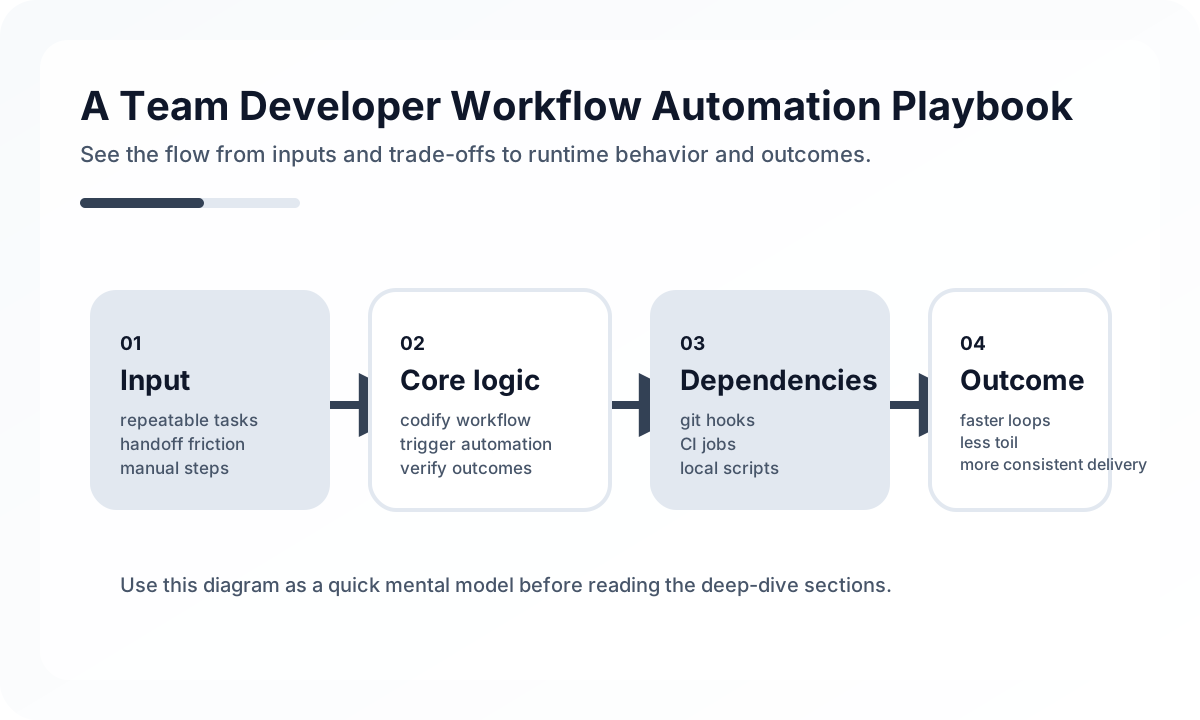
That means the real goal is not “automate everything.” It is “decide which human decisions should stop being manual.”
Start from Repeated Cognitive Cost
The strongest automation opportunities usually come from tasks that:
- happen often
- are easy to forget
- have clear pass or fail criteria
- should behave the same for every engineer
Examples:
- formatting changed files
- running a fast lint subset
- generating boilerplate consistently
- validating branch or commit conventions
- publishing a release artifact
Automation is most valuable where memory should not be part of quality control.
Separate Local, PR, and Release Responsibilities
One of the most common mistakes is putting too much into one layer. Local hooks, CI, and release workflows should not do the same job.
A practical split:
- local hooks: very fast feedback only
- pull request CI: reliable quality gates
- release automation: packaging, tagging, promotion, auditing
Example:
pre-commit:
  - format changed files
  - lint changed files

pull-request:
  - typecheck
  - tests
  - build
When local hooks try to act like full CI, developers start bypassing them. When CI tries to compensate for every missing local check, cycle time gets slow and noisy.
Scaffolding Is One of the Highest-ROI Automation Targets
Teams often think first about tests and pipelines, but scaffolding can be just as valuable.
Useful examples:
- generating a new service or module with the right defaults
- creating test templates
- generating API clients or type definitions
- creating documentation skeletons for recurring artifacts
Scaffolding reduces not just typing, but inconsistency. It gives the team a better starting shape for new work.
Documentation Automation Is Often Undervalued
Many teams automate code checks but leave runbooks, changelogs, and templates manual. That creates a gap between engineering flow and operational clarity.
Automation can help with:
- release note generation
- changelog structure
- API documentation publishing
- incident or postmortem templates
- environment setup instructions
The goal is not to automate meaning. It is to automate repetitive structure so humans can focus on the parts that require judgment.
Measure Bypass Behavior, Not Only Automation Coverage
A dangerous automation trap is celebrating that a script exists while ignoring whether the team trusts it. If engineers constantly skip hooks, rerun flaky steps, or maintain shadow scripts, the automation is signaling design failure.
Warning signs:
- frequent
--no-verifyusage - local scripts drifting from CI logic
- unclear script ownership
- pipelines that are too slow for normal feedback loops
Healthy automation is boringly dependable.
Common Failure Modes
- packing slow tests into pre-commit hooks
- automating the happy path but not exceptions
- leaving release steps half manual and half scripted
- treating documentation as separate from workflow automation
- allowing ownership of scripts to become unclear
Automation creates leverage only when the default path is faster than the workaround path.
Practical Checklist
- Does this automation remove repeated cognitive load?
- Is it in the correct layer: local, PR, or release?
- Will developers trust its latency and reliability?
- Is there a clear owner when the automation breaks?
- Does it standardize real team behavior rather than aspirational behavior?
Closing Judgment
Good workflow automation reduces mental overhead without making the team fight the system. The goal is not sophistication. The goal is a default path that is easier to follow than to bypass. When automation achieves that, quality rises with less friction instead of more ceremony.
Continue Reading
Related posts
Operating AI Coding Workspace Guardrails
Teams adopting AI coding tools need more than productivity. They need clear write boundaries, approval flows, and workspace guardrails.
🔧 ToolsPractical Engineering Notebook Habits
Development that depends only on memory creates repeat cost. This guide explains how engineers and teams can use notebooks as workflow tools.
📚 IT StoriesWhy Developers Fell in Love with the CLI
Even in an age of polished GUIs, developers keep returning to the terminal. This story explains why the CLI became a cultural center of engineering.
🧪 TestDesigning Smoke Tests for Release Gates
You cannot run everything before deployment. A strong release gate depends on a short, reliable smoke test set with clear purpose.
Next Path