Practical Vue Testing Library Design Guide
Why Testing Strategies Drift
- A large suite still fails if it cannot explain failures quickly enough for the team to trust CI.
- Treating one test tool or layer as a universal answer pushes cheap defects into expensive places.
- Healthy test strategy is measured by defect discovery location and operating cost, not by raw count.
Core Design Model
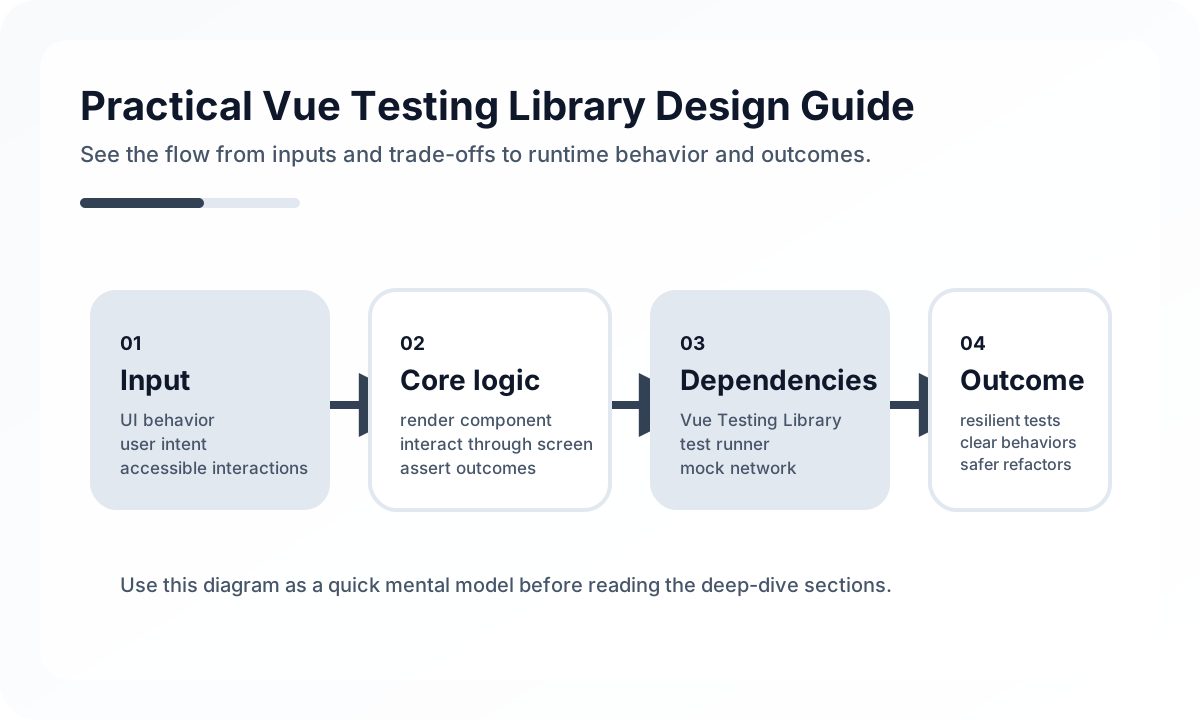
The core idea is the same in Vue: test visible user outcomes instead of peering into reactivity internals. The design step, then, is to define what this layer must prove and keep that responsibility distinct from the surrounding layers.
Patterns That Increase Confidence
Make failure diagnosis short
Rely on the DOM and accessibility surface instead of component internals.
Keep test boundaries explicit
Shared dependencies such as Pinia or the router should be standardized in render helpers.
Tie the suite to operational policy
Teams need a clear rule for awaiting async reactive updates consistently.
Practical Example
a basic interaction test that asserts on visible UI feedback after user input.
it("shows save confirmation", async () => {
  render(ProfileForm);
  await userEvent.click(screen.getByRole("button", { name: /save/i }));
  expect(await screen.findByText(/saved successfully/i)).toBeInTheDocument();
});
Tradeoffs and Anti-Patterns
- User-centered component tests are robust, but they need standardized setup.
- They trade internal visibility for refactor resilience.
- Domain-rule verification still belongs elsewhere.
The common anti-patterns look like this.
- Asserting directly on component internal state
- Letting provider setup vary test by test
- Handling reactive timing with arbitrary timeouts
Review Checklist
- Is the defect class this test should catch first explicitly defined?
- Is the same bug class being redundantly tested in a more expensive layer?
- Do failure messages point quickly toward diagnosis?
- Is there an ownership and quarantine policy for flaky tests?
- Are release gates separated from day-to-day feedback gates?
Closing Judgment
Vue Testing Library aligns Vue tests with user-visible results. The more assertions live at the surface, the more durable the tests become.
Continue Reading
Related posts
Spring Boot Test Slices: @WebMvcTest and @DataJpaTest
A practical guide to Spring Boot test slices from the perspective of test-pyramid design and execution cost. Covers when to use @WebMvcTest, @DataJpaTest, @JsonTest, @RestClientTest, and when @SpringBootTest is the better choice.
🧪 TestMock, Stub, and Spy Test Double Design Guide
A practical guide to choosing the right test double. Covers the difference between state verification and interaction verification, the risk of excessive mocking, and how to decide between mocks, stubs, spies, and fakes.
🔧 ToolsPostman Practical Guide: API Testing, Automation, and Team Collaboration
A practical guide to using Postman for API exploration, environment management, collection design, shared test flows, and Newman-based CI checks.
🖥️ FrontendNuxt Architecture Design Guide
This guide explains the rendering strategy, data layer, routing boundaries, caching, and operating model to consider when designing a Nuxt-based frontend architecture.
Next Path