Modern Test Strategy: Balancing Unit, Contract, and E2E
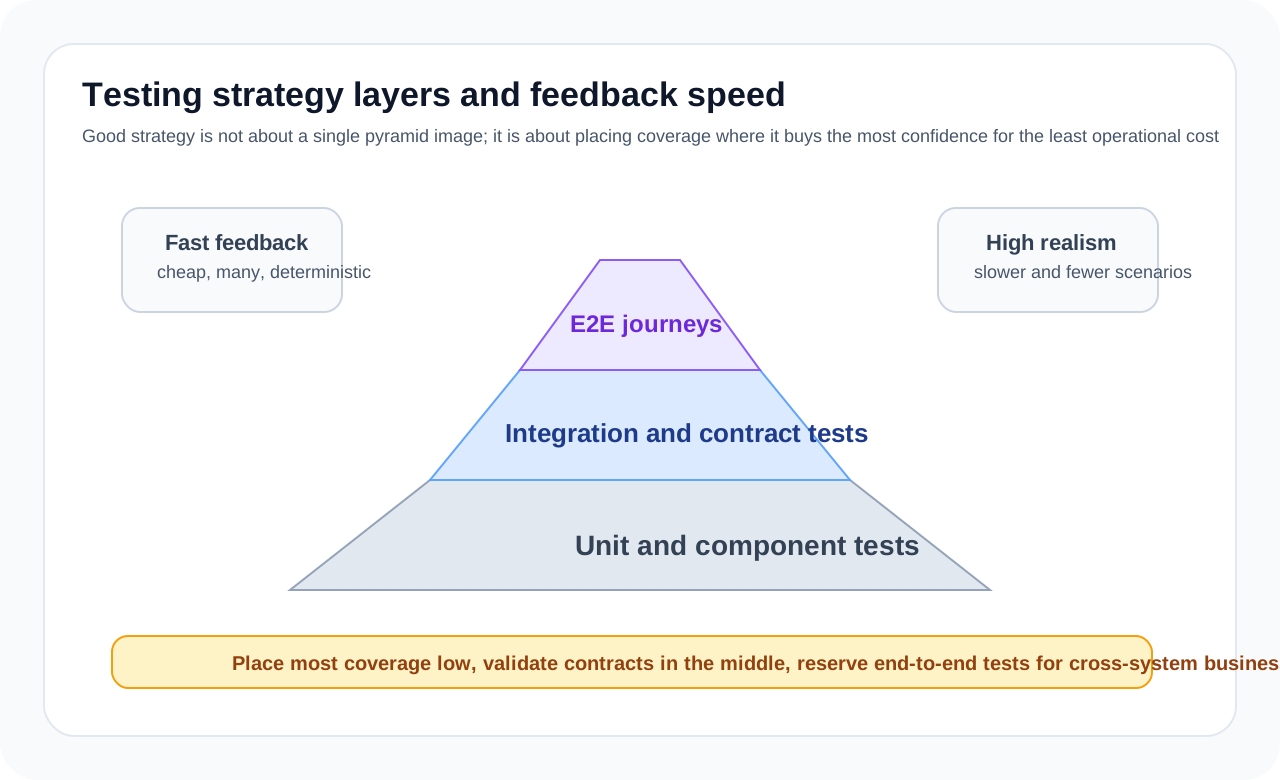
The practical challenge is that most teams do not suffer from too few tests. They suffer from slow suites, unclear ownership, flaky gates, and too many defects escaping to expensive layers.
Confidence comes from placement, not volume
The strongest test strategy begins with one question: where should this class of defect fail first?
Typical placement looks like this:
- unit tests for pure logic, calculations, and business rules
- integration tests for framework, persistence, and infrastructure boundaries
- contract tests for service agreements across teams or systems
- E2E tests for a limited set of critical user journeys
If every concern drifts upward into E2E, the suite becomes expensive and slow. If everything stays in unit tests, integration and contract risk go unproven.
The pyramid still matters, but the middle matters more now
The modern version of the test pyramid still favors many cheap tests and fewer expensive ones, but distributed systems require more attention to the middle layers.
That usually means:
- unit tests remain the cheapest feedback loop
- integration tests prove framework and persistence behavior
- contract tests reduce service-to-service drift
- E2E remains the final browser or user-flow proof
The biggest mistake is treating one layer as a universal answer. Healthy strategies give each layer a distinct job.
Contract tests close a real operational gap
In systems with APIs, events, or microservices, unit and integration tests alone often cannot prove that one system still matches another system’s expectations.
Contract tests help verify:
- request and response schema compatibility
- consumer expectations across teams
- event payload shape and required fields
- backward compatibility during change rollout
Without this layer, many defects appear only in staging or late integration environments.
E2E tests should protect business-critical journeys only
E2E tests are valuable because they prove that real user flows still work through the actual UI and service stack. They are expensive because they depend on full environment setup, test data, browser timing, and cross-layer coordination.
Strong E2E coverage usually focuses on:
- login and access-critical flows
- payment or checkout journeys
- permission-sensitive workflows
- the few top-value paths the business cannot ship broken
Weak E2E strategy tries to verify every detail at browser level, which makes the suite slow and brittle.
CI gates should run at different speeds for different purposes
A healthy delivery system does not treat every test as one undifferentiated gate.
A practical separation often looks like this:
- fast PR feedback runs unit and targeted integration checks
- branch or merge gates add broader integration and contract coverage
- release gates run selected E2E and high-confidence environment checks
This keeps developer feedback fast without reducing release discipline.
Flakiness is an operational problem
Flaky tests are not minor annoyances. They damage trust in CI and train teams to ignore real failures.
A mature strategy defines:
- who owns a flaky test
- when a test is quarantined
- how failures are triaged
- how long quarantine is acceptable
If rerunning until green becomes normal team behavior, the suite has already lost much of its value.
Failure diagnosis must stay short
Good test suites fail in ways that point quickly toward a likely cause.
That usually means:
- clear naming by behavior
- readable assertions
- small scenario scope
- minimal redundant overlap between layers
A large suite can still be low value if every failure takes too long to explain.
Common anti-patterns
Watch for these failure modes:
- treating coverage percentage as the main success metric
- using E2E to compensate for weak unit or contract layers
- running every test on every commit with the same gate policy
- normalizing flaky failures through rerun culture
- lacking ownership for broken tests
These patterns increase cost without creating proportionate confidence.
Review checklist
Before calling the strategy healthy, ask:
- Is the defect class for each layer explicitly defined?
- Are cheap layers catching what they realistically should catch?
- Are contract boundaries covered where systems depend on each other?
- Are E2E tests limited to journeys that truly need browser-level proof?
- Is there a real ownership and quarantine policy for flaky tests?
Closing judgment
The heart of testing strategy is placement, not volume. The more deliberately you choose where defects should fail first, the more reliable and cheaper the whole delivery system becomes.
Continue Reading
Related posts
Defining a Release Candidate Test Cutline
Running more tests is not the same as shipping safely. This guide explains how to define a release-candidate cutline around real risk.
🧪 TestChoosing the Right Boundary for Contract Tests
How to decide what a contract test should cover so teams catch integration risk without duplicating full end-to-end suites.
🔧 ToolsA Team Developer Workflow Automation Playbook
A practical playbook for workflow automation across local checks, CI, scaffolding, release steps, and documentation, with a focus on reducing cognitive load without creating bypass-heavy systems.
🚀 DevOpsKubernetes Advanced Operations — HPA, Resource Management, and Pod Scheduling
This article explains Kubernetes operations not as a collection of settings but from the perspective of resource placement and resilience. It covers when and how to use requests/limits, HPA, affinity, taints, PDBs, and probes in real environments.
Next Path