Test Data Management Strategy and Environment Trust
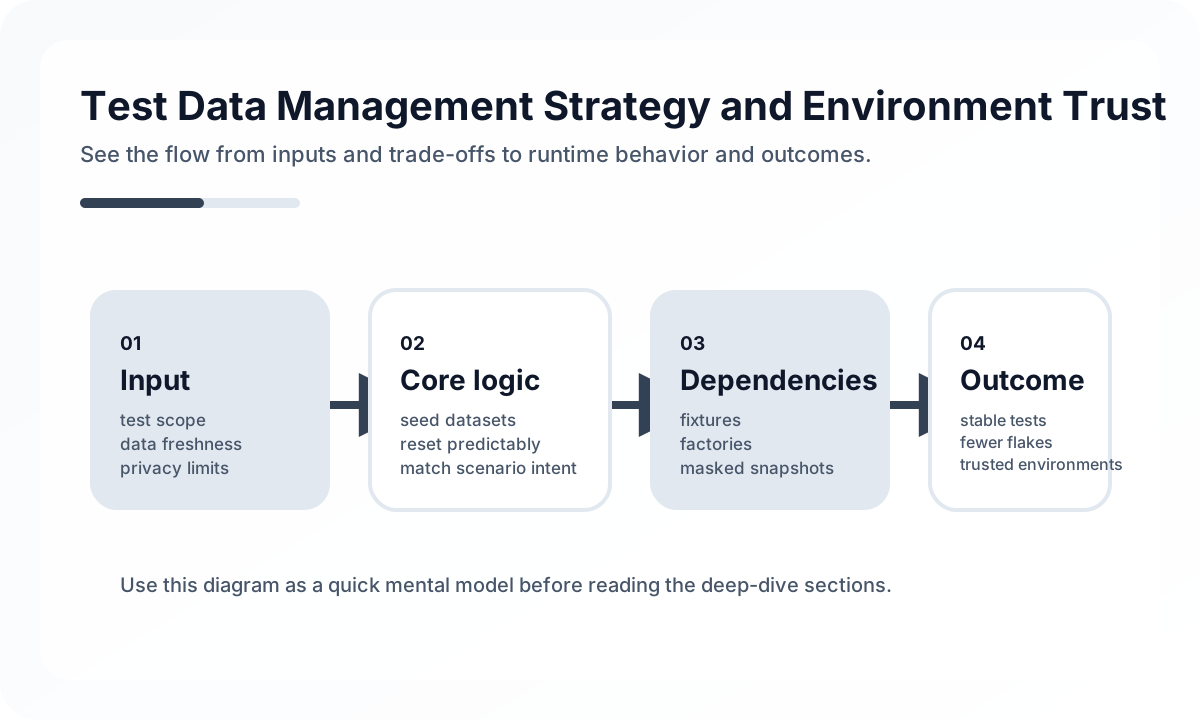
That is why test strategy needs a real test-data strategy, not just better tools.
Test Data Is Not a Minor Detail
When teams treat test data casually, the same problems keep returning:
- results change depending on execution order
- tests pass locally but fail in CI
- copied production data creates privacy risk
- setup cost grows every time a new scenario is added
Good test data should be managed with the same intentionality as test code itself.
Each Test Level Needs a Different Data Strategy
Using the same data approach everywhere usually creates unnecessary cost.
- unit tests benefit from tiny explicit fixtures and inline values
- integration tests benefit from factories and meaningful seed state
- end-to-end tests need scenario-oriented data sets that resemble user journeys
Unit tests should minimize data. E2E tests need enough context to reflect real workflows. A single strategy rarely serves both well.
Balance Static Samples and Generated Data
In practice, fixed samples alone are not enough, and random generation alone is not enough either.
- fixed samples improve readability and reproducibility
- generated data broadens coverage and reveals unexpected boundaries
A practical balance is to keep critical regression scenarios on stable samples while using generated data for edge cases and exploratory or property-like checks.
Predictability Matters More Than Reset Speed
Test-data design is tightly tied to environment reset strategy. Common options include:
- rollback per test
- database reset per suite
- ephemeral containerized databases
- shared test environments with namespace separation
Shared environments can look fast, but trust drops quickly when data contamination or collisions appear. Teams often optimize for speed before they optimize for predictability.
Production Data Use Needs Stricter Rules
Bringing production-like data into test systems requires caution. Simple masking may still leak relationships or sensitive patterns. A test data set should ideally satisfy these conditions:
- personally identifiable information is removed
- domain relationships needed for workflows are preserved
- retention and legal constraints are respected
- copy timing and generation method are documented
Over time, it is usually healthier to invest in high-quality synthetic data than to rely on partial production copies.
Data Setup Should Expose Domain Meaning
When every scenario writes raw SQL or long setup calls, maintainability degrades fast. Test data should be wrapped in domain language.
Examples:
- a user with a pending payment order
- a customer one day before subscription expiration
- a product in low-stock state
Factories, builders, and seeded state that express those meanings make tests easier to read and easier to evolve.
Practical Checklist
- Is the data strategy different for each test level?
- Are stable regression samples combined with broader generated cases?
- Is the reset strategy optimized for predictability, not just speed?
- Are production-data usage rules documented and enforced?
- Does setup code express domain meaning instead of raw mechanics?
Closing
Many test failures begin not with code defects but with data-management defects. Strong teams design not only the assertions, but also the lifecycle, reset model, and safety of their test data. In the end, test trust depends less on the number of tests than on how reliably those tests recreate meaningful system states.
Continue Reading
Related posts
Synthetic Monitoring vs E2E Testing
How to separate release-time end-to-end tests from production synthetic checks without duplicating effort or confusing confidence signals.
🧪 TestDefining a Release Candidate Test Cutline
Running more tests is not the same as shipping safely. This guide explains how to define a release-candidate cutline around real risk.
📱 MobileRunning a Mobile Crash Budget
Mobile stability is not only about reducing crashes. It is also about deciding which level is acceptable and when release should stop.
🤖 AI / LLMOpsAI Evaluation Rubric for Production Teams
A practical way to define quality rubrics, failure classes, and release gates for production AI features.
Next Path