REST Assured API Testing Strategy Guide
Why Testing Strategies Drift
- A large suite still fails if it cannot explain failures quickly enough for the team to trust CI.
- Treating one test tool or layer as a universal answer pushes cheap defects into expensive places.
- Healthy test strategy is measured by defect discovery location and operating cost, not by raw count.
Core Design Model
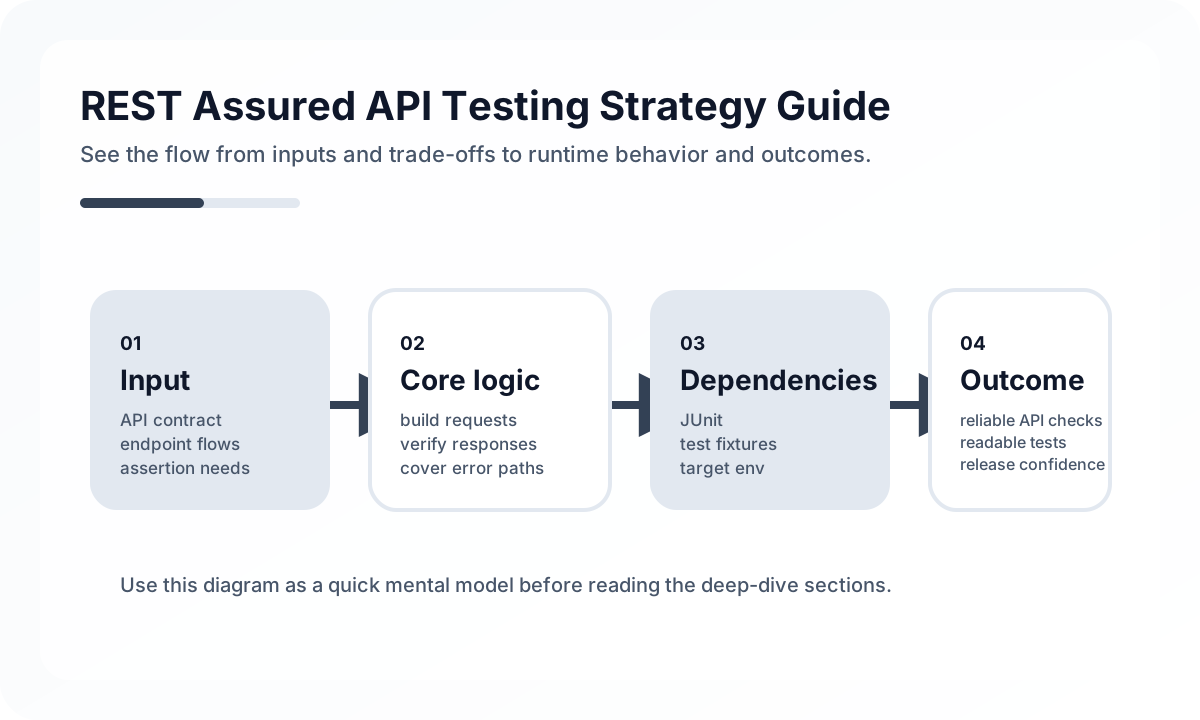
REST Assured is valuable because it expresses HTTP assertions declaratively and makes contract failures obvious. The design step, then, is to define what this layer must prove and keep that responsibility distinct from the surrounding layers.
Patterns That Increase Confidence
Make failure diagnosis short
Keep assertions focused on status, headers, and JSON fields that define the contract.
Keep test boundaries explicit
Stable test data and server setup strategy are required for trustworthy regression coverage.
Tie the suite to operational policy
Validate error schemas as seriously as happy-path responses.
Practical Example
a compact test that checks both the status code and the critical response fields.
given()
    .contentType(ContentType.JSON)
    .body(Map.of("email", "a@test.com"))
.when()
    .post("/api/users")
.then()
    .statusCode(201)
    .body("email", equalTo("a@test.com"));
Tradeoffs and Anti-Patterns
- API tests provide fast confidence, but they do not replace browser-level validation.
- Their value rises with realism, while execution speed usually drops.
- Disciplined scope matters.
The common anti-patterns look like this.
- Over-specifying every response field
- Stopping at status-code assertions only
- Expanding the suite while data initialization remains unstable
Review Checklist
- Is the defect class this test should catch first explicitly defined?
- Is the same bug class being redundantly tested in a more expensive layer?
- Do failure messages point quickly toward diagnosis?
- Is there an ownership and quarantine policy for flaky tests?
- Are release gates separated from day-to-day feedback gates?
Closing Judgment
REST Assured is strongest when it protects readable API contracts. Focused contract checks here can meaningfully reduce downstream E2E burden.
Continue Reading
Related posts
Spring Boot Test Slices: @WebMvcTest and @DataJpaTest
A practical guide to Spring Boot test slices from the perspective of test-pyramid design and execution cost. Covers when to use @WebMvcTest, @DataJpaTest, @JsonTest, @RestClientTest, and when @SpringBootTest is the better choice.
🧪 TestDesigning Smoke Tests for Release Gates
You cannot run everything before deployment. A strong release gate depends on a short, reliable smoke test set with clear purpose.
⚙️ BackendDesigning a Spring Boot REST API That Holds Up in Production
A production-focused guide to Spring Boot REST APIs. Learn how to keep controllers thin, contracts stable, transactions honest, and operational behavior predictable as the system grows.
⚙️ BackendA Practical Guide to CQRS and Event Sourcing
This guide explains CQRS and Event Sourcing in terms of domain boundaries, projections, consistency tradeoffs, snapshots, and operational complexity.
Next Path