API Load Testing with k6
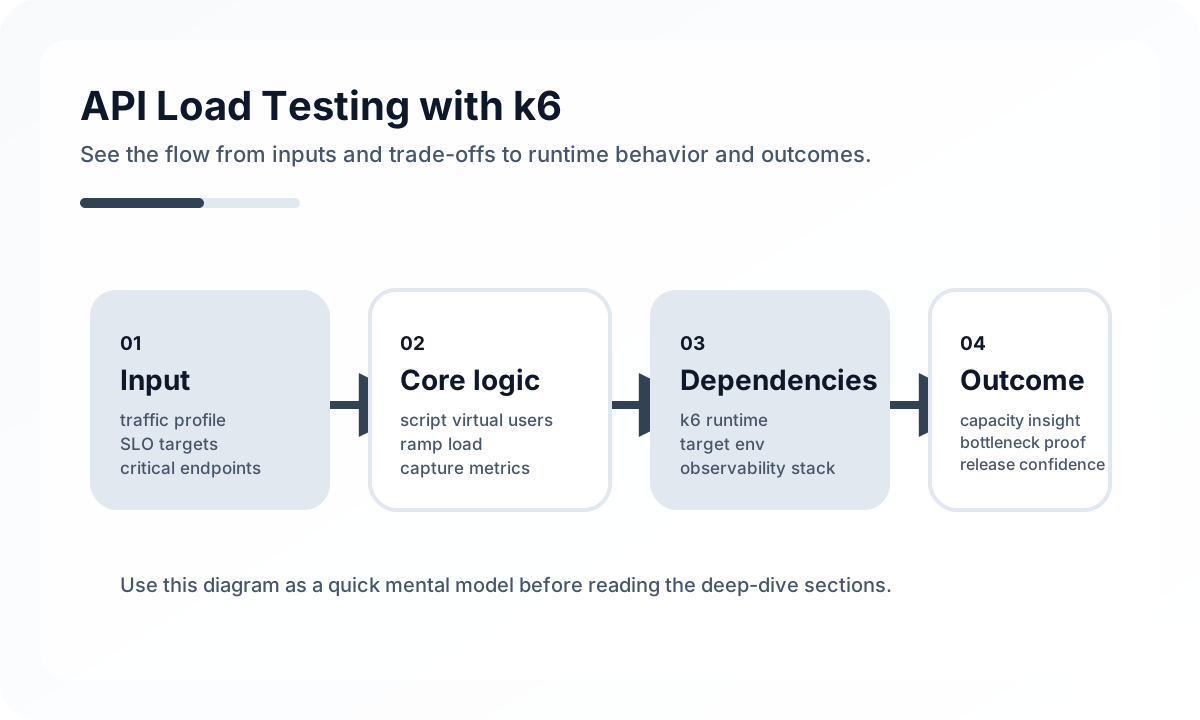
Why Testing Strategies Drift
- A large suite still fails if it cannot explain failures quickly enough for the team to trust CI.
- Treating one test tool or layer as a universal answer pushes cheap defects into expensive places.
- Healthy test strategy is measured by defect discovery location and operating cost, not by raw count.
Core Design Model
The purpose of load testing is not a pretty TPS number. It is understanding where the system bends and breaks. The design step, then, is to define what this layer must prove and keep that responsibility distinct from the surrounding layers.
Patterns That Increase Confidence
Make failure diagnosis short
Start with realistic user behavior and request distribution, not synthetic maximums.
Keep test boundaries explicit
Latency alone is insufficient. Watch error rate, resource usage, and downstream saturation too.
Tie the suite to operational policy
Baseline tests plus gradual ramp-up make regressions much easier to interpret.
Practical Example
a minimal k6 script with staged load and explicit latency thresholds.
export const options = {
  stages: [
    { duration: "1m", target: 50 },
    { duration: "3m", target: 200 },
    { duration: "1m", target: 0 },
  ],
  thresholds: {
    http_req_duration: ["p(95)<400"],
  },
};
Tradeoffs and Anti-Patterns
- Load testing costs infrastructure time, but it finds real bottlenecks before release.
- Artificial scenarios produce performance illusions.
- Raw numbers are risky when interpreted without workload context.
The common anti-patterns look like this.
- Judging success from a single peak TPS number
- Testing with unrealistic data shape and size
- Separating application metrics from infrastructure metrics
Review Checklist
- Is the defect class this test should catch first explicitly defined?
- Is the same bug class being redundantly tested in a more expensive layer?
- Do failure messages point quickly toward diagnosis?
- Is there an ownership and quarantine policy for flaky tests?
- Are release gates separated from day-to-day feedback gates?
Closing Judgment
k6 is not a performance bragging tool. It is a system-understanding tool. Capacity decisions only become meaningful when scenario, metrics, and interpretation are designed together.
Continue Reading
Related posts
Designing Smoke Tests for Release Gates
You cannot run everything before deployment. A strong release gate depends on a short, reliable smoke test set with clear purpose.
🧪 TestManaging the Lifecycle of Test Data
Many unstable tests fail because of data, not assertions. Teams need rules for creation, sharing, cleanup, and retention.
🚀 DevOpsKubernetes Advanced Operations — HPA, Resource Management, and Pod Scheduling
This article explains Kubernetes operations not as a collection of settings but from the perspective of resource placement and resilience. It covers when and how to use requests/limits, HPA, affinity, taints, PDBs, and probes in real environments.
🖥️ FrontendOptimizing Core Web Vitals: A Practical Guide to LCP, CLS, and INP
This guide explains Core Web Vitals not as a checklist, but from the perspective of perceived performance and rendering structure. It shows why LCP, CLS, and INP degrade, what to measure first, and how to optimize them in the right order.
Next Path