Cypress E2E Testing Strategy Guide
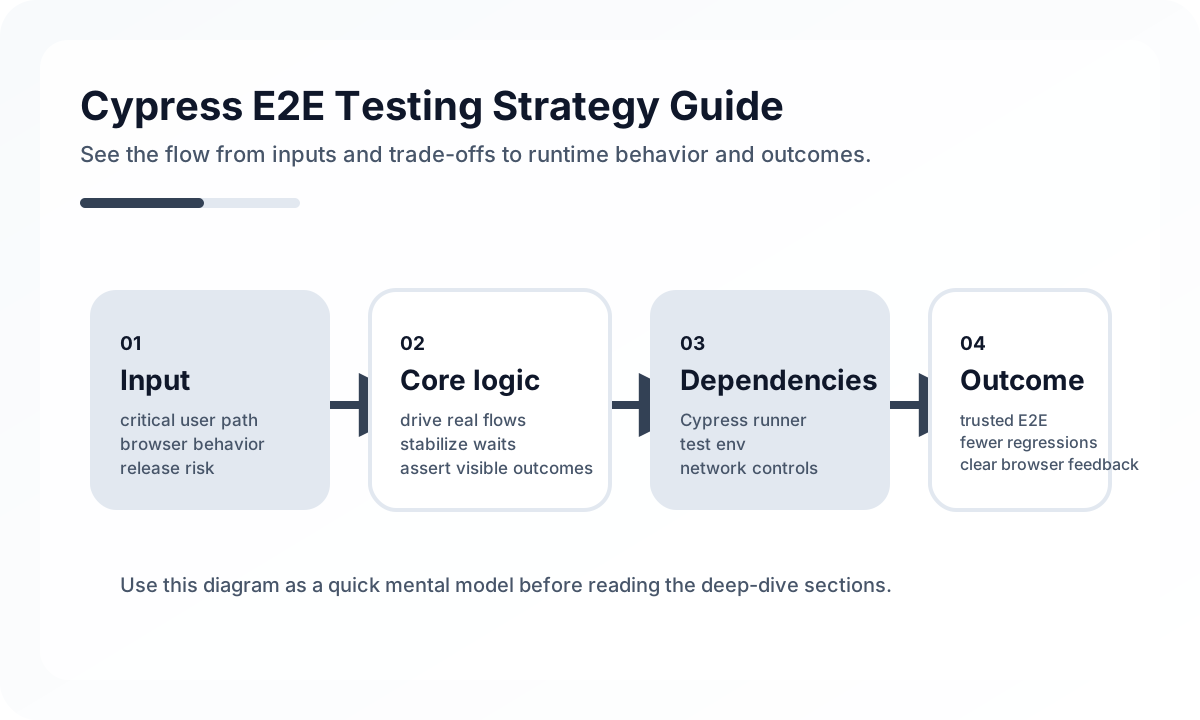
That is why strong Cypress strategy is mostly about scope control, test data discipline, and flake reduction.
E2E should prove critical user flows
Cypress is best used for workflows such as:
- authentication and session-critical journeys
- checkout or payment flows
- permission-sensitive actions
- high-value product flows that must work in a real browser
It is a weak fit for verifying every visual detail or every minor validation branch that cheaper layers can already prove.
Selector strategy should be stable
One of the easiest ways to make Cypress brittle is coupling tests to incidental DOM structure.
More stable patterns include:
- role-based selectors when accessible UI semantics exist
- dedicated
data-testidor similar attributes for test targeting - avoiding deep CSS path dependence
Good selectors express user intent or stable contract, not styling accident.
Wait for conditions, not time
Arbitrary sleeps are one of the fastest routes to flaky E2E suites.
A healthier approach is to wait for:
- visible UI state
- network alias completion
- URL changes
- domain-specific completion indicators
Condition-based waiting makes tests more deterministic and easier to debug under real CI timing.
Control network behavior intentionally
Cypress becomes much more reliable when tests decide clearly which dependencies are real and which are controlled.
Useful patterns include:
- stubbing unstable third-party APIs
- fixing response fixtures for known scenarios
- intercepting backend requests to assert important outcomes
- leaving only the flows that truly require full-stack proof to run against real services
This keeps E2E focused on the confidence it is meant to provide.
Test data ownership matters
Many flaky Cypress suites are actually test-data problems.
Teams should define:
- how test users and seed data are created
- how state is isolated between tests
- whether tests can run independently
- how cleanup or reset works in CI
If test data is shared casually across scenarios, failures become noisy and difficult to trust.
Debuggability is part of the design
Cypress is strong partly because failures are visual and traceable. Teams should preserve that advantage by keeping scenarios:
- short enough to understand quickly
- named by business journey
- explicit about setup and assertions
A giant end-to-end script that proves many things at once is much harder to diagnose than a focused user-journey test.
Common anti-patterns
Watch for these patterns:
- using E2E for small visual or unit-level concerns
- masking flakiness with random sleeps
- weak selector discipline
- shared state across tests
- too many cross-system dependencies in one scenario
These are the patterns that make Cypress feel slow and unreliable.
Review checklist
Before calling a Cypress suite healthy, ask:
- Does this journey truly need browser-level proof?
- Are selectors stable and intention-revealing?
- Does the test wait on real conditions instead of time?
- Is test data isolated and owned?
- Will a failure point quickly to a probable cause?
Closing judgment
Cypress is most valuable when it is reserved for journeys that truly need browser-level proof. Leave only the defects that should first fail in a real browser, and move everything else down to cheaper layers.
Continue Reading
Related posts
Cross-Browser E2E Testing with Playwright
How to use Playwright as a reliable E2E testing platform rather than just a browser automation tool. Covers strategy, configuration, selector rules, mocking, auth-state reuse, and practical ways to reduce flaky tests.
🧪 TestWriting JavaScript Unit Tests with Jest
A practical guide to Jest that goes beyond syntax. Covers what to unit test, how far mocking should go, and how to keep tests maintainable.
💬 LanguageTypeScript Utility Types: A Practical Guide
A production-focused guide to TypeScript utility types. Learn how to model DTOs, update payloads, selectors, and derived types without making your type layer harder to read.
💬 LanguageModern JavaScript Syntax Through ES2024
A practical guide to modern JavaScript syntax through an engineering lens. Learn which ES2024-era features genuinely improve code quality and which ones still need restraint.
Next Path