TypeScript Utility Types: A Practical Guide
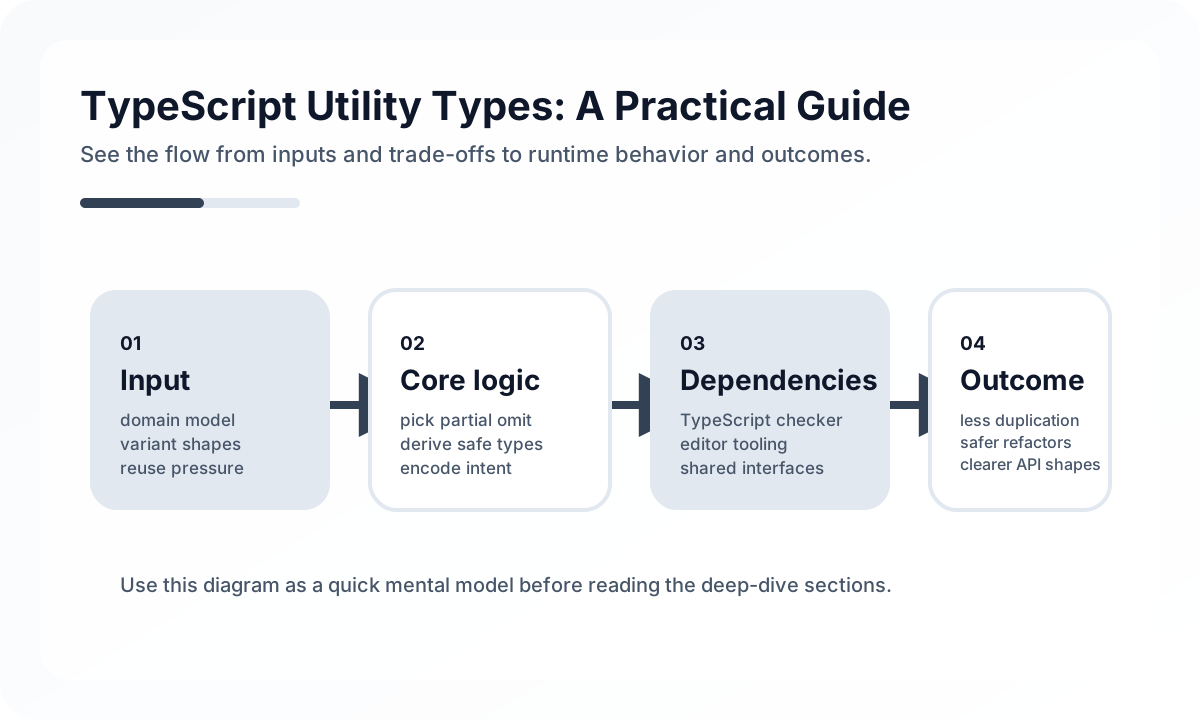
That is why the right question is not “Which utility type should I use?” but “Is this derived type still truthful about the business rule?”
Where Utility Types Earn Their Keep
Utility types are excellent at stable transformations:
- selecting fields for a DTO
- modeling partial update payloads
- mapping event names to handlers
- deriving parameter and return shapes from existing functions
These patterns reduce duplication and make refactors safer because the compiler keeps related shapes aligned.
Partial<T> Is Convenient and Dangerous
Partial<T> is one of the most overused utilities in production TypeScript.
It is appropriate when:
- patch semantics are real
- fields are independently optional
- validation happens at a separate boundary
It is dangerous when:
- the business rule requires some fields together
- optionality changes the meaning of the object
- engineers start using one “patch” type for several unrelated cases
Many bugs start when Partial<T> quietly erases constraints that mattered.
Example: Useful Derived Types
type User = {
  id: string;
  email: string;
  name: string;
  marketingOptIn: boolean;
  createdAt: string;
};

type CreateUserInput = Pick<User, "email" | "name" | "marketingOptIn">;
type UpdateUserInput = Partial<Pick<User, "email" | "name" | "marketingOptIn">>;
type UserSummary = Pick<User, "id" | "email" | "name">;
This works because each derived type has a narrow purpose:
- create input
- update input
- read model summary
The transformation stays obvious to the reader.
DTOs and Domain Models Are Not the Same Thing
A common mistake is to treat utility types as if they can generate every contract from one base entity.
That breaks down when:
- transport payloads differ from domain invariants
- write models and read models evolve separately
- authorization rules change which fields are visible
In those cases, explicit types can be healthier than deriving everything mechanically.
Composed Utility Types Need a Readability Budget
TypeScript allows deep compositions like:
type SafePreview = Readonly<Partial<Omit<User, "createdAt">>>;This is valid, but validity is not the same as clarity.
A useful team rule is to stop composing once a type expression becomes harder to parse than a named alias. Short type algebra is helpful. Dense type algebra is often deferred confusion.
Utility Types as Refactor Tools
One of the best uses of utility types is making large codebases easier to change.
For example:
Pickhelps create view models that stay aligned with a source entityReturnTypeprevents duplicated function-result contractsParametersis helpful for wrappers and decoratorsRecordcan make finite keyed maps explicit
These uses improve maintenance because the derived type remains anchored to a source of truth.
Common Mistakes
- using
Partial<T>to avoid modeling patch rules properly - deriving DTOs from entities that should evolve separately
- composing utility types until no one can read the result
- using
Record<string, T>when the keys are actually finite and known - preferring clever derivation over clear domain naming
The best utility-type usage usually feels boring. That is a compliment.
Review Checklist
- Is the derived type still faithful to the business rule?
- Would an explicit named type be easier to understand?
- Are update semantics truly partial, or only partially modeled?
- Is there a clear source type that this derivation should stay tied to?
- Can a new team member expand the type mentally without IDE gymnastics?
Closing Judgment
Utility types are most useful when they reduce drift between related contracts. They become harmful when they compress important domain meaning into opaque type expressions. Good TypeScript teams use them to support the model, not to replace modeling.
Continue Reading
Related posts
TypeScript Generics: A Practical Guide
A practical and production-focused guide to TypeScript generics. Learn when generics improve API contracts, when they overcomplicate code, and how to keep inference readable.
💬 LanguageModern JavaScript Syntax Through ES2024
A practical guide to modern JavaScript syntax through an engineering lens. Learn which ES2024-era features genuinely improve code quality and which ones still need restraint.
🔧 ToolsComplete ESLint + Prettier Setup Guide
A practical guide to separating linting and formatting concerns across React, Vue, and TypeScript projects, with team-level rules for local autofix and CI enforcement.
📱 MobilePWA Complete Guide: Install a Web App Without an App Store
How to build a Progressive Web App (PWA). Covers Service Workers, the Web App Manifest, offline support, push notifications, and home screen installation with practical examples.
Next Path