How Type Systems Change API Design
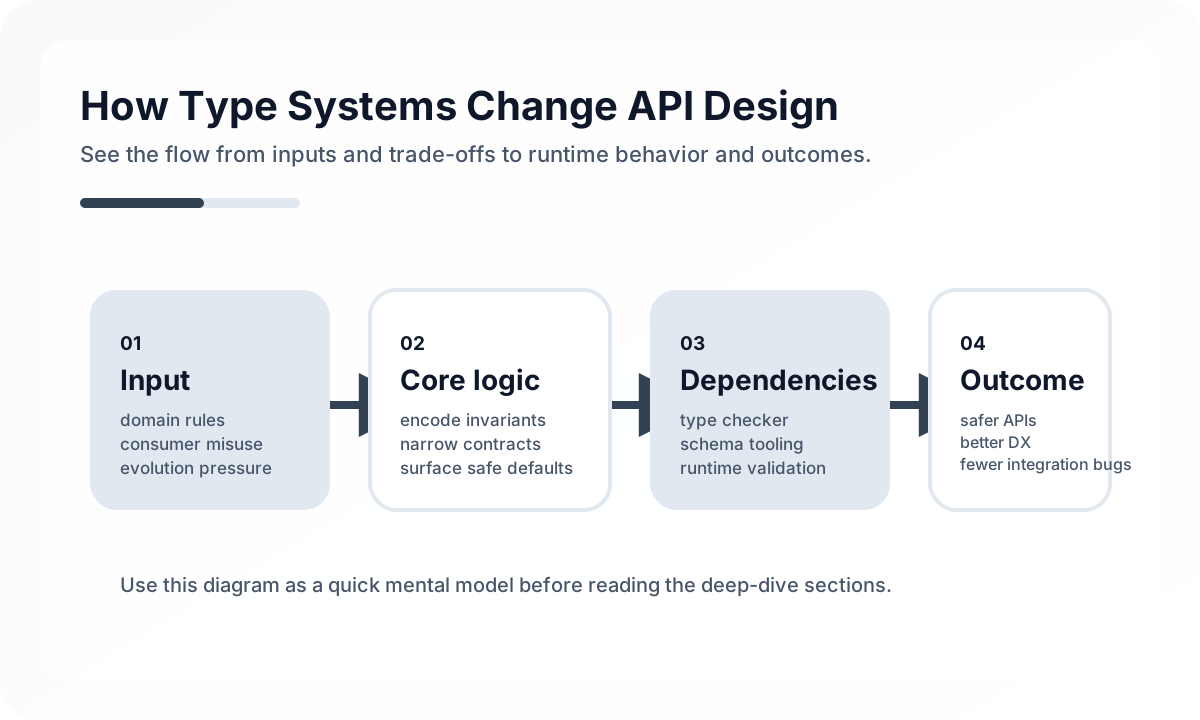
A strong type system does not mainly restrict developers. It helps them express intent more precisely. That makes type-system awareness less about syntax and more about design quality.
Types Can Be Stronger Than Documentation
An API contract written only in documentation drifts easily over time. A contract expressed in types is validated every time code changes.
- whether
nullis allowed - what shape a failure result has
- whether a collection may be empty
- which values are mandatory for callers
Once these constraints are represented in types, code review and testing become lighter because the feedback loop is embedded in the code itself.
Null Handling Directly Affects API Stability
When null safety is weak, defensive logic spreads everywhere. Callers keep guessing whether a value may be absent, and authors silently rely on unwritten assumptions. Languages that encode nullability in the type system move that ambiguity forward and make the dangerous edges visible.
A good API should not hide optionality.
- required values should be non-null
- optional values should be clearly marked
- empty results and failure results should be distinct
Without those distinctions, callers have to infer meaning from null, empty arrays, exceptions, and status codes.
Generics Matter More for Constraints Than Reuse
Generics are often introduced as a way to remove duplication, but in production code they are even more useful for expressing what is safely allowed. Repositories, event buses, and serialization modules may look generic, but they still rely on strong constraints.
A well-designed generic API clarifies:
- the relationship between input and output types
- where covariance or contravariance matters
- what shape strategy objects or callbacks must follow
Generics also become unreadable when overused. Once an API needs too many type parameters, flexibility may be turning into design opacity.
Immutability Lowers Collaboration Cost
Immutable structures make boundaries easier to trust. Callers know that values they pass in will not be unexpectedly mutated, and authors can make state transitions explicit instead of hidden.
This matters even more in asynchronous and concurrent systems. Shared mutable objects create bugs that are hard to reproduce and harder to reason about across layers.
Exception-Driven APIs vs Result-Driven APIs
Languages differ in how they express failure. Some center exceptions, while others encourage Result, Either, or other explicit outcome models. The real question is not which style is fashionable, but how predictable failure is for the caller.
Exceptions are not inherently wrong, but explicit result types are often clearer when:
- business failure is part of the normal flow
- retry, fallback, or user messaging depends on failure type
- callers need to distinguish between several expected failure modes
For system-level failures that should immediately propagate, exceptions may still be the cleaner fit.
Language Choice Shapes Design Culture
Kotlin, Rust, TypeScript, and Go all encourage different habits.
- Kotlin nudges teams toward null safety and state modeling with sealed classes.
- Rust forces explicit thinking about ownership, resources, and results.
- TypeScript makes frontend and boundary contracts far more visible in code.
- Go keeps the type system simpler but requires discipline around interfaces and explicit error handling.
Choosing a language is therefore also choosing where mistakes are likely to be caught.
Closing
Type systems are not just developer preference. They reshape the cost structure of design. APIs become easier to understand not because the documentation is always better, but because the types carry more intent. When a team uses the language well, many sources of uncertainty in testing, review, and operations are reduced before the code even runs. Good design often comes not from more freedom, but from clearer constraints.
Continue Reading
Related posts
TypeScript Generics: A Practical Guide
A practical and production-focused guide to TypeScript generics. Learn when generics improve API contracts, when they overcomplicate code, and how to keep inference readable.
💬 LanguageWhere Type Safety Ends and Runtime Validation Begins
Strong type systems do not remove the need for validation. This guide explains how production teams should divide responsibility between types and runtime checks.
📈 TrendsJDK 25 Trends: How to Read LTS Adoption in Practice
JDK 25 reached GA on September 16, 2025 and serves as the reference implementation of Java 25. The real question is not how many JEPs landed, but which ones deserve production attention now.
⚙️ BackendBackend Idempotency and Retry Design Principles
A practical guide to designing idempotent backend behavior across duplicate requests, network retries, and asynchronous processing.
Next Path