Understanding Rust Ownership, Borrowing, and Lifetimes
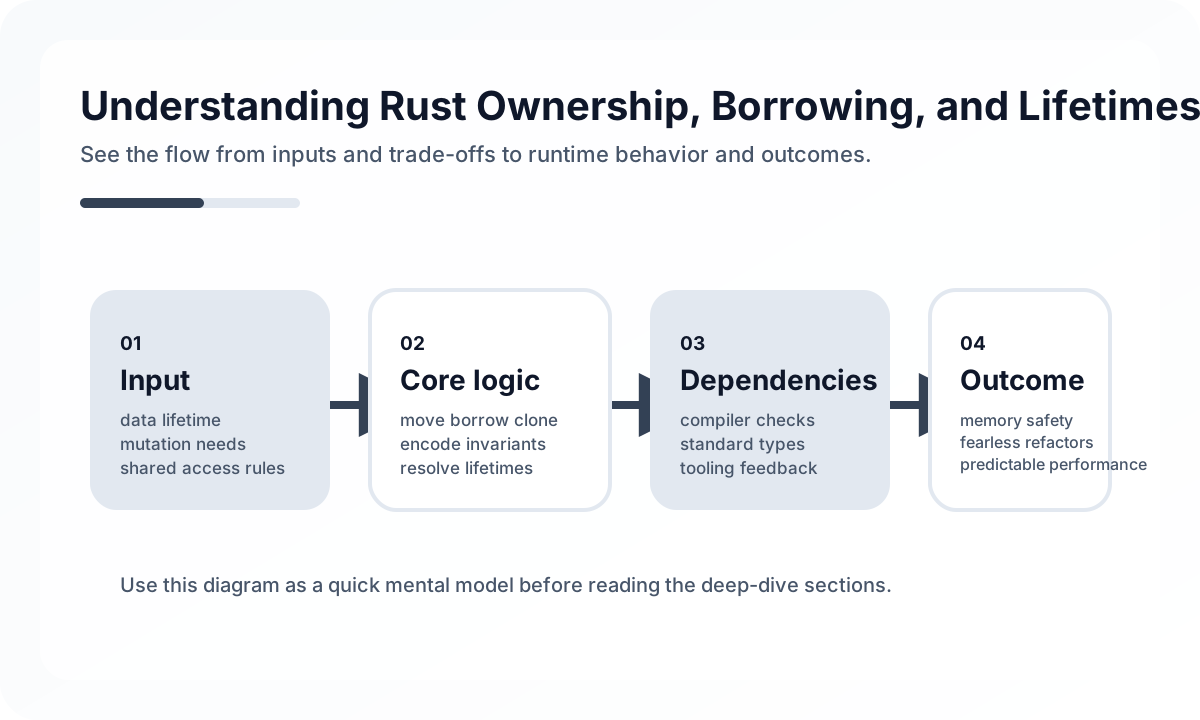
That is why ownership, borrowing, and lifetimes are not mainly syntax hurdles. They are API-design tools.
Ownership Is About Responsibility, Not Just Memory
The simplest way to read Rust ownership is:
- every value has one clear owner
- transfers of responsibility are explicit
- temporary access must respect safety rules
The memory-safety benefit is obvious, but the architectural effect is just as important. Rust forces teams to decide:
- who owns data
- who can mutate it
- how long references remain valid
- where sharing is truly necessary
These are exactly the questions that many systems languages leave partially implicit.
Borrowing Clarifies Boundaries
Borrowing is valuable because it separates access from ownership.
That creates several practical design wins:
- helper functions can inspect data without taking it over
- mutation becomes visible through
&mut - APIs become more honest about who can change what
Borrowing also exposes poor design quickly. If too many functions need mutable access, or if lifetimes become difficult to express, the code is often signaling that ownership boundaries are not clean yet.
Lifetimes Are a Design Signal
Lifetimes are commonly feared because they look abstract. In practice, explicit lifetime work usually appears when a design is trying to tie references together across boundaries.
That is not necessarily bad. But it does mean something important is happening:
- values are being shared rather than owned
- references outlive the most obvious local scope
- API design is depending on temporal relationships
When lifetime annotations become painful, it is often worth asking whether the API should own data instead of borrowing it, or whether a boundary should clone strategically.
Rust Rewards Explicit Data Movement
One reason Rust feels different from many languages is that hidden copying and hidden aliasing are both reduced.
That means teams learn to think more carefully about:
- passing by value versus by reference
- immutable versus mutable access
- short-lived views versus long-lived ownership
- concurrency safety through type-level guarantees
This can feel demanding at first, but it creates codebases where resource behavior is easier to reason about under pressure.
Example: Ownership Making an API Honest
#[derive(Debug)]
struct User {
    email: String,
}

fn normalize_email(input: &str) -> String {
    input.trim().to_lowercase()
}

fn update_email(user: &mut User, email: String) {
    user.email = normalize_email(&email);
}
This small example is useful because the contracts are visible:
normalize_emailborrows input and returns owned outputupdate_emailrequires mutable access to the user- the caller decides when ownership of
emailis transferred
That kind of explicitness is the real value.
Ownership and Concurrency Fit Together
Rust’s ownership model becomes even more valuable in concurrent systems because the language can reject many unsafe sharing patterns at compile time.
This is why Rust is attractive for:
- infrastructure software
- high-throughput services
- low-latency systems
- code where data races would be expensive or dangerous
The language does not remove concurrency complexity, but it narrows the space of legal mistakes significantly.
Common Anti-Patterns When Learning Rust
- fighting the borrow checker instead of reading the design feedback
- cloning excessively just to silence ownership friction
- forcing borrowed APIs where owned values would be simpler
- treating lifetime annotations as magic rather than relationship markers
- assuming a successful compile means the API design is already good
Rust pushes developers to satisfy correctness rules, but strong code still requires judgment about ergonomics and boundary design.
Review Checklist
- Does the API express ownership transfer clearly?
- Are borrows used to clarify access rather than to avoid thinking about data lifetime?
- Would ownership simplify a complex lifetime relationship?
- Is mutation explicit and narrow?
- Is concurrency safety benefiting from ownership, or is the design working around it awkwardly?
Closing Judgment
Rust ownership, borrowing, and lifetimes are best understood as design constraints that improve honesty. They do not just prevent memory bugs. They help teams build APIs where data flow, mutation, and sharing are harder to misunderstand.
Continue Reading
Related posts
Kotlin Basics for Java Developers
A practical guide to Kotlin for Java developers through a production lens. Learn what Kotlin changes in team habits, not just in syntax, especially around null safety, state modeling, and coroutines.
💬 LanguageTypeScript Utility Types: A Practical Guide
A production-focused guide to TypeScript utility types. Learn how to model DTOs, update payloads, selectors, and derived types without making your type layer harder to read.
🤖 AI / LLMOpsDesigning a Memory Window Budget for Agents
Agents do not get better just because they remember more. In production, memory budgets and summarization rules drive quality.
📈 TrendsJDK 25 Trends: How to Read LTS Adoption in Practice
JDK 25 reached GA on September 16, 2025 and serves as the reference implementation of Java 25. The real question is not how many JEPs landed, but which ones deserve production attention now.
Next Path