Runtime, Memory, and Concurrency Tradeoffs for System Design
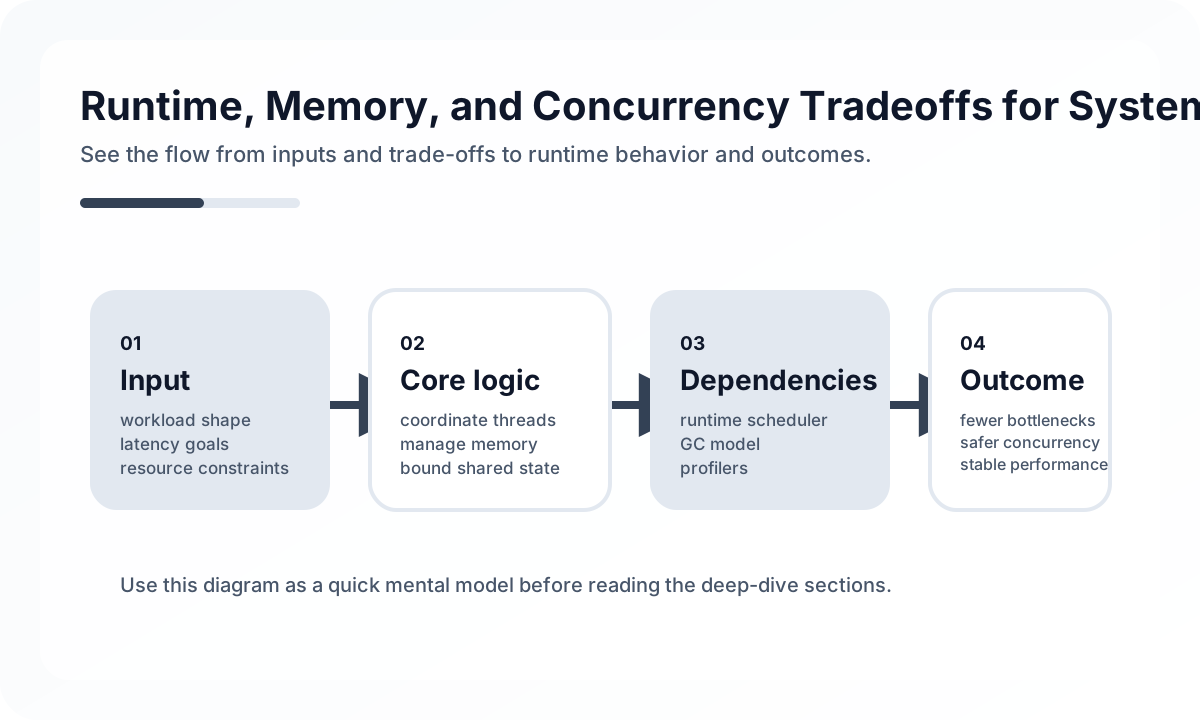
That is why “Which language is fastest?” is usually the wrong question. A better one is: “Which runtime fails in the most understandable way for this workload?”
The Dimensions That Matter
At system-design time, the important runtime differences are usually:
- memory model and allocation behavior
- garbage collection or ownership cost
- concurrency model and scheduling behavior
- startup characteristics and deployment shape
- observability and debugging maturity
These dimensions determine not only performance but also operational behavior under stress.
Java: Strong General-Purpose Throughput
Java is often the safest choice for large backend systems because it combines mature tooling, strong libraries, and predictable scaling patterns.
It tends to work well when:
- throughput matters at service scale
- the team needs mature profilers and tracing
- codebases are large and long-lived
- concurrency needs are significant but not exotic
The tradeoff is that JVM tuning, heap behavior, and startup profile still matter. Java gives teams power, but it also gives them enough knobs to create avoidable complexity.
Go: Operational Simplicity With Visible Tradeoffs
Go is attractive because the deployment model is simple and the language keeps control flow visible.
It tends to fit well for:
- infrastructure services
- network daemons and control planes
- teams that value operational clarity over abstraction depth
Its tradeoff is not weak performance. It is that simplicity must be maintained deliberately. If interfaces sprawl or goroutine ownership is unclear, codebases become harder to reason about than the syntax suggests.
JavaScript and TypeScript: Strong at Boundary-Rich Systems
JavaScript and TypeScript shine where the event-loop model aligns with the problem:
- edge runtimes
- API gateways
- frontend-heavy product platforms
- teams that benefit from shared language across client and server
The main tradeoff is that CPU-heavy tasks and hidden blocking boundaries are a poor match. The ecosystem can move fast enough that architecture discipline matters more than raw language capability.
Python: Excellent Leverage, Uneven Concurrency Story
Python remains a pragmatic choice for automation, data workflows, internal tools, and product teams that need fast iteration.
It performs best when:
- library leverage outweighs raw runtime efficiency
- background jobs or data pipelines dominate
- service-level performance targets are moderate
The difficulty comes when teams expect the concurrency story to look like Go, Java, or Node without respecting Python’s runtime limits and library mix.
Rust: Explicit Control, High Return for the Right Problems
Rust is strongest when memory safety, low overhead, and correctness under concurrency are non-negotiable.
It is especially valuable for:
- high-throughput infrastructure
- latency-sensitive services
- security-sensitive components
- systems where data ownership must stay explicit
The tradeoff is not that Rust is “too hard.” It is that the engineering return only pays off when the problem is important enough to justify that precision.
A Better Language-Selection Process
A realistic selection process starts with workload shape, not reputation.
Use questions like these:
- Is the system I/O-bound or CPU-bound?
- Does tail latency matter more than average throughput?
- Will memory growth under load be a hard limit?
- How painful will on-call debugging be if concurrency goes wrong?
- Does the team need ecosystem leverage more than low-level control?
Those questions usually narrow the field faster than feature comparisons.
Example Comparison by Workload
workload: internal API gateway with many slow upstream calls
main risks: timeout storms, queueing, debug difficulty

good candidates:
- Java with virtual threads
- Go with goroutines
- TypeScript with async I/O

less ideal:
- Rust, if iteration speed matters more than fine-grained control
- Python, if upstream concurrency and latency are both very high
This kind of reasoning is more durable than ranking languages globally.
Common Mistakes
- choosing from one benchmark chart
- copying concurrency patterns from another runtime without adjustment
- underestimating debugging cost
- ignoring library maturity and deployment friction
- assuming the team’s existing skill level is irrelevant
A runtime decision is partly technical and partly organizational. Both sides matter.
Review Checklist
- What exact workload shape is driving the choice?
- Which runtime model fails most predictably under load?
- Which operational tools will the team rely on at 2 a.m.?
- Are memory, scheduling, and error-propagation costs understood well enough?
- Is the selected language solving the main constraint, or only satisfying familiarity?
Closing Judgment
Runtime design is not about winning a language debate. It is about selecting the failure modes your team can understand and control. The best choice is rarely the most fashionable runtime. It is the one whose tradeoffs remain legible when the system is under pressure.
Continue Reading
Related posts
Java 21 Virtual Threads: A Practical Concurrency Guide
A production-focused guide to Java 21 Virtual Threads. Learn where they improve throughput, where they do not help, and what to validate before rolling them into a Spring Boot service.
💬 LanguageGo Language Basics: A Practical Quick-Start Guide
A production-minded guide to Go fundamentals. Learn why Go feels simple, where that simplicity creates discipline requirements, and how teams should read channels, interfaces, and error handling in real systems.
📈 TrendsJDK 25 Trends: How to Read LTS Adoption in Practice
JDK 25 reached GA on September 16, 2025 and serves as the reference implementation of Java 25. The real question is not how many JEPs landed, but which ones deserve production attention now.
🚀 DevOpsKubernetes Advanced Operations — HPA, Resource Management, and Pod Scheduling
This article explains Kubernetes operations not as a collection of settings but from the perspective of resource placement and resilience. It covers when and how to use requests/limits, HPA, affinity, taints, PDBs, and probes in real environments.
Next Path