Python Decorators: A Practical Guide
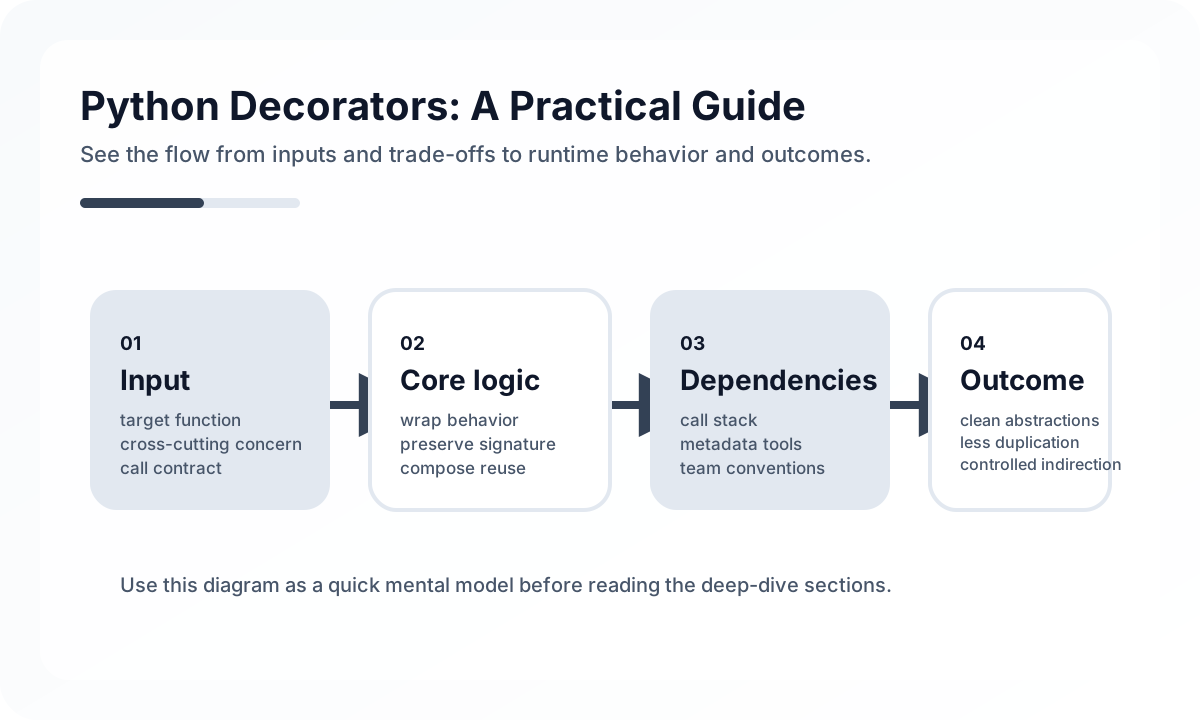
That visibility question is the real one. A decorator is helpful when it makes repeated policy clearer. It is harmful when it hides too much behavior behind a nice function signature.
What Decorators Are Actually Good At
Decorators are most useful when they attach repeated policy to many functions without duplicating the same scaffolding everywhere.
Common healthy uses include:
- authentication and authorization checks
- retry or timeout wrappers
- tracing and metrics
- caching
- registration in plugin or routing systems
In all of these cases, the main benefit is not syntax. It is that the code advertises policy at the boundary.
Why Decorators Become Dangerous
Decorators get expensive when they stop acting like visible policy and start acting like hidden control flow.
Typical failure patterns include:
- changing return types silently
- swallowing exceptions unexpectedly
- mutating call arguments invisibly
- performing I/O in what appears to be a lightweight wrapper
- stacking several decorators until execution order becomes hard to reason about
The core problem is that decorators are easy to add and easy to overuse.
Production Rule: Decorators Should Stay Legible
A healthy decorator usually has these properties:
- the wrapped behavior is easy to explain
- the decorator name reflects what it does
- metadata such as function name and docstring are preserved
- failure behavior remains understandable
- the decorator does not change the function contract in surprising ways
When these rules break, code review gets harder and debugging gets slower.
functools.wraps Is Not Optional
One of the smallest but most important production details is preserving metadata with functools.wraps.
Without it:
- logs become harder to read
- tracing tools lose function identity
- documentation and introspection degrade
- debugging stacks become less useful
This is a good example of how decorator quality is really about operability, not elegance.
Example: A Useful Retry Decorator
from collections.abc import Callable
from functools import wraps
import time


def retry(times: int, delay_seconds: float) -> Callable:
    def decorator(fn: Callable) -> Callable:
        @wraps(fn)
        def wrapper(*args, **kwargs):
            last_error = None

            for attempt in range(times):
                try:
                    return fn(*args, **kwargs)
                except Exception as exc:
                    last_error = exc
                    if attempt == times - 1:
                        raise
                    time.sleep(delay_seconds)

            raise last_error

        return wrapper

    return decorator
This decorator is useful because:
- the policy is explicit
- the contract is simple
- metadata is preserved
- failure behavior is still understandable
The example is not good because it is short. It is good because it is legible.
Decorators and Frameworks
Framework-heavy Python codebases often depend on decorators for routing, dependency injection, task registration, and caching. That is normal, but it raises the bar for clarity.
The more decorator-driven a codebase becomes, the more important it is to know:
- what executes at import time
- what executes at call time
- which decorators alter registration versus runtime behavior
- how several decorators compose
Without this understanding, framework code can feel magical in the worst sense.
Common Anti-Patterns
- using decorators to hide complex orchestration
- stacking too many wrappers on critical paths
- changing return behavior without making it obvious
- skipping
@wraps - preferring decorators when an explicit wrapper or helper would be easier to trace
Decorators are not bad because they are indirect. They are bad when their indirection is larger than their clarity benefit.
Review Checklist
- Does the decorator express a clear repeated policy?
- Would a helper function or explicit wrapper be easier to understand?
- Is metadata preserved with
@wraps? - Is error and retry behavior visible enough for operators?
- Will a new engineer understand the final execution order?
Closing Judgment
Python decorators are excellent when they make cross-cutting concerns visible at the right boundary. They become dangerous when they make behavior feel magical. In mature codebases, the best decorators are the ones that remain easy to explain during incidents.
Continue Reading
Related posts
A Practical Guide to the Java Stream API
A production-minded guide to the Java Stream API. Learn where streams clarify business rules, where imperative code is safer, and how to avoid unreadable pipelines.
💬 LanguagePython asyncio: A Practical Guide to Asynchronous Programming
A production-focused guide to Python asyncio. Learn when async I/O helps, how to structure cancellation and timeouts, and which failure modes matter in real services.
📈 TrendsJDK 25 Trends: How to Read LTS Adoption in Practice
JDK 25 reached GA on September 16, 2025 and serves as the reference implementation of Java 25. The real question is not how many JEPs landed, but which ones deserve production attention now.
⚙️ BackendBuilding a REST API Quickly with Python FastAPI
This guide takes FastAPI beyond demo code and focuses on schema separation, dependency boundaries, authentication, exception policy, and production checkpoints.
Next Path