Kotlin Basics for Java Developers
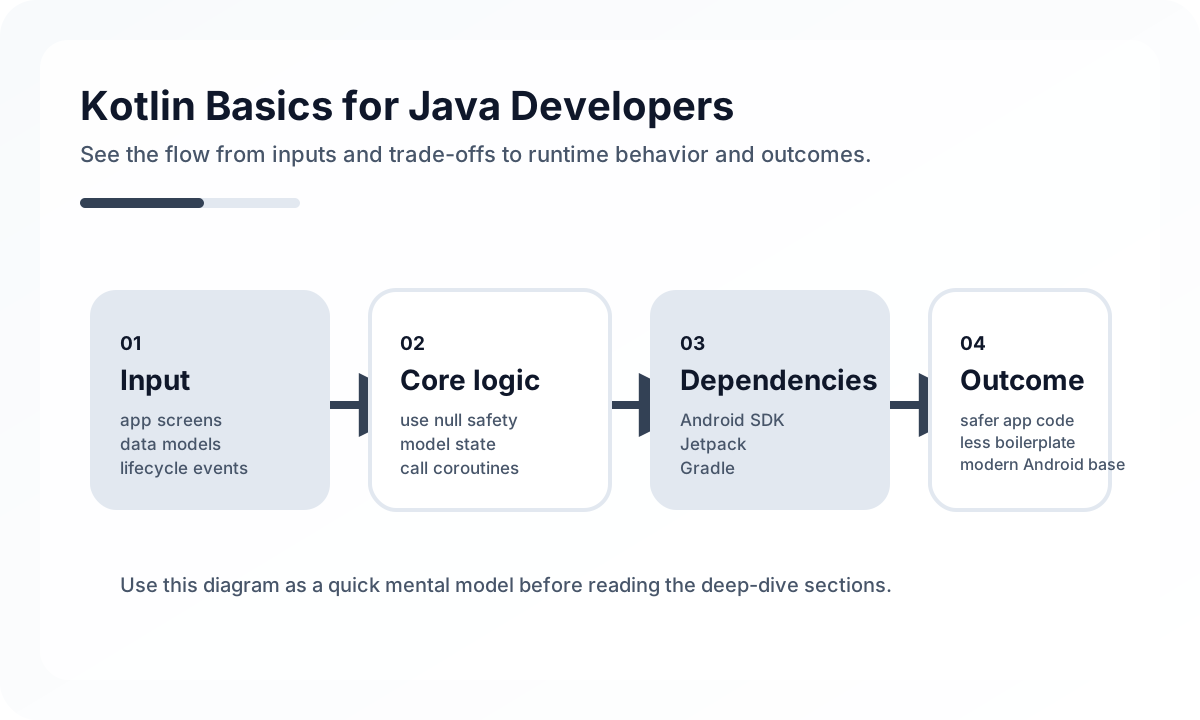
That is why a productive Kotlin migration is less about learning syntax replacements and more about recognizing where the language shifts design pressure.
What Kotlin Actually Changes
Java developers usually notice the surface improvements first:
- less boilerplate
- data classes
- extension functions
- better collection APIs
The deeper changes are more important:
- nullability becomes visible in the type system
- immutable defaults become easier to maintain
- sealed hierarchies improve state modeling
- coroutines change how asynchronous work is expressed
This means Kotlin affects architecture, not just ergonomics.
Null Safety Is the Biggest Cultural Shift
The most important Kotlin upgrade for many teams is not syntax brevity. It is the fact that null handling stops being informal.
In Java, nullability often lives in documentation, conventions, or defensive habits. In Kotlin, the type system forces decisions earlier.
That has several practical effects:
- optional values become explicit
- API contracts become easier to reason about
- defensive branching spreads less unpredictably
- review conversations get sharper because intent is visible
Of course, this only helps if teams resist overusing !! and loosely typed interop layers.
Data Classes and Sealed Types Improve Model Quality
Kotlin encourages more expressive domain modeling than typical Java codebases.
Data classes reduce the noise around immutable records, and sealed classes make state transitions easier to represent cleanly.
This matters especially in:
- UI state models
- API result wrappers
- workflow states
- validation outcomes
The key gain is not fewer lines. It is fewer hidden assumptions.
Coroutines Should Be Treated as an Execution Model
Coroutines are one of Kotlin’s strongest features, but they are easy to misuse when teams read them as “lighter threads” or “nicer callbacks.”
In practice, coroutines are valuable because they make asynchronous flows readable while preserving structured cancellation and lifecycle control.
They work well when:
- suspending boundaries are explicit
- cancellation matters
- async work belongs to a clear owner
- the team understands dispatcher use
They become costly when:
- blocking work sneaks into coroutine flows
- scope ownership is vague
- cancellation is ignored
- coroutine launch sites multiply without policy
So Kotlin does not reduce async complexity automatically. It gives teams better tools to manage it.
Extension Functions Are Helpful Only if They Stay Honest
Extension functions are one of Kotlin’s most attractive features because they make APIs feel more fluent. The risk is that they can also make code look more object-oriented or domain-native than it really is.
Healthy usage usually means:
- small helpers close to the problem domain
- naming that clarifies intent
- avoiding heavy hidden logic in seemingly innocent calls
When extension functions start hiding expensive work, network access, or domain-critical behavior, readability drops fast.
Example: Kotlin Making State Explicit
sealed interface LoginResult {
    data class Success(val userId: String) : LoginResult
    data class Failure(val reason: String) : LoginResult
    data object Locked : LoginResult
}

fun login(email: String?, password: String?): LoginResult {
    val safeEmail = email?.trim()?.lowercase() ?: return LoginResult.Failure("email is required")
    val safePassword = password ?: return LoginResult.Failure("password is required")

    if (safeEmail == "locked@example.com") {
        return LoginResult.Locked
    }

    return if (safePassword == "secret") {
        LoginResult.Success("user-123")
    } else {
        LoginResult.Failure("invalid credentials")
    }
}
This is a useful Kotlin example because the win is not shorter syntax alone. The result states are explicit, and nullability is handled near the boundary.
Common Kotlin Anti-Patterns
- treating Kotlin as only a boilerplate-reduction tool
- overusing
!!to bypass type-system pressure - launching coroutines without lifecycle ownership
- hiding domain logic in extension functions
- writing Java-style mutable models in Kotlin syntax
These mistakes keep the syntax benefits while losing most of the design benefits.
Review Checklist
- Is nullability modeled honestly?
- Are state transitions clearer than they would be in Java?
- Do coroutine scopes have clear ownership and cancellation rules?
- Are extension functions small and transparent?
- Is the team using Kotlin to improve design, or only to shorten code?
Closing Judgment
Kotlin helps Java teams most when they use it to improve contracts, state modeling, and asynchronous structure. If it is used only to write fewer characters, much of its real value disappears.
Continue Reading
Related posts
Java 21 Virtual Threads: A Practical Concurrency Guide
A production-focused guide to Java 21 Virtual Threads. Learn where they improve throughput, where they do not help, and what to validate before rolling them into a Spring Boot service.
💬 LanguageA Practical Guide to the Java Stream API
A production-minded guide to the Java Stream API. Learn where streams clarify business rules, where imperative code is safer, and how to avoid unreadable pipelines.
📱 MobileJetpack Compose for Beginners: Declarative Android UI
How to build Android app UIs with Jetpack Compose. Covers Composable functions, state, LazyColumn, ViewModel, and navigation with practical examples.
📈 TrendsJDK 25 Trends: How to Read LTS Adoption in Practice
JDK 25 reached GA on September 16, 2025 and serves as the reference implementation of Java 25. The real question is not how many JEPs landed, but which ones deserve production attention now.
Next Path