Modern JavaScript Syntax Through ES2024
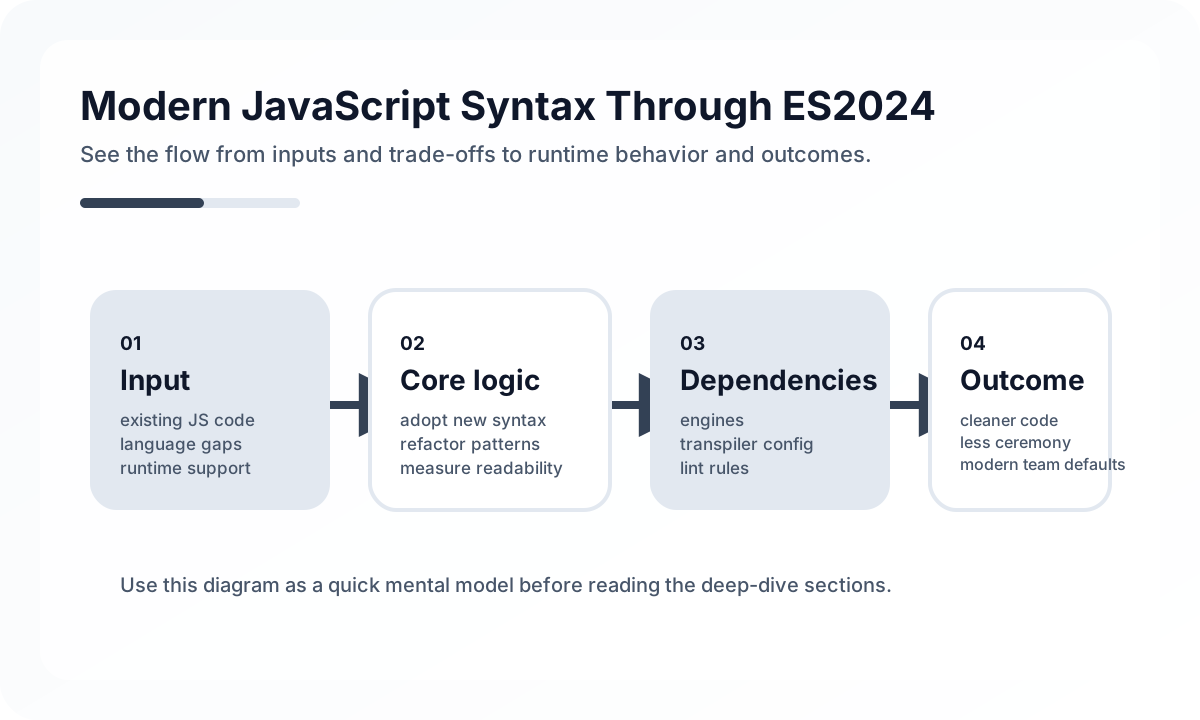
The useful way to read ES2024-era JavaScript is not as “more concise syntax.” It is as a set of tools that can reduce ambiguity, remove brittle boilerplate, and clarify intent when used carefully.
The Real Question Is Not Feature Support
Most teams ask whether a syntax feature is available in their runtime or build chain. That matters, but it is not the whole decision.
The more important questions are:
- does this syntax reduce ambiguity for readers
- does it replace repeated boilerplate safely
- does it improve the failure behavior of the code
- will the team use it consistently enough that review gets easier, not harder
New syntax only helps if it sharpens the codebase’s defaults.
Optional Chaining and Nullish Coalescing Changed the Baseline
Optional chaining and nullish coalescing are already common, but they are still worth discussing because they changed how defensive code is written.
They are valuable when:
- nullability is real at external boundaries
- fallback values should distinguish between missing and falsy
- nested object access would otherwise be noisy
They are dangerous when:
- they hide missing invariants that should be enforced earlier
- they get stacked so deeply that the data-shape problem is ignored
These operators are excellent at boundary handling. They are poor substitutes for better domain guarantees.
Array and Object Grouping Matter Because They Encode Intent
Grouping APIs are useful not because they save lines, but because they make collection intent explicit.
Instead of building ad hoc reducers each time, developers can express:
- “group this data by category”
- “turn these records into keyed buckets”
That clarity is why these features matter. A codebase with many reporting, analytics, and UI aggregation paths benefits when grouping becomes a standard pattern instead of many hand-written reducers.
Promise Utilities Improve Coordination, Not Just Convenience
Modern promise helpers are often treated as ergonomic sugar. In reality, they influence how teams model concurrency and failure.
For example:
Promise.all()encodes fail-fast parallel workPromise.allSettled()makes partial success explicitPromise.any()expresses a first-success strategy
Using the right helper is less about syntax knowledge and more about being honest about failure policy.
That is a good lens for modern JavaScript in general: newer features help most when they clarify semantics that were previously implicit.
Ergonomics Can Quietly Create Laziness
One of the risks of modern JavaScript is that convenience syntax can reduce pressure to model data well.
Typical examples:
- excessive optional chaining instead of validated inputs
- fallback defaults applied too late in the flow
- spread syntax used so freely that object ownership becomes murky
- helper chains that look expressive but hide expensive work
So newer syntax should be reviewed not only for correctness, but for whether it encourages stronger boundaries or just thinner code.
Example: Boundary-Safe Modern JavaScript
function normalizeUser(input) {
  const email = input?.email?.trim()?.toLowerCase();
  const locale = input?.preferences?.locale ?? "en-US";

  if (!email) {
    throw new Error("email is required");
  }

  return {
    id: input.id,
    email,
    locale,
    marketingOptIn: input.preferences?.marketingOptIn ?? false,
  };
}
This is a healthy use of newer syntax because:
- optional access is limited to the outer boundary
- required invariants are still enforced
- defaults are explicit and meaningful
The code is shorter, but more importantly, its intent is cleaner.
Team Rules Matter More Than Syntax Awareness
Modern JavaScript becomes expensive when every engineer adopts features differently.
Good teams define rules such as:
- where optional chaining is acceptable
- when
??should be preferred over|| - how promise coordination should express failure behavior
- when a reducer should be replaced by a clearer built-in pattern
Without these defaults, modern syntax can make a codebase feel fragmented rather than upgraded.
Common Anti-Patterns
- using optional chaining to avoid validating real invariants
- treating every new syntax feature as automatically more readable
- mixing several promise coordination styles with no policy
- using spread and destructuring so heavily that data flow becomes hard to trace
- upgrading syntax faster than team conventions
The issue is rarely that modern JavaScript is too advanced. It is that teams adopt it without architectural intent.
Review Checklist
- Does the feature make intent clearer, not just shorter?
- Is the syntax reducing boilerplate or hiding a modeling problem?
- Would a new engineer understand the failure behavior from the code?
- Are defaults and null handling still explicit?
- Is the team using the same feature consistently across similar code?
Closing Judgment
Modern JavaScript is most valuable when it makes code more honest about nullability, fallback behavior, and asynchronous intent. It becomes harmful when teams use new syntax to compress ambiguity instead of removing it.
Continue Reading
Related posts
TypeScript Utility Types: A Practical Guide
A production-focused guide to TypeScript utility types. Learn how to model DTOs, update payloads, selectors, and derived types without making your type layer harder to read.
💬 LanguageTypeScript Generics: A Practical Guide
A practical and production-focused guide to TypeScript generics. Learn when generics improve API contracts, when they overcomplicate code, and how to keep inference readable.
📱 MobilePWA Complete Guide: Install a Web App Without an App Store
How to build a Progressive Web App (PWA). Covers Service Workers, the Web App Manifest, offline support, push notifications, and home screen installation with practical examples.
📱 MobileReact Navigation 6 Complete Guide
A practical guide to React Navigation 6, the standard navigation library for React Native. Covers Stack, Tab, Drawer, nested navigators, and deep linking.
Next Path