A Practical Guide to the Java Stream API
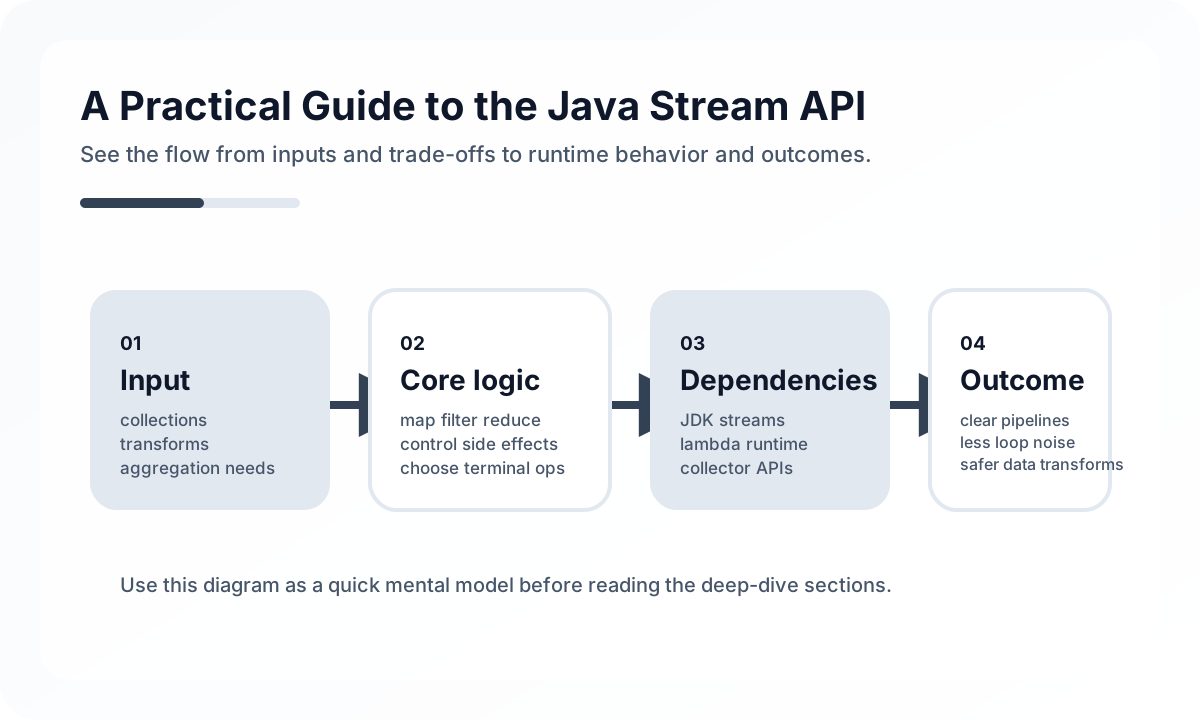
Streams are excellent for collection transformation. They are a poor fit for stateful workflows, branching orchestration, and code that depends on side effects to be understandable.
Where Streams Add Real Value
Streams are strongest when the code answers a narrow data question:
- filter a collection to valid items
- map records into another shape
- group, summarize, or aggregate values
- flatten nested collections
In those cases, a stream can make the intent more obvious than a hand-written loop because the reader sees the transformation pipeline directly.
Where Imperative Code Is Better
Not every loop should become a stream.
Imperative code is often safer when:
- each step mutates state intentionally
- there are several branching conditions with named decisions
- error handling must be interleaved with processing
- performance debugging depends on seeing step-by-step flow
This is an important standard for teams: streams are a tool for clarity, not a sign of sophistication.
A Practical Design Rule
A good stream pipeline usually has these traits:
- each step has one obvious purpose
- lambdas are short enough to read without scrolling
- business terminology survives the transformation
- side effects are absent or tightly contained
Once the pipeline starts hiding conditionals, mutable accumulators, or remote calls, readability drops fast.
Example: A Healthy Aggregation Pipeline
This is a reasonable use of streams because the code reads like a data question.
Map<String, Long> revenueByCategory = orders.stream()
    .filter(Order::isPaid)
    .flatMap(order -> order.items().stream())
    .collect(Collectors.groupingBy(
        Item::category,
        Collectors.summingLong(Item::price)
    ));
The steps are easy to explain:
- keep only paid orders
- flatten order items
- sum price by category
That direct mapping between code and business language is the real advantage.
Example: When to Stop Using a Stream
If the pipeline begins to include validation rules, audit logging, fallback logic, and exception translation, the stream is probably no longer the best abstraction.
At that point, a loop with named local variables often wins because:
- debugging is easier
- branching is explicit
- log placement is natural
- future edits are less risky
Many teams improve their codebase simply by allowing “boring loops” where loops are clearer.
Parallel Streams Need Extra Skepticism
Parallel streams are often presented as a near-free speedup. In production, they are much more situational.
They can help when:
- the work is CPU-heavy
- the operation is pure
- the data size is large enough
- the fork-join pool behavior is acceptable for the service
They often hurt when:
- work blocks on I/O
- shared state slips into the pipeline
- the common pool interferes with other work
- the team never benchmarks representative workloads
If the service is latency-sensitive, implicit parallelism deserves the same caution as any thread-pool decision.
Common Stream Anti-Patterns
- mutating external collections inside
forEach - placing remote calls inside
map - hiding domain decisions inside dense lambdas
- chaining so many operations that the business rule disappears
- forcing
Optional,Stream, and exception translation into one expression
These problems are easy to miss in review because the code still looks compact.
Review Checklist
- Is the stream solving a pure transformation problem?
- Can each stage be explained in one short sentence?
- Would a new team member understand the domain rule without running the code?
- Are side effects, logging, and error handling kept outside the pipeline when possible?
- Has the team avoided parallel streams unless benchmarking justified them?
Closing Judgment
The Stream API is most valuable when it makes data flow feel smaller and clearer. It becomes harmful when developers use it to compress complexity instead of reducing it. Good Java teams are not the ones that use streams everywhere. They are the ones that know exactly when to stop.
Continue Reading
Related posts
Kotlin Basics for Java Developers
A practical guide to Kotlin for Java developers through a production lens. Learn what Kotlin changes in team habits, not just in syntax, especially around null safety, state modeling, and coroutines.
💬 LanguageJava 21 Virtual Threads: A Practical Concurrency Guide
A production-focused guide to Java 21 Virtual Threads. Learn where they improve throughput, where they do not help, and what to validate before rolling them into a Spring Boot service.
📈 TrendsJDK 25 Trends: How to Read LTS Adoption in Practice
JDK 25 reached GA on September 16, 2025 and serves as the reference implementation of Java 25. The real question is not how many JEPs landed, but which ones deserve production attention now.
🔧 ToolsEssential IntelliJ IDEA Shortcuts and Productivity Tips
A practical guide to IntelliJ IDEA productivity through navigation, safe refactoring, debugging flow, and team-level IDE habits rather than shortcut memorization alone.
Next Path