Go Language Basics: A Practical Quick-Start Guide
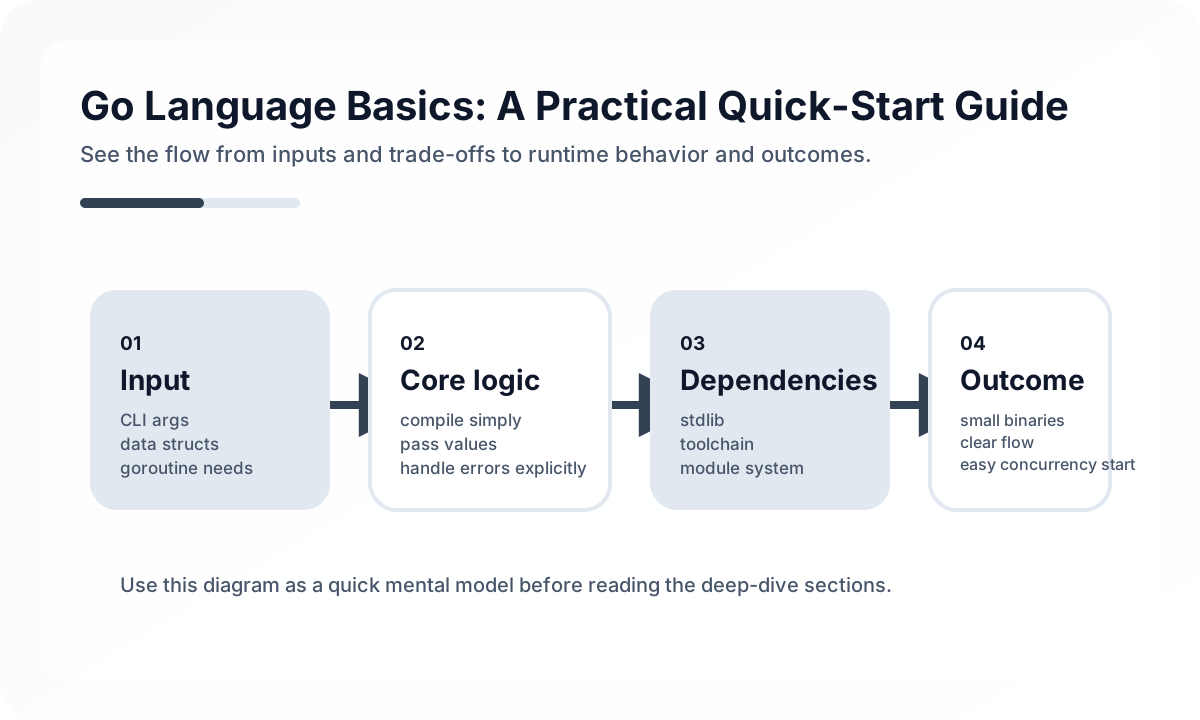
That visibility is the real reason Go works so well for infrastructure and service code. The language does not remove complexity. It makes it harder to hide complexity behind abstraction.
What Teams Usually Misread About Go
Beginners often interpret Go as “simple syntax, simple systems.” In production, the reality is different.
- the syntax is small, but operational discipline still matters
- concurrency is approachable, but ownership rules are still required
- interfaces are lightweight, but can become vague if overused
- explicit error returns improve clarity only when teams keep them meaningful
So the right way to learn Go is not by memorizing syntax first. It is by understanding what kinds of engineering behavior the language encourages.
Why Go Feels Different in Practice
Go code tends to feel different from Java, Kotlin, or TypeScript because the language has a clear bias:
- prefer straightforward control flow
- keep dependency surfaces narrow
- make errors part of ordinary execution
- allow concurrency easily, but not invisibly
This gives Go an unusual combination. It is friendly to read, but it does not automatically protect teams from sloppy design. In some ways, its simplicity demands more judgment, not less.
Concurrency: Easy to Start, Easy to Misuse
Goroutines are one of Go’s biggest strengths, but they are also where many codebases become messy.
Goroutines are cheap enough that developers reach for them quickly. The danger is assuming cheap concurrency means free concurrency.
The practical questions are:
- who owns the goroutine lifetime
- how does cancellation propagate
- what happens if a receiver stops reading from a channel
- what prevents unbounded background work
The language makes concurrency accessible. It does not make concurrency architecture automatic.
Channels Are Coordination Tools, Not Magic Pipes
Channels are often taught as the defining Go feature. In real code, they are best treated as one coordination option among several.
Channels are a good fit when:
- ownership transfer should be explicit
- work needs to be serialized through a small boundary
- producer and consumer relationships are central to the design
They are a poor fit when:
- a mutex would express the state boundary more directly
- the communication graph becomes hard to trace
- buffering rules are unclear
- the code is using channels mainly to look idiomatic
Good Go code is not “channel-heavy.” It is selective.
Interfaces Are Powerful Because They Are Small
Go interfaces work best when they describe exactly the capability a caller needs.
That is why many healthy Go codebases define interfaces near the consumer, not near the implementation. The goal is not to create an object hierarchy. The goal is to express the minimum dependency contract.
This is also where teams go wrong:
- broad interfaces with many methods
- package-level abstractions created too early
- interfaces used preemptively before multiple implementations exist
Go rewards narrow boundaries. It does not reward abstract architecture for its own sake.
Error Handling Is a Design Surface
Explicit error returns are often described as verbose. In practice, they are one of Go’s best design tools.
They force teams to answer:
- which failures are expected
- where retry or fallback belongs
- what context should be attached
- which errors should cross package boundaries
Go error handling only becomes noisy when teams return raw errors with no structure, wrap inconsistently, or ignore domain meaning.
Example: Concurrency With Context Ownership
func FetchAll(ctx context.Context, urls []string, client *http.Client) ([]string, error) {
    ctx, cancel := context.WithCancel(ctx)
    defer cancel()

    type result struct {
        body string
        err  error
    }

    ch := make(chan result, len(urls))

    for _, url := range urls {
        url := url
        go func() {
            req, err := http.NewRequestWithContext(ctx, http.MethodGet, url, nil)
            if err != nil {
                ch <- result{err: err}
                return
            }

            resp, err := client.Do(req)
            if err != nil {
                ch <- result{err: err}
                return
            }
            defer resp.Body.Close()

            body, err := io.ReadAll(resp.Body)
            if err != nil {
                ch <- result{err: err}
                return
            }

            ch <- result{body: string(body)}
        }()
    }

    out := make([]string, 0, len(urls))
    for range urls {
        res := <-ch
        if res.err != nil {
            cancel()
            return nil, res.err
        }
        out = append(out, res.body)
    }

    return out, nil
}
This example is useful not because it uses goroutines, but because ownership is visible:
- cancellation is explicit
- result collection is bounded
- failure ends the broader operation
That is the real Go pattern to look for.
Common Go Anti-Patterns
- spawning goroutines without cancellation or ownership
- using channels where direct locking is clearer
- defining interfaces too early and too broadly
- returning errors with too little context
- confusing small syntax with low architectural risk
Go codebases usually become harder not because the language is complicated, but because teams assume the language will keep things simple for them automatically.
Review Checklist
- Is concurrency bounded and cancellable?
- Does each interface describe a real consumer need?
- Are channels being used for coordination rather than style?
- Do errors preserve enough context to diagnose production failures?
- Is the code simple because the design is clear, or only because syntax is short?
Closing Judgment
Go is most useful when a team wants visible control flow, disciplined dependency boundaries, and accessible concurrency. Its simplicity is a strength, but only when teams understand that the language is giving them clarity tools, not safety rails.
Continue Reading
Related posts
Go Worker Pools and Backpressure Design
A practical guide to worker pools, bounded concurrency, queue control, and backpressure when building Go services.
💬 LanguageJava 21 Virtual Threads: A Practical Concurrency Guide
A production-focused guide to Java 21 Virtual Threads. Learn where they improve throughput, where they do not help, and what to validate before rolling them into a Spring Boot service.
📈 TrendsJDK 25 Trends: How to Read LTS Adoption in Practice
JDK 25 reached GA on September 16, 2025 and serves as the reference implementation of Java 25. The real question is not how many JEPs landed, but which ones deserve production attention now.
🚀 DevOpsKubernetes Advanced Operations — HPA, Resource Management, and Pod Scheduling
This article explains Kubernetes operations not as a collection of settings but from the perspective of resource placement and resilience. It covers when and how to use requests/limits, HPA, affinity, taints, PDBs, and probes in real environments.
Next Path