Vue vs React In-Depth Comparison Guide
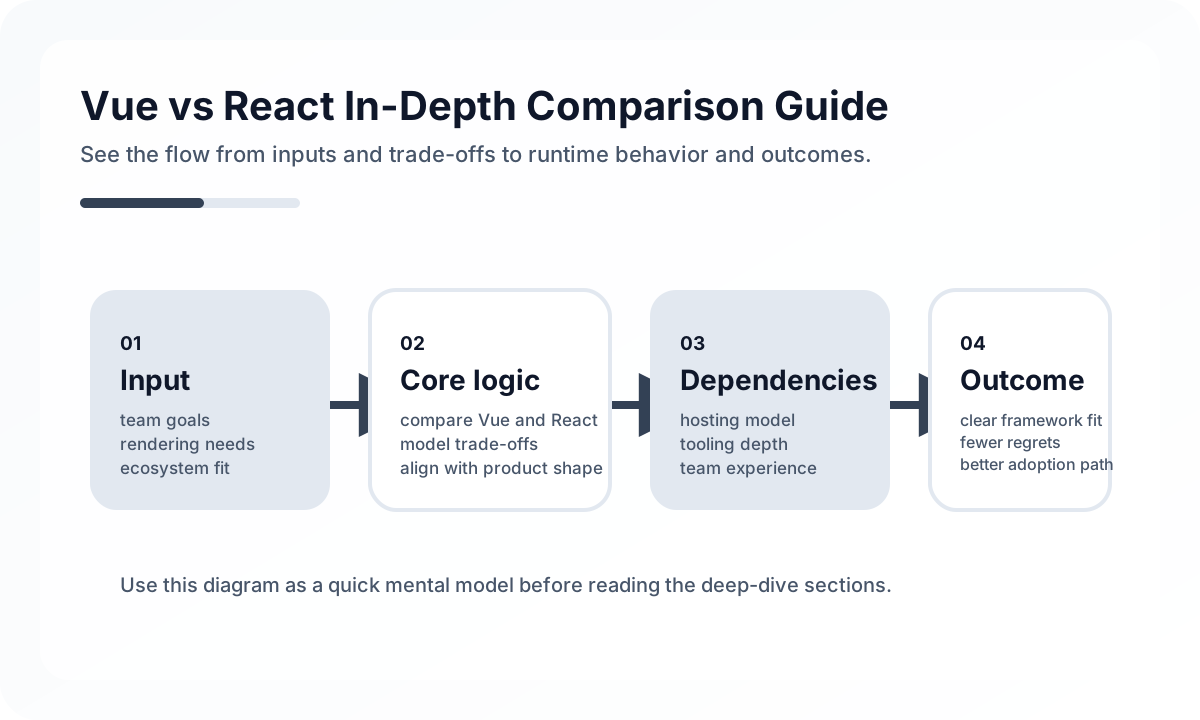
Architecture diagram
Vue Architecture                     React Architecture
----------------                     ------------------
Template + SFC                       JSX + Composition
      |                                     |
Composable / Pinia                    Hooks / Server State
      |                                     |
Nuxt or Vue SPA                       Next.js or React SPA
      |                                     |
Predictable conventions               Flexible composition
This comparison is not about declaring a winner. It shows how the two ecosystems organize structure differently. Vue is stronger in explicit conventions and file-level structure, while React gives more freedom in composition and abstraction. The real question is whether the team values consistency or flexibility more.
Both are powerful, but the philosophy is different
Vue tends to provide a more integrated development experience. Routing, state management, SFC structure, and template syntax connect naturally, so teams often converge on similar project shapes faster.
React starts from a smaller core and a broader ecosystem. It favors composing UI through functions and gives you far more choices for data layers and rendering models. The trade-off is that teams need to define more structural rules themselves.
Architectural differences
Vue has a stronger feeling of “this is the standard way to organize it.” SFCs, the Composition API, Vue Router, and Pinia fit together naturally, which makes project-wide conventions easier to establish.
React offers more choice. You can stay CSR-first, or combine Next.js App Router, RSC, TanStack Query, Zustand, form libraries, and more to match the team’s situation. That flexibility is powerful, but without clear agreements it can lead to inconsistency.
Differences in data flow and state management
Vue’s reactivity model often feels more intuitive for state updates. Because template and logic live together inside an SFC, implementing screens can be very fast.
React makes state feel more explicit. It pushes teams to think more consciously about immutability, rendering, memoization, and separating server state from UI state. That can become an advantage in large-scale architecture.
Put simply, Vue is often more screen-implementation friendly, while React gives more explicit control over state and rendering models.
Rendering models and server-friendliness
One of the biggest differences in modern frontend work is support for server and hybrid rendering.
React, through the Next.js ecosystem, offers a very wide range of options, including SSR, SSG, ISR, and RSC. That is especially valuable in products that mix content and application behavior.
Vue also supports SSR and hybrid rendering strongly through Nuxt. Still, React often has more market visibility, hiring depth, and ecosystem references in large organizations.
Team scaling and onboarding
Vue is often easier to onboard into because the syntax and tool flow feel more organized. It tends to have a lower entry barrier for backend-leaning teams or teams already comfortable with template-based development.
React has a wider initial learning surface because of its flexibility, but large organizations often benefit from its broader talent pool and widely shared patterns. As teams get bigger, React’s status as a market standard can matter more.
Differences in component design experience
Vue keeps template, script, and style in one file, which makes screen-level readability strong. React leans on JSX and functional composition, which makes logic separation more flexible.
Neither style is universally better. The right fit depends heavily on whether the team prefers declarative templates or function-oriented composition.
Ecosystem and options
React has a wider and more expandable ecosystem. Data fetching, state management, forms, animation, and rendering all come with a broad library pool. But that also means higher decision cost.
Vue’s choices are more curated. The standard combination is easier to recognize, so teams can align faster. The trade-off is that some advanced patterns or large-scale ecosystem assets are richer on the React side.
When Vue is often the better fit
Vue can be a strong choice under conditions like these.
- the team wants a consistent structure quickly
- there are not many dedicated frontend specialists
- template-driven thinking feels more natural to the team
- the team prefers a managed ecosystem and a clearer default flow
When React is often the better fit
React can be stronger under conditions like these.
- rendering strategy flexibility matters a lot
- the organization has to think about large-scale hiring
- server components, hybrid rendering, and broad ecosystem leverage are important
- the team is already comfortable with functional composition and explicit state models
The conclusion depends on the product and the organization
Both Vue and React are mature enough for large-scale services. The important question is not which framework is superior, but which one better matches the team’s structure and the product’s needs.
Wrap-up
The real core of the Vue vs React comparison is not syntax preference, but organization design. Vue is stronger for consistency and fast alignment. React is stronger for flexibility and ecosystem breadth. The most realistic comparison is the one that looks at product shape, team experience, and long-term scaling strategy together.
What Gets Hard in Production
- React and Vue can both support excellent frontends, but they encourage different mental models around abstraction, state, and composition.
- The meaningful comparison is about team cognition and architectural fit, not about framework tribalism.
- Migration cost and ecosystem alignment often matter more than headline performance claims.
Architecture Decisions That Matter
- Choose based on team familiarity, existing ecosystem investments, and the style of abstraction your product code needs.
- React often rewards explicit composition and ecosystem assembly; Vue often rewards convention and progressive readability.
- Compare tooling, hiring pipeline, and integration surface with your backend and deployment stack.
Practical Example
A practical framing is to compare how teams build features over time, not how they write hello world:
React -> explicit hook and composition patterns, larger library choice surface
Vue -> integrated conventions, template-oriented readability, smoother adoption for some teams
Anti-Patterns to Avoid
- Treating framework choice as a permanent identity statement.
- Ignoring the cost of retraining, migration, and ecosystem replacement.
- Comparing only syntax taste and not operational fit.
Operational Checklist
- Evaluate one representative feature module in each stack.
- Review state, testing, SSR, and build tooling implications.
- Estimate migration or onboarding cost honestly.
- Favor the framework that the team can operate consistently well.
Final Judgment
React versus Vue is usually a question of organizational fit and engineering style. The winning framework is the one your team can build, evolve, and debug with the least accidental complexity.
Continue Reading
Related posts
Reconciliation Boundaries in Optimistic UI
Optimistic UI feels fast, but complexity appears when the server disagrees. This guide explains where optimistic updates should stop.
🖥️ FrontendReact Activity and View Transitions Adoption Notes
Recent React work around Activity and View Transitions is about more than animation. It changes how teams can approach UI continuity and preserved state.
📈 TrendsWhat the React Foundation Means for Engineering Teams
Why the React Foundation matters beyond governance news, and how it may affect framework coordination, ecosystem stewardship, and long-term frontend strategy.
📱 MobileReact Native vs Flutter: 2026 Comparison Analysis
A practical comparison of the strengths and weaknesses of React Native and Flutter for mobile app development. Covers performance, developer experience, ecosystem, and the job market.
Next Path