React Architecture Design Guide
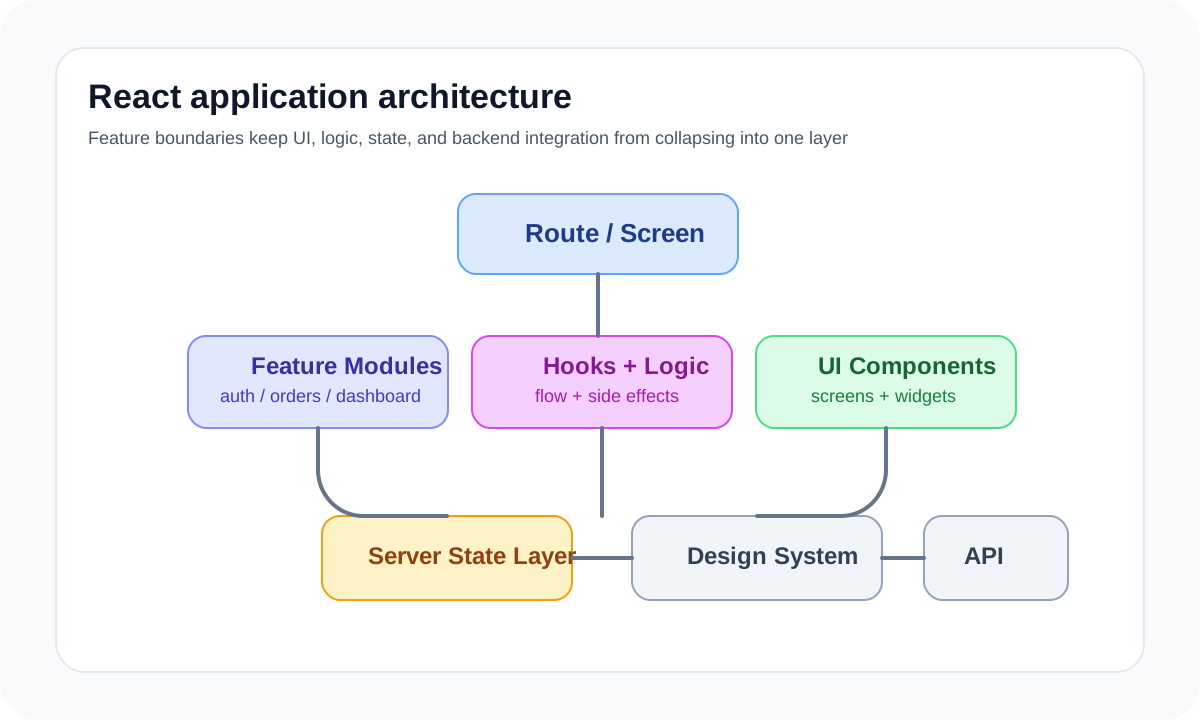
React projects move fast when they are small, but as they grow, structure matters more than code volume. Too many components can be a problem, scattered state can be a problem, and mixing server data with local UI state raises maintenance cost quickly. That is why the core of React architecture is less about “How should we write components?” and more about “What should be separated by which boundary?”
Architecture diagram
[Route / Screen]
      |
      v
[Feature Modules]
 Auth / Dashboard / Orders
      |
  +---+------------------------+
  |                            |
  v                            v
[Hooks / Domain Logic]   [UI Components]
  |                            |
  v                            v
[Server State Layer]     [Design System]
      |
      v
 [API / BFF / Backend]
One important idea in React architecture is not to make the component tree and the responsibility tree identical. Screens compose feature modules, feature modules use hooks and the server-state layer to handle data, and the design system isolates presentation rules. That separation keeps UI structure and data structure from dragging each other down.
Core questions for React architecture
A good React architecture can usually answer these questions clearly.
- Is this component responsible for presentation or for flow?
- Is this state local UI state, shared state, or server state?
- Should this logic stay inside the component or move to a custom hook?
- Is this page better modeled as CSR, SSR, or RSC?
- Can the team read the structure predictably?
Without clear answers, complexity accumulates no matter how good the tools are.
Split components into presentation and composition
In React, structure tends to get clearer when components are divided into reusable presentation units and screen-level composition layers.
- presentational components: UI-focused pieces like buttons, cards, and list items
- container or page components: data loading, permission branching, and screen orchestration
- custom hooks: combined state and side-effect logic
If every component fetches data, manages state, and renders at the same time, testing and refactoring get difficult later.
State is a layered model, not one big thing
One of the biggest sources of confusion in React projects is where state should live. A practical split usually looks like this.
- local state: inputs, modal visibility, temporary selections
- shared client state: auth, theme, global filters, user preferences
- server state: lists, detail responses, and cacheable data from APIs
- URL state: search terms, sort order, pagination, and other shareable state
Without this distinction, too much data lands in Context, or the app falls into heavy prop drilling. Treating server state like global state is especially risky because caching and synchronization complexity grows fast.
Server state deserves its own layer
Tools like TanStack Query matter in React because server state is not just a useState problem. It comes with all of these concerns.
- caching
- refetch timing
- staleness rules
- errors and retries
- optimistic updates
- background refresh
If each component implements those rules on its own, the structure becomes heavy very quickly. Strong React architecture treats server state as a separate layer.
Custom hooks define logic boundaries
Custom hooks are one of the strongest structural tools in React, but extracting every piece of logic into a hook is not good design by itself. A custom hook works best when its responsibility and reuse value are clear.
These are often strong candidates for extraction.
- authentication session flow
- search filter composition
- infinite scrolling
- form submission and validation flow
- URL-state synchronization
By contrast, logic that is tightly bound to one page can remain in that page if doing so keeps the code easier to read.
Rendering models directly affect architecture
Modern React architecture cannot think only in CSR terms. In ecosystems like Next.js, rendering choices directly affect structure.
- CSR: for heavily interactive client-side screens
- SSR: when initial display and SEO matter
- SSG: when data changes infrequently and fast response matters
- RSC: when server-handled parts can reduce client cost
Whichever rendering model becomes the default changes data loading, component boundaries, cache strategy, and bundle size.
Folder structure should match how the team reads the codebase
Two structures are common in React projects.
- type-based:
components,hooks,pages,services - feature-based:
features/auth,features/posts,features/dashboard
Type-based structure is simple when a codebase is small. As scale grows, feature-based structure often supports collaboration better. The important thing in either case is that shared UI, domain logic, API boundaries, and test locations stay consistent.
Do not mix shared UI and feature UI
Design-system components like buttons, inputs, modals, and toasts should stay separate from domain-specific UI like filter bars, order status cards, or dashboard widgets. Shared UI should maximize generality. Feature UI should preserve context.
If those layers are mixed, the shared layer starts absorbing domain requirements until it is no longer truly shared.
Common failure patterns in React architecture
- putting too much state into one Context
- repeating
fetchand error handling on every page - having many custom hooks with vague responsibilities
- mixing server state and form state
- storing URL-worthy state only locally and making restore/share behavior weak
These problems usually come from blurry boundaries, not from React itself.
Structure without team rules does not last
Because React is flexible, teams need explicit rules or style drift happens quickly. It helps to define things like these.
- where data loading should happen
- when to use a server-state tool
- the allowed scope of Context
- the criteria for extracting custom hooks
- the boundaries between page, feature, and shared components
Architecture is often closer to team agreement than to the framework itself.
Wrap-up
The core of React architecture is not creating many components, but separating responsibilities clearly. Once presentation, composition, state, data, and rendering models are treated as distinct concerns, the project becomes more durable and the team can move faster.
What Gets Hard in Production
- React architecture degrades when boundaries blur and every feature reaches into everything else.
- Most maintainability problems are not caused by JSX or templates, but by unclear ownership of data, side effects, and composition.
- A strong codebase has explicit component, hook, route, and server-state boundaries.
Architecture Decisions That Matter
- Organize by feature and responsibility before organizing by file type convenience.
- Keep business logic close to domain modules and UI assembly close to routes or screens.
- Decide how shared utilities, data access, and stateful abstractions are allowed to cross boundaries.
Practical Example
A maintainable front-end structure usually mirrors ownership rather than framework primitives:
features/
  billing/
  catalog/
shared/
  ui/
  api/
  utils/
app/
  routes/
  providers/
Anti-Patterns to Avoid
- One giant component tree with no domain grouping.
- Shared folders that become a dependency sink for everything.
- Mixing transport concerns, business rules, and presentation formatting in the same modules.
Operational Checklist
- Review dependency direction between shared code and feature code.
- Watch component and hook/composable reuse for meaningful abstraction, not just deduplication.
- Keep public module APIs small and intentional.
- Refactor when route-level complexity starts leaking across features.
Final Judgment
React architecture is strong when module boundaries explain how the product works. Folder neatness without ownership clarity is cosmetic architecture.
Continue Reading
Related posts
React Design System Architecture Guide
This guide explains the tokens, component layers, accessibility, and release strategy needed to design a React-based design system in production.
🖥️ FrontendReact + SPA Architecture Guide
This guide explains the screen boundaries, state structure, routing, data layer, and performance strategy needed to design a React-based SPA in production.
📈 TrendsWhat the React Foundation Means for Engineering Teams
Why the React Foundation matters beyond governance news, and how it may affect framework coordination, ecosystem stewardship, and long-term frontend strategy.
⚙️ BackendA Practical Guide to CQRS and Event Sourcing
This guide explains CQRS and Event Sourcing in terms of domain boundaries, projections, consistency tradeoffs, snapshots, and operational complexity.
Next Path