Nuxt vs Next.js In-Depth Comparison Guide
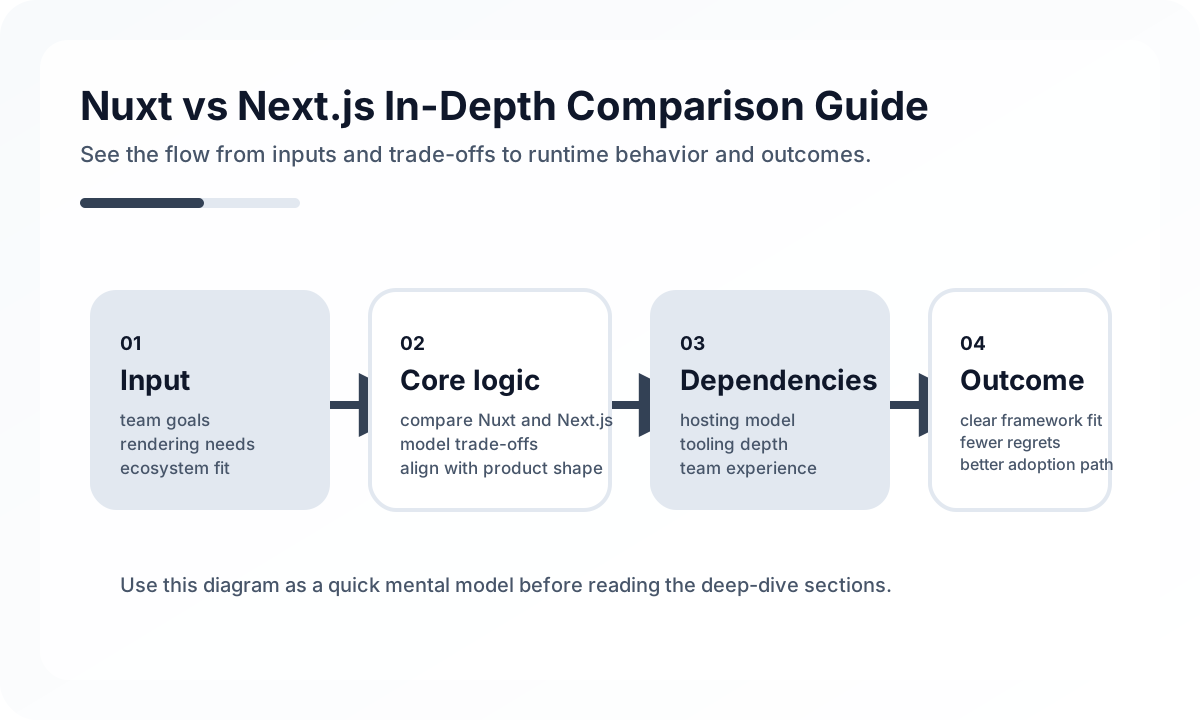
Nuxt and Next.js are the representative full-stack frontend frameworks in the Vue and React ecosystems. Both provide SSR, static generation, routing, server integration, metadata management, and deployment optimizations, but the real differences in production appear deeper than a feature checklist. The important question is not which framework is more famous, but which rendering model the team can operate well and which product structure the team can keep stable over time.
Architecture diagram
Nuxt Flow                       Next.js Flow
---------                       ------------
Route/Layout                    Route/Segment
   |                                |
useAsyncData / server api      RSC / Route Handler / Action
   |                                |
SSR + Hydration                 SSR + Streaming + Hydration
   |                                |
Predictable convention          Flexible rendering graph
The point of this comparison is not feature count, but structural tendency. Nuxt puts convention first. Next.js puts options first. That makes the better choice depend on whether the team wants faster alignment or more fine-grained optimization freedom.
The important difference is not the overlap
At a surface level, both support file-based routing, server rendering, API integration, and per-page cache strategy. The deeper difference is that Nuxt is stronger at organizing Vue philosophy into framework conventions, while Next.js is closer to offering multiple rendering models on top of React’s flexibility.
That difference leads directly to different team operating styles.
- Nuxt makes it easier to establish consistency and shared rules.
- Next.js is more powerful, but quality varies more depending on the team’s architectural discipline.
Learning curve and team onboarding
For a team already familiar with Vue, Nuxt is often easier to learn quickly. Pages, layouts, middleware, server APIs, and data fetching follow a relatively intuitive model, and the framework’s default flow is easier to recognize.
Next.js is more demanding. React already has more flexibility, and with the App Router the team also needs to understand server components, client components, caching, streaming, and server actions. That power is valuable for experienced teams, but mixed levels of understanding can easily lead to mixed structure.
Differences in rendering model
Nuxt is strong when teams want practical control over SSR, CSR, and SSG at the page level. It gives a more predictable way to decide which pages render first on the server and which data belongs behind the server boundary.
Next.js goes further with server components, streaming, and more granular caching options. That can be very strong for large-scale products and advanced optimization, but it can also bring unnecessary conceptual overhead to simpler services.
In short, Nuxt’s rendering model is often clearer, while Next.js is more detailed and more demanding.
Data access and server boundaries
In Nuxt, patterns like server API routes and useAsyncData make BFF-style boundaries fairly natural. It works well for Vue teams that want to manage full-stack boundaries inside the frontend repository.
Next.js also offers strong server-boundary tools through route handlers and server actions, but because the choices are wider, explicit team rules matter more. Without them, server and client responsibilities tend to blur quickly.
Design systems and component structure
The React ecosystem has especially deep support for design systems, headless UI, and advanced composition patterns. That often gives Next.js more choice when building large-scale product UI systems.
Nuxt and Vue, on the other hand, often produce more straightforward component structures and clearer template-based UI code. For teams with mixed experience levels, that explicitness can be a genuine advantage.
SEO and content-oriented services
Both can support SEO-friendly architectures, but for content and marketing-heavy services, Nuxt often gets to a solid result faster because of its simpler conventions. Next.js tends to be stronger when large content platforms mix internationalization, personalized behavior, and aggressive performance optimization.
The important thing is not just “SSR for SEO,” but understanding which pages get search traffic, which data is user-specific, and what cache strategy is realistic.
Operational complexity
Nuxt often starts with lower operational complexity because the structure is more predictable and there are fewer concepts to operate at once.
Next.js gives more knobs to tune, including deployment targets, cache strategy, server actions, streaming, and runtime choices. That can enable advanced optimization, but if operations do not support it, debugging cost rises quickly.
Which teams does each fit best?
Nuxt tends to fit well when:
- the team is comfortable with Vue
- the service mixes content pages and product pages
- the team wants quick structural consistency
- the goal is to adopt SSR without too much conceptual overhead
Next.js tends to fit well when:
- the team is deeply invested in the React ecosystem
- the team can make use of server components, streaming, and advanced caching
- complex design-system work and large product experiences matter
- the frontend team wants to manage more of the full-stack boundary directly
Common misunderstandings
- “Next.js is newer, so it must always be better”
- “Nuxt is only for simple services, and large services must use Next.js”
- “They both support SSR, so the difference is small”
In reality, team ability and product structure matter much more. More complex tools are not better by default. What matters is whether the team can turn that complexity into rules they can actually operate.
Wrap-up
The difference between Nuxt and Next.js is not just Vue vs React preference. It is about rendering-model complexity, team design maturity, operating structure, and how well the framework fits the product. Nuxt is strong when quick alignment and clear conventions matter. Next.js is strong when advanced optimization and ecosystem breadth matter.
A good choice is not the more famous framework. It is the framework the team can operate consistently and well.
What Gets Hard in Production
- Nuxt and Next.js both solve full-stack frontend concerns, but they optimize for different defaults and team ergonomics.
- The better choice depends less on benchmark mythology and more on rendering strategy, hosting expectations, and team familiarity.
- Framework fit becomes visible in long-term maintenance, not just in the first scaffold command.
Architecture Decisions That Matter
- Choose based on ecosystem fit, routing and rendering needs, and how much convention your team wants versus how much explicitness it prefers.
- Evaluate deployment platform assumptions and cache model, not just component syntax.
- Consider whether your product is content-heavy, app-heavy, or hybrid.
Practical Example
A practical comparison starts from workload shape:
content-heavy marketing and editorial flows -> Nuxt can feel especially cohesive
React-heavy product platform with existing React expertise -> Next.js can be a stronger default
Anti-Patterns to Avoid
- Choosing only on popularity momentum.
- Assuming feature parity means identical operational cost.
- Ignoring team experience when adopting a framework with strong conventions.
Operational Checklist
- Review SSR, caching, and deployment expectations side by side.
- Prototype one representative route family before committing.
- Estimate migration and hiring impact.
- Measure how much framework magic the team can realistically own.
Final Judgment
Nuxt versus Next.js is rarely about which framework is universally superior. It is about which one matches your rendering model, hosting plan, and team operating style with less friction.
Continue Reading
Related posts
Nuxt Architecture Design Guide
This guide explains the rendering strategy, data layer, routing boundaries, caching, and operating model to consider when designing a Nuxt-based frontend architecture.
🖥️ FrontendReact Architecture Design Guide
This guide explains how to design a React application as a maintainable system, covering component boundaries, state layers, server state, rendering models, and team collaboration structure.
⚙️ BackendA Practical Guide to CQRS and Event Sourcing
This guide explains CQRS and Event Sourcing in terms of domain boundaries, projections, consistency tradeoffs, snapshots, and operational complexity.
💬 LanguageType Narrowing at I/O Boundaries
A type system is strong inside the application, but external input still needs to be narrowed and validated early. This guide explains the boundary strategy.
Next Path