Rendering, Caching, and Hydration Strategy for Large Frontends
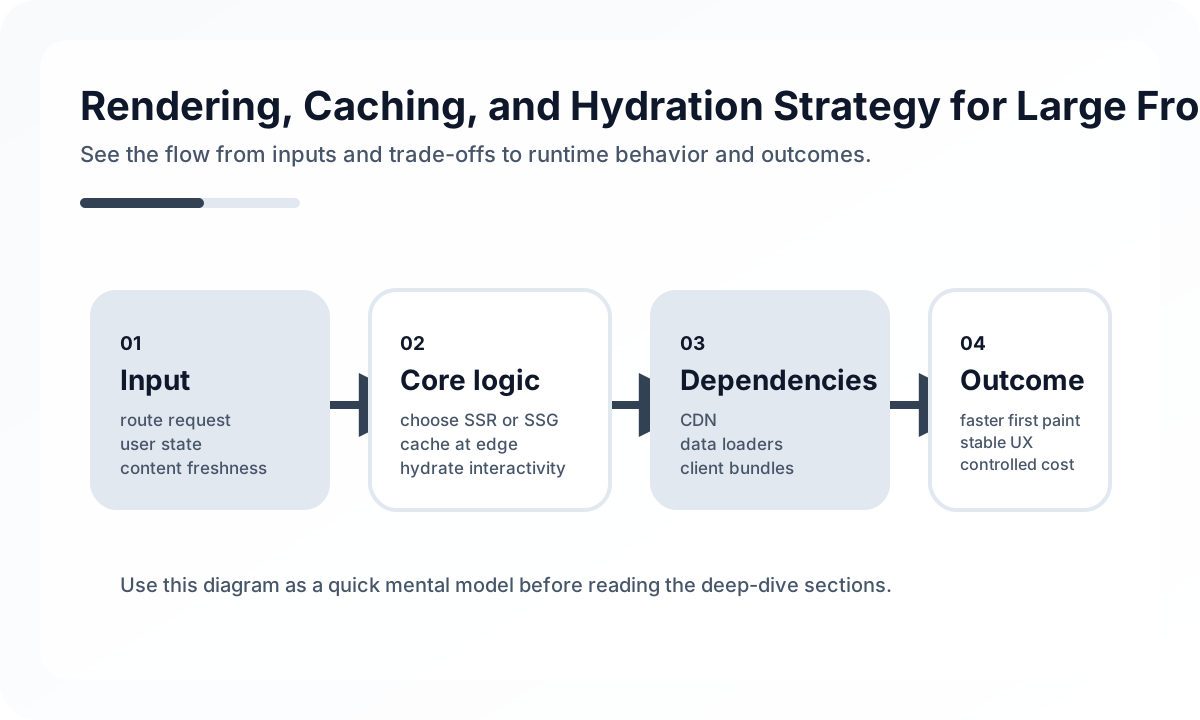
This guide focuses on how to combine SSR, SSG, ISR, RSC, hydration boundaries, browser cache, CDN cache, and data cache in a practical way for large production systems.
Start with the Right Questions
Rendering strategy is not a framework preference. It is an answer to a set of product and operational questions:
- What must be visible on the first paint?
- Does the page need SEO, or is it an authenticated view?
- How frequently does the data change?
- How much of the page is personalized per user?
- Can users read meaningfully without hydration, or is immediate interaction required?
- Is server cost more important than perceived speed, or the other way around?
Two teams using the same framework can arrive at completely different correct answers because their constraints differ.
Think in Layers, Not Features
[Origin App]
   |
   +--> HTML generation: SSR / SSG / ISR / RSC
   |
   +--> Data cache: fetch cache / query cache / KV / DB read model
   |
   v
[CDN Cache]
   |
   v
[Browser Cache]
   |
   +--> HTML
   +--> JS/CSS assets
   +--> API responses
   |
   v
[Hydration + Client State]
A common mistake is collapsing these layers into one discussion. Teams debate SSR vs SSG while ignoring that the real bottleneck is a missing server data cache. Or they talk about hydration cost when the real issue is poor CDN cache keys. These are different layers with different failure modes.
Distinguish SSR, SSG, ISR, and RSC by Role
SSR
SSR generates HTML per request. It is a strong fit for pages that need SEO and request-time personalization, such as logged-in dashboards, permission-aware pages, or region-specific views. The tradeoff is obvious: every request burns server work, and poor cache support quickly hurts TTFB.
SSG
SSG generates HTML at build time. It is ideal for docs, marketing pages, and stable content. It is simple and cheap, but becomes painful if content changes frequently or the build pipeline becomes the invalidation bottleneck.
ISR
ISR is the operational compromise between SSG and SSR. You keep mostly static pages but allow periodic or event-driven regeneration. This is useful for large content catalogs, but teams often overuse it as a default for anything “somewhat dynamic.” That usually creates invalidation complexity without enough benefit.
RSC
RSC lets you render server components without sending all of that rendering logic to the client bundle. The upside is lower client JavaScript, narrower hydration scope, and simpler server-side data access. The downside is that poorly chosen boundaries make ownership between server and client blurry and harder to reason about.
Hydration Boundaries Are Cost Boundaries
Hydration connects static HTML to interactive behavior. The mistake in many codebases is treating the entire page tree as one hydration unit. That pushes too much JavaScript, too much main-thread work, and too many event bindings into the startup path.
A better baseline:
- Keep read-only content server-only when possible.
- Create client boundaries only around actual interactive islands.
- Prioritize above-the-fold interactive elements.
- Defer heavy widgets like search panels, charts, editors, or large carousels.
[Server Content]
  |- article body              -> server only
  |- product summary           -> server only
  |- add-to-cart button        -> client boundary
  |- reviews filter panel      -> client boundary
  |- recommendation carousel   -> deferred client boundary
This does not mean you should split everything into dozens of tiny boundaries. Extremely granular boundaries can make data flow, bundle behavior, and ownership harder to maintain. The goal is simpler: send JavaScript only where JavaScript has a clear job to do.
Cache Is Not One Thing
1. Browser asset cache
Hashed JS and CSS should be aggressively cached. This is the easy part. Long-lived immutable caching with filename hashes is the standard baseline.
2. Browser API cache
API caching in the browser is much riskier because authentication, privacy, and staleness rules matter. A careless Cache-Control header on authenticated responses can become a security issue, not just a performance issue.
3. CDN HTML cache
This is extremely powerful for public pages. But once localization, cookies, experimentation, or personalization appear, cache-key design becomes the real problem. Preventing cache pollution matters more than maximizing raw hit rate.
4. Server data cache
This sits behind SSR or RSC and caches fetches to databases, CMSs, or internal APIs. Even when HTML cannot be shared between users, data cache can still remove a large amount of repeated work.
5. Client data cache
Client-side caches such as TanStack Query help with tab switching, optimistic UI, and post-hydration navigation. But if the client immediately refetches data that the server already rendered, most of the benefit is wasted.
Strategy by Page Type
Content pages
- Default to SSG or ISR
- Use CDN caching heavily
- Keep body content server-only
- Hydrate only comments, bookmarks, reactions, or lightweight tools
Product detail pages
- Default to SSR or ISR with layered data caches
- Keep price and inventory on shorter TTLs
- Defer recommendation and review filters when possible
Authenticated dashboards
- Default to SSR or RSC-based personalization
- Shared HTML caching is usually limited
- Lean on server data cache plus client query cache
- Hydrate charts, tables, and editors selectively
Search results
- Use SSR for SEO landing entries
- Use client cache for follow-up filter changes
- Separate hydration priority between filter controls and result rendering
Common Anti-Patterns in Large Systems
- Standardizing everything on SSR and exploding server cost
- Hydrating every page like an SPA and blocking the main thread
- Trying to solve personalized pages with CDN HTML caching
- Having the client immediately refetch server-provided data after mount
- Adopting ISR without a real invalidation model
- Using RSC but turning nearly every child into a client component anyway
These are not framework failures. They are boundary failures.
Decision Guide
If SEO + low change frequency -> SSG first
If SEO + medium change frequency -> ISR or SSR with CDN strategy
If per-user personalization -> SSR/RSC, cache data not HTML
If interaction is optional -> delay hydration
If page is read-heavy and stable -> push work to build/CDN
If page is user-specific and mutable -> push work to server data cache
Example Structure
export default async function ProductPage({ params }) {
  const product = await getProduct(params.id); // server-cacheable
  const inventory = await getInventory(params.id); // short TTL

  return (
    <>
      <ProductSummary product={product} inventory={inventory} />
      <AddToCartClient productId={params.id} />
      <Suspense fallback={<ReviewsSkeleton />}>
        <ReviewsServerSection productId={params.id} />
      </Suspense>
      <DeferredRecommendationsClient productId={params.id} />
    </>
  );
}
The important point is not the framework syntax. It is that not every part of the page is treated as the same rendering problem.
Operational Checklist
- Is each page classified by SEO, personalization, freshness, and interaction level?
- Are HTML cache and data cache designed separately?
- Are hydration targets explicitly controlled rather than accidental?
- Does the client avoid immediate duplicate refetches after SSR/RSC delivery?
- Do CDN cache keys account for locale, region, experiment cohort, and auth state?
- Is cache invalidation defined as an operational workflow, not an afterthought?
- Are TTFB, LCP, INP, and hydration errors measured together?
Wrap-Up
Good rendering strategy in a large frontend is not a slogan like “we use SSR” or “we moved to RSC.” It is a boundary design problem: what should be precomputed, what should be cached at the CDN, what should be cached at the data layer, and which parts of the UI actually deserve client JavaScript. Framework features are useful, but performance and operational cost are ultimately shaped by those boundary decisions.
What Gets Hard in Production
- Rendering strategy, cache strategy, and hydration cost are tightly linked, yet teams often optimize them separately.
- A page can have fast HTML delivery and still feel slow if hydration blocks interaction or data goes stale immediately.
- The hardest bugs usually come from mismatch between cache lifetime and user expectation.
Architecture Decisions That Matter
- Choose rendering mode per route family based on personalization, freshness, and interaction urgency.
- Design cache layers from CDN to browser with explicit ownership and invalidation rules.
- Reduce hydration scope by keeping non-interactive regions server- or static-rendered where possible.
Practical Example
A practical route policy can be expressed as a matrix rather than ad hoc decisions:
marketing pages -> static + long CDN cache
catalog pages -> server render + revalidation window
user dashboard -> personalized SSR + short data cache
admin tools -> client-heavy with guarded API cache
Anti-Patterns to Avoid
- Using SSR everywhere and assuming that alone solves performance.
- Hydrating large marketing sections that have no meaningful interaction.
- Serving aggressively cached data without a business-defined freshness budget.
Operational Checklist
- Measure TTFB, LCP, and time to interactive together.
- Track hydration error rate and stale-data incidents.
- Document cache key strategy across route handlers and APIs.
- Test route families under cold cache and warm cache separately.
Final Judgment
The right rendering strategy is the one that matches freshness and interaction requirements. Caching and hydration are not follow-up details; they decide whether the rendering choice actually works.
Continue Reading
Related posts
Designing Partial Hydration Boundaries
Frontend performance improves when teams decide what really needs interaction first, not when they hydrate everything immediately.
🖥️ FrontendVue + SSR Architecture Guide
This guide explains when to adopt SSR in Vue, how it differs from SPA, and how to think about data loading, caching, hydration, and deployment from a practical engineering perspective.
📈 TrendsWhat the React Foundation Means for Engineering Teams
Why the React Foundation matters beyond governance news, and how it may affect framework coordination, ecosystem stewardship, and long-term frontend strategy.
⚙️ BackendA Practical Guide to Spring Boot and Redis Caching Strategies
This guide goes beyond @Cacheable and focuses on TTL design, invalidation, hot keys, consistency tradeoffs, and the metrics needed to run Redis caching well in production.
Next Path