Frontend BFF Pattern Guide
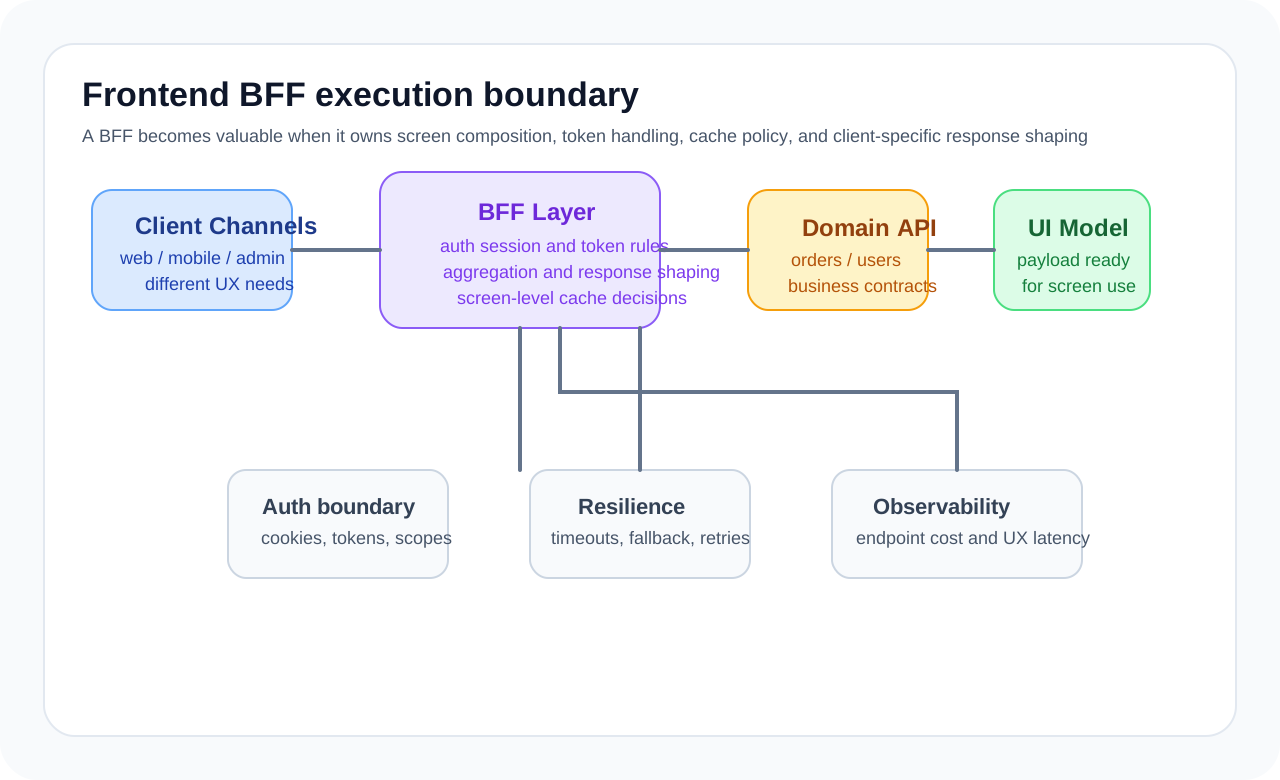
A BFF, or Backend for Frontend, is a pattern that adds a middle layer so the frontend can receive data in a shape that matches its real needs. Many teams think of it as just “one more API server for the frontend,” but in practice a BFF is an architectural decision that redefines screen-oriented data composition, authentication boundaries, network optimization, and team ownership.
As frontend applications get more complex, it becomes more common for backend APIs and screen requirements not to line up cleanly. A single screen may need data from multiple endpoints, mobile and web may need different response shapes, or token handling and cache policy may differ per interface. That is where a BFF becomes valuable.
Architecture diagram
[Web / Mobile / Admin]
          |
          v
       [BFF Layer]
   auth / aggregation / mapping
          |
   +------+------------------+
   |                         |
   v                         v
[Domain API 1]          [Domain API 2]
   |                         |
   +-----------+-------------+
               v
        [External / Legacy API]
In this structure, the BFF is not just a proxy. It translates screen-level requirements into calls to domain APIs. The client receives responses shaped for UI usage, while auth handling, headers, response composition, and error mapping are controlled on the server side. The real value of a BFF is not “adding one more API,” but clarifying the responsibility boundary between frontend and backend.
Why a BFF becomes necessary
A BFF is often worth introducing in cases like these.
- one screen needs to compose multiple backend services
- auth and authorization logic is too complex to expose directly to clients
- web, mobile, and admin clients all need different response formats
- external API calls should not be exposed directly from the browser
- the client is making too many network requests
A BFF is not needed because the backend is bad. It is needed because frontend requirements and domain APIs have different responsibilities.
Core responsibilities of a BFF
A good BFF does not absorb all business logic. It should usually stay focused on responsibilities like these.
- screen-level data aggregation
- auth token or session handling
- external API encapsulation
- response normalization
- cache and error mapping
- providing frontend-friendly contracts
If it starts owning core domain rules or data persistence, the frontend layer can easily grow into a second backend.
Separate screen models from domain models
One reason to introduce a BFF is to shape data around what the UI actually needs. The important point is not to expose raw domain models directly. The UI often wants data in units like cards, lists, detail panels, or dashboard sections.
That is why a BFF is often better when it does more than blindly proxy domain APIs. It should provide responses shaped for screen models. At the same time, if every screen gets a completely unique response shape, maintenance suffers, so it is better to define rules at a reusable view-model level.
Especially useful for auth and security boundaries
If the browser communicates directly with many services, token handling, cookie management, CORS, and sensitive-header exposure all become complicated. A BFF can bring those concerns back behind a server boundary and simplify the security model.
In production, the following matter in particular.
- exposing access tokens to the browser as little as possible
- keeping external API credentials server-only
- shaping responses on the server based on user permissions
- mapping errors safely instead of leaking raw upstream messages
Cache strategy affects both performance and cost
At first glance, adding a BFF seems like adding another network hop. When designed well, it can improve overall performance instead, because the server can combine data the client previously fetched in several requests and centralize cache behavior.
But cache design matters.
- user-specific responses must be separated from public responses
- teams need a policy for how long aggregated results can be cached
- partial response or fallback behavior should be decided in advance
- cache invalidation events need to be explicit
Team structure and ownership matter too
A BFF is both a technical pattern and an organizational pattern. Success depends heavily on who owns it. If the frontend team owns it directly, iteration on screen needs is often faster, but the team also needs stronger backend operational capability. If a platform team owns it, reliability may improve, but responsiveness to product change can slow down.
That makes these questions important before implementation even starts.
- Who owns the contract of this layer?
- Who handles deployment and incidents?
- Where is the responsibility boundary between domain services and the BFF?
- If there are multiple frontend channels, should each have its own BFF?
Common anti-patterns
- the BFF absorbs domain logic and becomes another giant backend
- screen-specific endpoints grow without control and fragment the API contract
- the BFF adds hops without adding cache or aggregation value
- auth and permission logic are duplicated in both the BFF and origin services
- ownership is unclear and both frontend and backend teams move slowly
Wrap-up
The core of the frontend BFF pattern is not adding one more API server. It is placing a clear translation layer between screen requirements and domain APIs. A well-designed BFF can improve frontend productivity and security at the same time while reducing network cost and UI complexity.
But if the responsibility boundary is designed poorly, it can quickly become another legacy server. The real success factor is whether the team can agree on exactly what this layer is responsible for.
What Gets Hard in Production
- A BFF helps the frontend move faster only if it reduces orchestration complexity instead of becoming a duplicate monolith.
- The real challenge is not proxying requests, but deciding what aggregation, policy, and formatting belong at the edge of the product.
- Without clear ownership, the BFF can become a place where domain logic drifts away from the actual service boundary.
Architecture Decisions That Matter
- Define the BFF around frontend use cases, not around backend team structure.
- Keep authentication handling, response shaping, and caching policy explicit and testable.
- Decide which logic is presentation orchestration and which logic must remain in core services.
Practical Example
A healthy BFF endpoint usually composes service calls around one screen or workflow:
GET /bff/dashboard
  -> fetch profile service
  -> fetch notifications service
  -> fetch recommendations service
  -> normalize partial failures for UI
Anti-Patterns to Avoid
- Rebuilding core business rules inside the BFF.
- Creating one BFF layer that serves unrelated clients with conflicting needs.
- Forwarding raw backend errors and payload shapes directly to the browser.
Operational Checklist
- Track endpoint latency, fan-out depth, and partial failure rate.
- Version response contracts as carefully as public APIs.
- Set timeout and fallback policy per downstream dependency.
- Audit whether the BFF still reduces frontend complexity in practice.
Final Judgment
The BFF pattern is valuable when it owns UI-oriented orchestration and leaves domain authority in core services. If it becomes a second backend, complexity usually doubles rather than drops.
Continue Reading
Related posts
Designing Partial Hydration Boundaries
Frontend performance improves when teams decide what really needs interaction first, not when they hydrate everything immediately.
🖥️ FrontendServer-Driven UI Trade-offs for Product Teams
Where server-driven UI helps, where it hurts, and how to avoid turning flexibility into a slower product platform.
⚙️ BackendA Practical Guide to CQRS and Event Sourcing
This guide explains CQRS and Event Sourcing in terms of domain boundaries, projections, consistency tradeoffs, snapshots, and operational complexity.
⚙️ BackendJob Status Patterns for Long-Running Bulk APIs
Treating long-running backend work as a synchronous API problem usually hurts both user experience and operational stability. Here is a practical job-status pattern.
Next Path