Progressive Delivery and Incremental Release Strategies
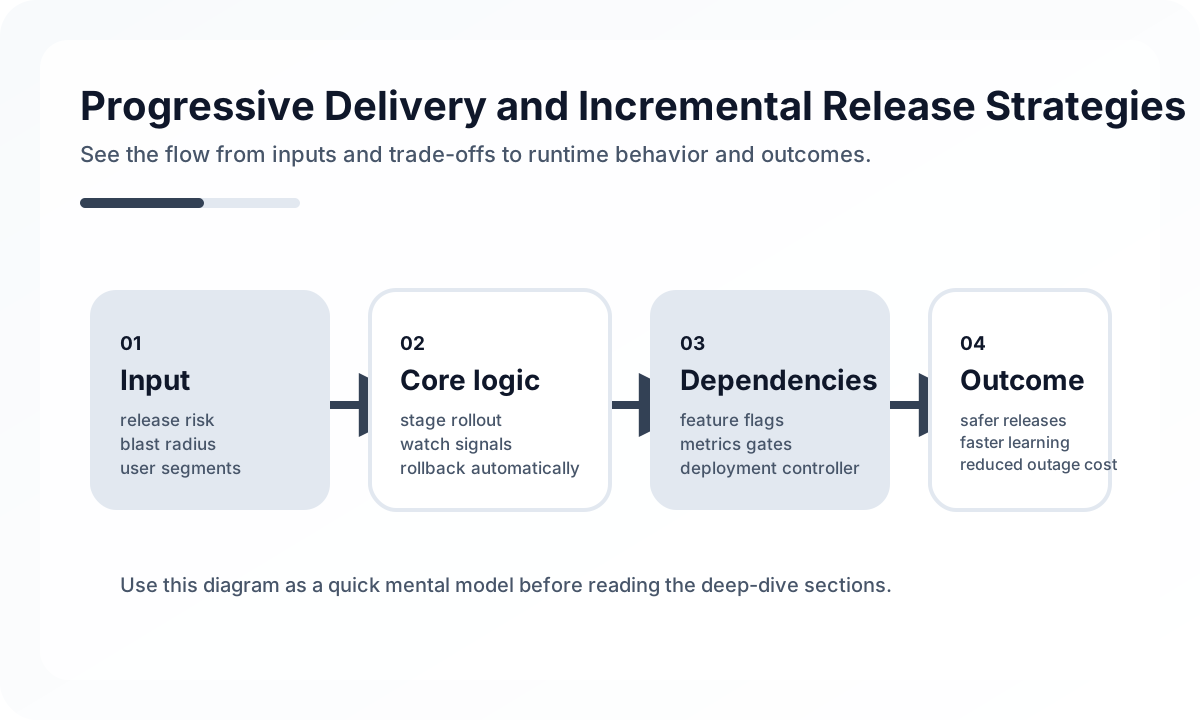
Progressive delivery is not just canary deployment. It is an operating model that combines code rollout, traffic control, feature exposure, observability signals, and rollback criteria into one loop so that release risk is absorbed step by step.
Why Incremental Release Matters
If you ship a change to all traffic at once, failure also arrives at full scale. Incremental release gives teams better answers to questions like:
- which user segment sees the impact first
- whether failure signals can be detected within minutes
- whether rollout stop and rollback can be automated
- whether a feature can be disabled without reverting all code
Release strategy is therefore not just a delivery technique. It is a way to design blast-radius control.
Blue-Green, Canary, and Feature Flags Serve Different Purposes
Treating these three ideas as interchangeable creates confusion.
- Blue-green makes environment switching explicit and speeds up rollback.
- Canary validates a new version with limited traffic before full rollout.
- Feature flags separate deployment from feature exposure.
Strong teams do not insist on only one method. A common pattern is to use blue-green at the environment level, canary for user traffic ramp-up, and flags for experimental or risky features.
The Real Core Is Stage Gates
The most important question is not “what percentage should we start with?” but “what criteria allow us to move to the next stage?”
Deploy -> Internal traffic -> 1% canary -> 10% canary -> 50% rollout -> 100%
             |                  |            |             |
             v                  v            v             v
         smoke checks       SLI check    business KPI   full release
Every stage needs explicit pass criteria:
- error rate stays below threshold
- p95 latency does not regress
- business metrics such as payment success or signup completion remain healthy
- no region, device type, or tenant shows isolated breakage
Without these rules, canary rollout becomes little more than a comforting ritual.
Feature Flags Are Operational Safety Mechanisms
Feature flags are often treated as UI toggles for experiments, but in production they are much more important:
- expose a new algorithm only to a small cohort
- enable a risky third-party integration for a subset of traffic
- turn off noncritical features during performance incidents
- disable the faulty behavior without rolling back the entire deployment
Flags also become technical debt quickly. A flag without an expiration date, owner, or cleanup plan increases delivery complexity. Each flag should have a reason to exist, an expected removal point, and a clear owner.
Progressive Delivery Must Be Bound to Observability
Many rollout failures come not from the deployment mechanism itself but from weak decision data. Right after deployment, teams should compare at least four kinds of signals:
- service metrics such as error rate, latency, and throughput
- business metrics such as conversion, completion, or cancellation rate
- infrastructure metrics such as CPU, memory, and autoscaling behavior
- dependency health for databases, caches, and external APIs
Comparison matters more than absolute numbers. Overall service averages can look fine while the canary version is clearly failing. That is why metrics need labels for release version, region, and flag state.
Common Anti-Patterns
Teams often run into the same problems:
- canary rollout exists, but the stop criteria are manual and vague
- too many flags exist, and nobody understands the real combination space
- blue-green switching is easy, but data migrations are not rollback-safe
- release approvals are slow while accountability remains unclear
Schema changes are especially risky. If old and new versions need to coexist, the database transition must be designed to support a compatibility window instead of assuming an immediate hard switch.
Practical Checklist
If the following items are missing, progressive delivery usually remains superficial:
- Can the deployed version be identified per unit of traffic?
- Can the canary cohort or traffic slice be controlled deliberately?
- Can rollout stop or rollback happen automatically at threshold breach?
- Are flag states visible in logs and metrics?
- Is flag cleanup included in release planning?
Closing
Progressive delivery is not just a cautious attitude toward releases. It is a disciplined production design that makes frequent releases survivable. Strong teams connect deployment mechanics, feature control, observability, and automated guardrails into one system. In the end, release strategy is less about speed alone and more about recoverability.
Continue Reading
Related posts
Kubernetes Advanced Operations — HPA, Resource Management, and Pod Scheduling
This article explains Kubernetes operations not as a collection of settings but from the perspective of resource placement and resilience. It covers when and how to use requests/limits, HPA, affinity, taints, PDBs, and probes in real environments.
🚀 DevOpsControlling Preview Environment Costs
Preview environments accelerate feedback, but without lifecycle rules they can quickly become an expensive form of shadow production.
📱 MobileA Mobile Feature Flag Expiry Playbook
Feature flags accelerate releases, but if they are never retired they quickly increase code and operational complexity.
🧪 TestConnecting Synthetic Monitoring and Canary Testing
Testing should not end at pre-release CI. This post explains how to connect synthetic monitoring with canary rollout validation.
Next Path