Platform Observability as an Incident Response System
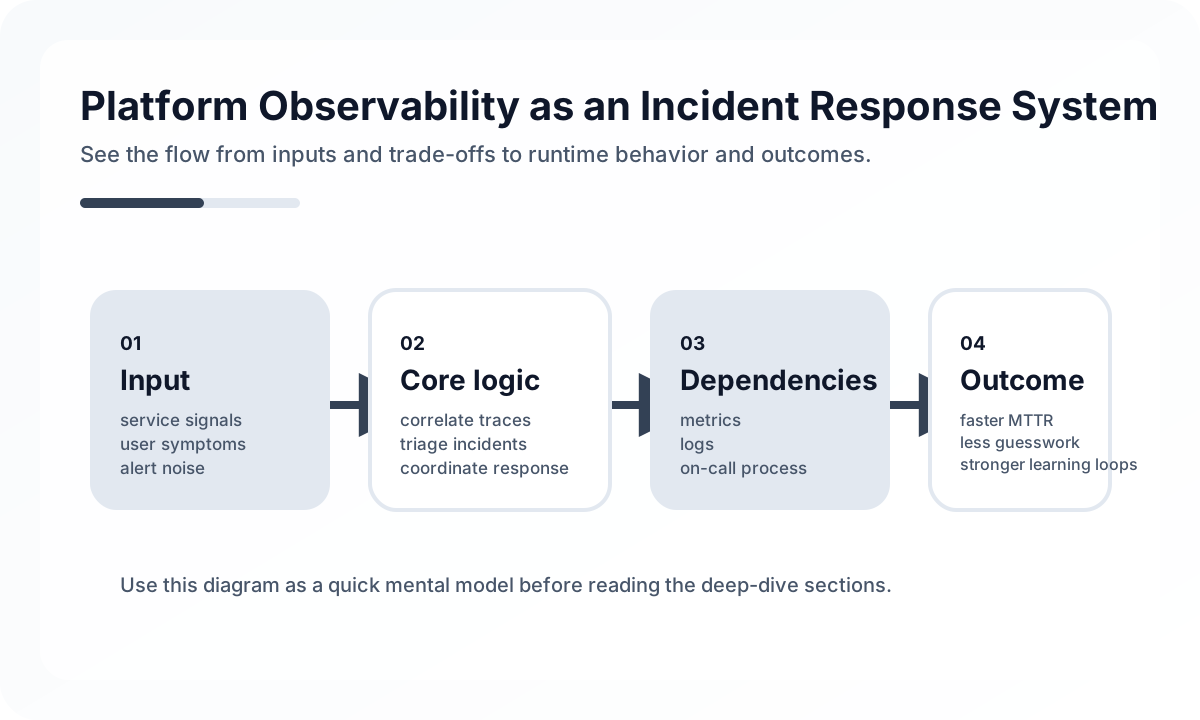
Good observability is not about drawing more graphs. It is about deciding who gets alerted, what evidence they see first, how metrics connect to logs and traces, when to wake people up, when to automate mitigation, and how postmortems feed back into the system.
Redefine the Goal
Observability in production should serve concrete outcomes:
- detect abnormal behavior quickly
- assess blast radius quickly
- reduce the hypothesis space quickly
- execute recovery actions quickly
- feed the learning back into design and operations
That means observability is not an aesthetic dashboard exercise. It is part of your recovery-time and alert-fatigue strategy.
Metrics, Logs, and Traces Must Be Designed Together
[Metrics] -> what is wrong?
   |
   v
[Logs]    -> what happened?
   |
   v
[Traces]  -> where did it happen?
These signals are complements, not substitutes.
- Metrics are strong at anomaly detection and trend awareness.
- Logs provide event-level context.
- Traces expose request paths and dependency bottlenecks.
The failure mode is building them independently. Alerts fire from metrics, but logs have no trace ID, traces lack business keys, and operators lose time manually joining evidence.
Alert Quality Matters More Than Alert Volume
Low-quality alerts wear teams down faster than outages do. A good alert should:
- map to user impact
- point to an actionable owner
- avoid firing on harmless spikes
- narrow the likely cause space
Bad alerts:
- CPU above 80%
- one error log line appeared
- pod restarted once
Better alerts:
- checkout API error rate above 3% for 5 minutes with meaningful traffic volume
- p95 latency for the checkout path doubled
- login success rate dropped sharply in one region
The closer the alert is to user impact, the more useful it becomes.
SLOs Should Drive Operations, Not Just Reporting
An SLO that lives only in documentation is mostly ceremonial. It should define:
- what service quality means
- how much failure is acceptable
- what the team does when the budget is being burned too quickly
If your order-creation API has a 99.9% availability objective, that should shape alerts, release decisions, and incident thresholds. Error budgets are valuable only when they influence tradeoffs, not when they sit in slides.
Dashboards Must Support Response, Not Presentation
A common dashboard problem is that it contains plenty of information but answers none of the urgent questions. During an incident, an operator should be able to read the dashboard in this order:
- Is there real user impact right now?
- Which service, region, and endpoint are affected?
- When did the issue begin?
- Is the dominant symptom saturation, error, or latency?
- Was there a recent deployment or config change?
Good incident dashboards do not need to be numerous. They need to keep the critical flow on one screen:
- traffic
- error rate
- latency distribution
- dependency health
- deployment timeline
Runbooks Need to Be Executable Paths
If the response starts with “where is that wiki page?” the runbook has already failed. A useful runbook should state:
- what user impact this alert implies
- the most common likely causes
- which metrics and logs to inspect in the first five minutes
- what immediate mitigation steps are available
- when and how to escalate
Alert: checkout-error-rate-high
1. Verify user impact on checkout success dashboard
2. Check deployment timeline in last 30 minutes
3. Correlate trace latency on payment dependency
4. If payment timeout dominant, enable fallback or rate limiting
5. If DB saturation dominant, scale read replicas or shed noncritical traffic
Long runbooks do not help during active incidents. Short, concrete runbooks do.
Correlation Is What Reduces Guesswork
Metrics, logs, traces, deployment events, and business identifiers should reinforce each other.
- Put
trace_id,span_id,tenant_id, andorder_idinto structured logs when relevant. - Add HTTP route, dependency name, and DB statement class to traces.
- Render deployment and config-change events inside the operational dashboard.
- Make high-error alerts link directly to top exception classes and release versions.
Without correlation, response quality depends too much on institutional memory and a few senior operators.
Postmortems Must Change the System
If postmortems end as documents without engineering follow-through, the feedback loop is broken. Good postmortem questions include:
- What was detected first, and what remained invisible?
- Why was the alert too late or too noisy?
- Which runbook step was missing or unclear?
- Which metric, tag, or trace field would have shortened diagnosis?
- Which code, infrastructure, or documentation changes reduce recurrence?
The output should be concrete changes, not just a narrative.
Operational Checklist
- Is every critical user flow backed by explicit SLI/SLO definitions?
- Are alerts tied to user impact rather than mostly raw infrastructure symptoms?
- Does every important alert map to an owning team and runbook?
- Do logs and traces share correlation keys?
- Do dashboards show deployment or config-change events alongside health signals?
- Does the team review alert fatigue regularly?
- Do postmortem actions turn into tracked work with priority?
Wrap-Up
Observability is not a pile of collection tools. It is an operational system for detecting, narrowing, recovering, and learning from incidents. If metrics, logs, traces, alerts, runbooks, SLOs, and postmortems are disconnected, response stays slow even with expensive tooling. When those elements are connected into one response path, the same tools become dramatically more effective.
What Gets Hard in Production
- Observability only helps incident response when telemetry is tied to service ownership and user-impact questions.
- Teams drown in dashboards when metrics, logs, and traces exist without operational decision paths.
- Good response depends as much on runbooks, severity rules, and communication flow as on tooling.
Architecture Decisions That Matter
- Define critical user journeys and service-level indicators before expanding dashboards.
- Keep alerting focused on actionable symptoms and error budgets, not raw metric abundance.
- Connect observability signals to incident roles, escalation paths, and postmortem feedback.
Practical Example
An effective incident flow starts from user impact and narrows quickly:
symptom -> affected journey -> owning service -> recent change -> mitigation option -> communication updateAnti-Patterns to Avoid
- Alerting on every technical metric with no response owner.
- Collecting traces and logs that nobody uses in incidents.
- Treating postmortems as blame documents instead of system-learning tools.
Operational Checklist
- Review alert fatigue and acknowledgment time.
- Run drills for paging, mitigation, and rollback.
- Audit dashboard usefulness after real incidents.
- Track recurring causes and fix classes, not only incident count.
Final Judgment
Platform observability is successful when it reduces time to understanding and time to mitigation. More telemetry alone does not achieve that.
Continue Reading
Related posts
Runbook Quality for On-Call Teams
What makes an operational runbook actually usable during incidents instead of just technically complete.
🚀 DevOpsKubernetes Advanced Operations — HPA, Resource Management, and Pod Scheduling
This article explains Kubernetes operations not as a collection of settings but from the perspective of resource placement and resilience. It covers when and how to use requests/limits, HPA, affinity, taints, PDBs, and probes in real environments.
📚 IT StoriesHow Containers and Kubernetes Changed the Feeling of Deployment
Deployment once felt like a tense event. Containers and Kubernetes helped turn it into something more repeatable, automated, and systematized.
🔧 ToolsDocker Desktop Practical Guide for Managing Development Environments
A practical guide to using Docker Desktop as a local development standard through Compose, volume strategy, resource tuning, Dev Containers, and onboarding design.
Next Path