Kubernetes Fundamentals Design Guide
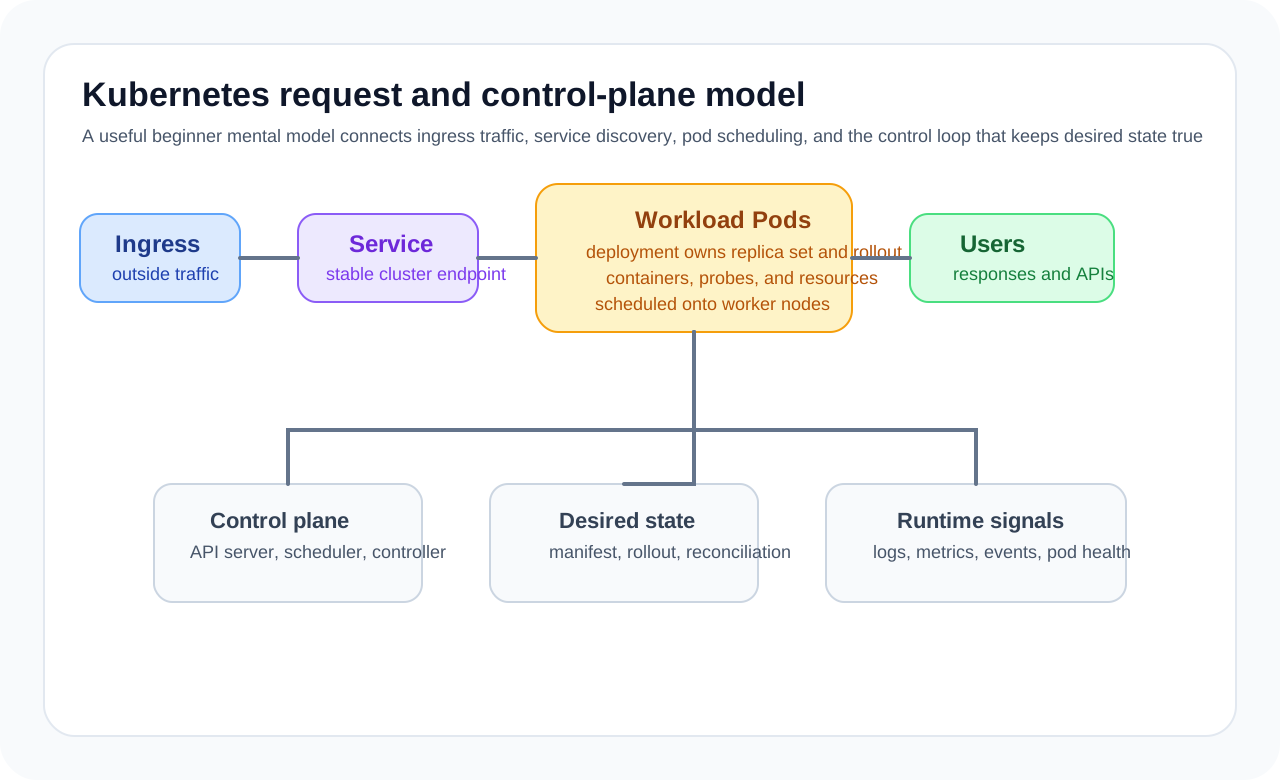
A Pod is an execution unit, but not an operations unit
A Pod is the smallest unit in which containers actually run. But in practice, most teams manage workloads through higher-level resources such as Deployments rather than operating Pods directly. Since Pods can die and be recreated, designs that depend on fixed IPs or local state are risky.
A Deployment maintains the desired state
The core of a Deployment is that it keeps moving the current state toward the declared desired state. Version rollouts, rollbacks, and replica count changes all operate on top of that model.
A Service hides network instability
Pods change constantly, but a Service gives you a stable access point. That is why applications communicate through Service names instead of targeting Pod IPs directly.
ConfigMaps and Secrets create configuration boundaries
If you separate environment-specific values from the application image and manage them as external configuration, it becomes much easier to deploy the same image across multiple environments. But remember that a Secret is only base64-encoded by default, not encrypted by itself.
The operational questions matter more than the YAML
Using Kubernetes is not just swapping out a deployment script. It raises operating questions such as how to define readiness probes, how to set resource requests and limits, whether restart alone is enough during failure, and where logs and metrics will be observed.
Common mistakes
Teams often treat Pods like VMs, depending on SSH access and local file state. It is also common to deploy without requests and limits, or to treat liveness and readiness as the same thing and make outages worse.
Closing thoughts
The point of Kubernetes fundamentals is not memorizing resource types, but understanding the declarative operating model. Once you understand what problems Pods, Deployments, Services, and ConfigMaps are each solving, even a complex cluster becomes much easier to read.
What Gets Hard in Production
- Kubernetes basics matter because the platform is easy to misuse if pods, services, and deployments are treated as simple YAML objects without runtime understanding.
- Most beginner pain comes from missing mental models for scheduling, networking, and health management.
- The control plane automates operations, but it does not remove the need for application discipline.
Architecture Decisions That Matter
- Treat pods as ephemeral execution units, not durable servers.
- Define resource requests, probes, and rollout behavior intentionally from the start.
- Separate cluster concerns from application concerns so YAML remains readable.
Practical Example
A minimal production-minded deployment declares health and resource expectations explicitly:
resources:
  requests:
    cpu: 100m
    memory: 256Mi
livenessProbe:
readinessProbe:
Anti-Patterns to Avoid
- Shipping containers with no readiness or liveness strategy.
- Running stateful assumptions inside stateless deployments.
- Copying manifests without understanding the scheduling consequences.
Operational Checklist
- Review requests and limits against real usage.
- Test rollout and rollback paths.
- Observe pod restart patterns and probe failures.
- Keep manifests versioned and environment-aware.
Final Judgment
Kubernetes basics are about runtime behavior, not just object names. Teams that learn the execution model early avoid a large class of avoidable outages.
Continue Reading
Related posts
Kubernetes Advanced Operations — HPA, Resource Management, and Pod Scheduling
This article explains Kubernetes operations not as a collection of settings but from the perspective of resource placement and resilience. It covers when and how to use requests/limits, HPA, affinity, taints, PDBs, and probes in real environments.
🚀 DevOpsDocker from Fundamentals to Production Practice
This article looks at Docker from a practical engineering perspective, beyond basic container concepts, covering image design, layer caching, volumes, networking, and operational pitfalls.
📚 IT StoriesHow Containers and Kubernetes Changed the Feeling of Deployment
Deployment once felt like a tense event. Containers and Kubernetes helped turn it into something more repeatable, automated, and systematized.
📈 TrendsKubernetes v1.34: What Platform Teams Should Actually Watch
A practical reading of Kubernetes v1.34 for platform teams, focusing on the changes that most affect operations, workload design, and cluster governance.
Next Path