Docker Compose Development Environment Design Guide
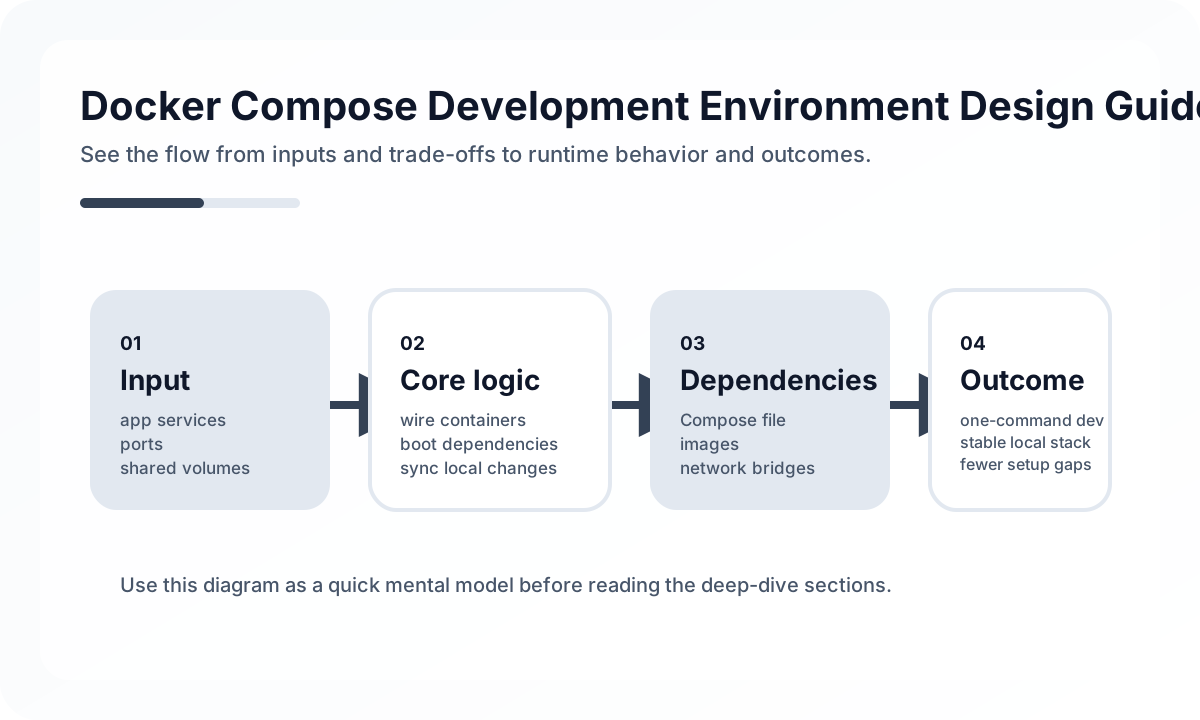
Compose standardizes the development experience
A good Compose file is not about starting as many services as possible. Its purpose is to make the minimum system required for development easy to reproduce.
services:
  app:
    build: .
    ports:
      - "8080:8080"
    depends_on:
      - db
      - redis

  db:
    image: mysql:8
    environment:
      MYSQL_ROOT_PASSWORD: secret
The misconception that it must exactly match production
A local Compose environment does not need to be 100% identical to production. What matters is whether developers can easily run and validate the key dependencies. That said, it is still better not to drift too far from production in ports, environment variables, service names, and the baseline network structure.
Volume and data initialization strategy matters
When you run the database and cache in containers, you often run into disappearing data. In local development, it is usually better to keep baseline data through named volumes while also having a simple way to reset it when needed.
depends_on does not mean the service is ready
Just because a service is running at the container level does not mean it is actually ready. Database connectivity, migration completion, and broker readiness should be reinforced through health checks or application-side retry logic.
Common mistakes
Teams often overload one Compose file with too many tools, or let debug settings that do not exist in production harden into the local default. Another common mistake is putting sensitive environment values directly into example files.
Closing thoughts
It is more practical to think of Docker Compose as a development environment standardization tool than a container orchestration tool. If you define service boundaries, data persistence, readiness, and environment variable rules clearly, Compose becomes a steady foundation for team productivity.
What Gets Hard in Production
- Compose is most useful for local development orchestration, but it becomes brittle if it tries to imitate production too literally.
- The value is reproducible developer workflows, not perfect infrastructure realism.
- Dependency startup order, volumes, and environment drift are the common failure points.
Architecture Decisions That Matter
- Use Compose to standardize local dependencies and shared commands.
- Keep service definitions small and aligned with the real developer workflow.
- Be explicit about what is mocked, what is persisted, and what can be safely reset.
Practical Example
A good local stack exposes only the dependencies the app truly needs for productive work:
services:
  app:
  db:
  redis:
  mock-mail:
Anti-Patterns to Avoid
- Packing every optional infrastructure service into the default developer stack.
- Hiding startup races behind repeated manual restarts.
- Letting local env values drift far from CI and deployment expectations.
Operational Checklist
- Document standard startup and reset commands.
- Test first-run onboarding on a clean machine.
- Review volume usage and data reset policy.
- Keep Compose files consistent with the app contract as dependencies evolve.
Final Judgment
Docker Compose is valuable when it reduces local setup friction and ambiguity. It loses value when the stack is too heavy to trust or too different from the app it is supposed to support.
Continue Reading
Related posts
Docker from Fundamentals to Production Practice
This article looks at Docker from a practical engineering perspective, beyond basic container concepts, covering image design, layer caching, volumes, networking, and operational pitfalls.
🚀 DevOpsKubernetes Advanced Operations — HPA, Resource Management, and Pod Scheduling
This article explains Kubernetes operations not as a collection of settings but from the perspective of resource placement and resilience. It covers when and how to use requests/limits, HPA, affinity, taints, PDBs, and probes in real environments.
🔧 ToolsDocker Desktop Practical Guide for Managing Development Environments
A practical guide to using Docker Desktop as a local development standard through Compose, volume strategy, resource tuning, Dev Containers, and onboarding design.
📚 IT StoriesHow Containers and Kubernetes Changed the Feeling of Deployment
Deployment once felt like a tense event. Containers and Kubernetes helped turn it into something more repeatable, automated, and systematized.
Next Path