A Practical Guide to PostgreSQL
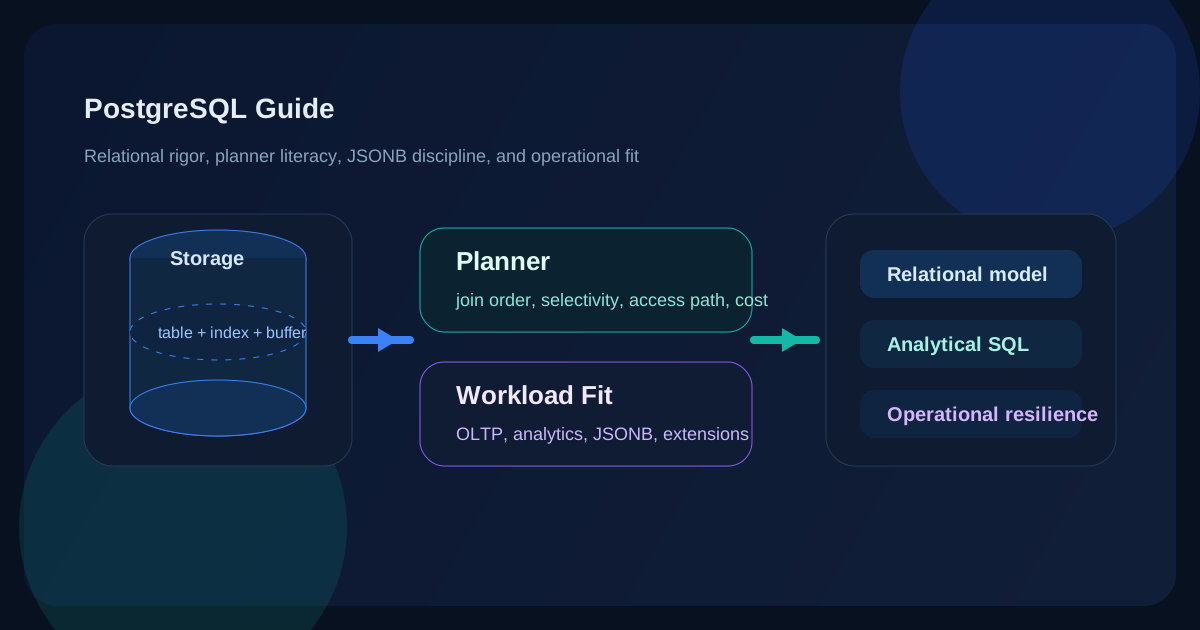
That combination is powerful, and it is also exactly why casual use gets expensive. PostgreSQL rewards strong modeling and planner literacy. It does not reward indiscriminate use of every advanced capability it offers.
The Real Strength of PostgreSQL
PostgreSQL becomes especially valuable when a system needs all of the following at once:
- relational integrity
- complex read models
- analytical SQL features
- selective semi-structured data handling
- an extension ecosystem that can grow with the workload
That is why it often fits product backends better over time than teams initially expect. The database can evolve from straightforward OLTP into more expressive read behavior without forcing an early platform split.
PostgreSQL Is Not Just a Row Store
The planner, indexing model, extension support, and SQL expressiveness together make PostgreSQL much more than a place to store rows and run CRUD queries.
[Application Query]
      |
      +--> relational query
      +--> jsonb access
      +--> analytical window query
      |
      v
[PostgreSQL Planner]
      |
      v
[table / index / buffer / sort / aggregate]
      |
      v
[result]
That architectural flexibility is one of PostgreSQL’s biggest strengths. It is also why design discipline matters early.
JSONB Is Powerful, but It Is Not a License to Avoid Modeling
JSONB is one of PostgreSQL’s most attractive features because it gives teams room for flexible substructures without leaving the database.
It works well when:
- part of the data model is genuinely variable
- the variable structure is not the center of relational joins
- the team understands how indexing and query patterns will work
It works poorly when:
- core business fields are hidden inside JSONB
- constraints should exist but do not
- join-heavy or filter-heavy access paths depend on document-like blobs
In other words, JSONB is best treated as a selective flexibility tool, not as an excuse to stop thinking about schema.
Window Functions Replace a Lot of Wasteful Application Logic
One of PostgreSQL’s biggest practical advantages is how naturally it handles ranking, previous-row comparison, running totals, top-N per group, and other analytical read patterns.
When teams fail to use window functions, they often:
- move too much post-processing into application code
- read more rows than necessary
- introduce pagination and ranking bugs
Window functions are not just “advanced SQL.” They are often the cleanest way to keep read-model logic close to the data.
Planner Literacy Is More Valuable Than Feature Literacy
Many teams learn PostgreSQL features faster than they learn how the planner behaves. In production, that is backwards.
The more important skill is understanding:
- when sequential scan is actually reasonable
- when index scan or bitmap scan is chosen
- whether estimated rows and actual rows diverge badly
- how sorts, hashes, and buffers affect cost
This is why EXPLAIN ANALYZE matters so much. PostgreSQL tuning is usually not about enabling a feature. It is about understanding why the planner made a costly choice.
Arrays, CTEs, and Extensions All Need Boundaries
PostgreSQL’s versatility can tempt teams into overusing every advanced feature.
Healthy use tends to look like this:
- arrays for compact, modest multi-value data
- CTEs for readable query decomposition where planning behavior is understood
- extensions where they genuinely remove platform split pressure
Unhealthy use usually looks like this:
- arrays where relational modeling should exist
- CTEs treated as always faster
- extensions adopted faster than operational knowledge
PostgreSQL’s strength is breadth. Its risk is breadth without rules.
Example: Stable Relational Core, Flexible Metadata Edge
orders
  id
  tenant_id
  status
  total_amount
  metadata jsonb
This pattern often works well because:
- high-value query fields remain relational
- variable product-specific detail can live in JSONB
- indexes can stay aligned with dominant read paths
The point is not that JSONB is present. The point is that the relational core still owns the most important invariants.
Operational Reality Matters
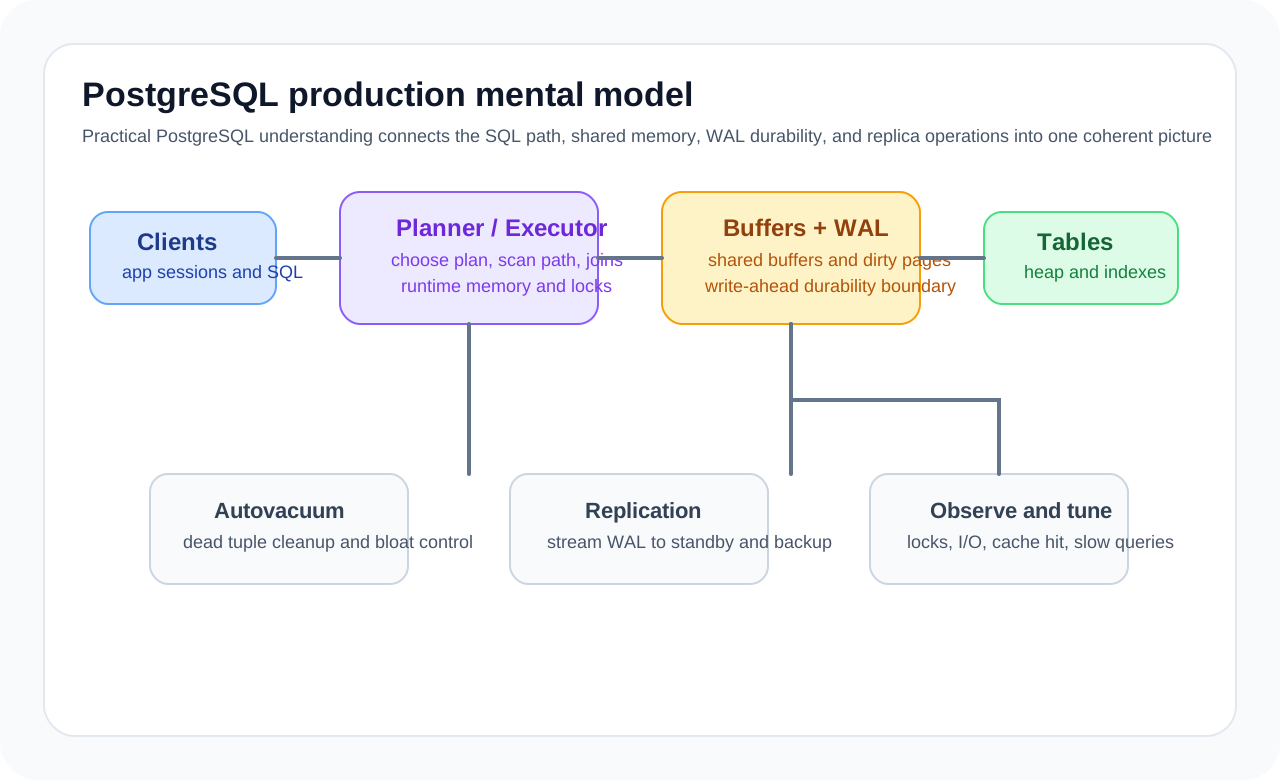
PostgreSQL design quality is not only about schema and SQL. Operations matter early:
- autovacuum behavior
- table and index bloat
- replication lag
- long-running transactions
- extension lifecycle and upgrade compatibility
A database can feel well designed at the schema level while still becoming unstable through neglected maintenance behavior.
Common Anti-Patterns
- using JSONB as a default schema strategy
- adding indexes without planner evidence
- treating CTEs as readability and performance wins simultaneously by default
- pushing analytical SQL into the application without checking whether PostgreSQL can do it better
- underestimating vacuum and storage maintenance
PostgreSQL usually punishes not ignorance of features, but casual complexity.
Review Checklist
- Are core invariants still modeled relationally?
- Is JSONB used where flexibility is real, not just convenient?
- Do important queries get reviewed with
EXPLAIN ANALYZE? - Are advanced SQL features reducing application complexity rather than showing off database power?
- Is operational maintenance treated as part of the database design?
Closing Judgment
PostgreSQL is strongest when teams use its expressiveness with restraint and operational discipline. Its real advantage is not feature abundance by itself, but the fact that many complex data problems can remain inside one coherent system without forcing premature fragmentation.
Continue Reading
Related posts
Database Learning Path: Beginner to Advanced
A structured database roadmap from indexing and query basics to replication, partitioning, and schema-safe operations.
🗄️ DatabaseA Practical Database Index Design Playbook
A production-oriented playbook for index design that covers read/write tradeoffs, composite indexes, covering indexes, cardinality, execution plans, anti-patterns, and an operational review workflow.
📈 TrendsPostgreSQL 18 Trends: What Actually Matters in Practice
PostgreSQL 18 is more than an upgrade headline. AIO, skip scan, better post-upgrade recovery, OAuth, and generated columns all point to a release focused on operational cost reduction.
🚀 DevOpsKubernetes Advanced Operations — HPA, Resource Management, and Pod Scheduling
This article explains Kubernetes operations not as a collection of settings but from the perspective of resource placement and resilience. It covers when and how to use requests/limits, HPA, affinity, taints, PDBs, and probes in real environments.
Next Path