A Guide to MongoDB Schema Design
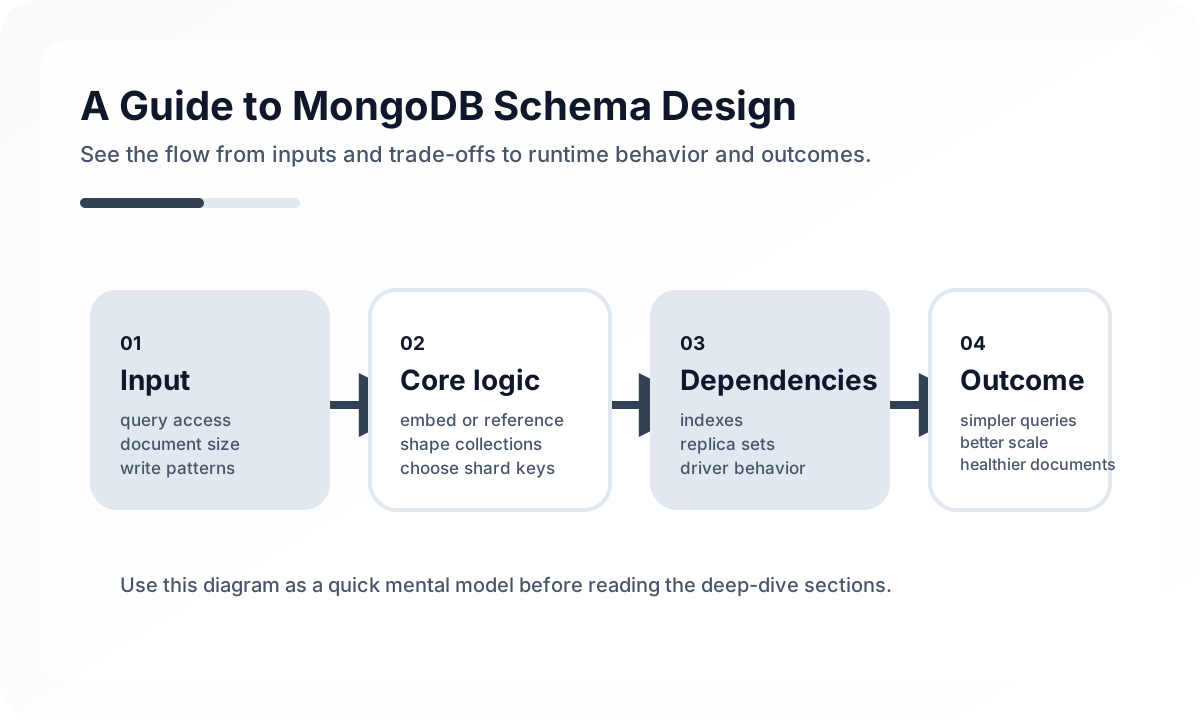
Structure at a Glance
[Access Pattern]
      |
      +--> read together? ---- yes --> [Embed]
      |
      +--> updated independently? -> yes --> [Reference]
      |
      v
[Index + aggregation design]
      |
      v
[document size / query cost / update cost]
The core of MongoDB schema design is not whether data is normalized, but where to draw document boundaries based on what gets read together and what changes together.
Embedding vs. Referencing Is Not Philosophy, but an Access-Pattern Problem
Embedding works well when related data is almost always read together, the number of child items is limited, and updating at the parent-document level is natural. Referencing is better when child data is large in volume, updated independently, and reused from multiple places.
Document Boundaries Are Also Transaction Boundaries
In MongoDB, changes within a single document can be treated as a very strong unit of work. That means document boundaries are not just a storage format choice. They also define your real consistency boundary.
Indexes Must Be Designed for Query Patterns, Not Collections
Indexes matter just as much in MongoDB, but the goal is not to index “frequently used fields.” You want indexes that match query predicates + sort order + range limits together.
Aggregation Pipelines Are Powerful, but Not a Substitute for a Read Model
Aggregation pipelines are powerful, but if you push every complex read into them, operational cost rises quickly. You need to check whether you are repeatedly scanning entire large collections, whether too many $lookup stages are turning MongoDB into a join-heavy database, and whether a summary collection would be a better fit.
Transactions Are Possible, but Overuse Reduces MongoDB’s Strengths
MongoDB supports multi-document transactions, but the default model is much more natural when you take advantage of document-level atomicity. If multi-document transactions become frequent, that can be a signal that your schema boundaries are wrong.
When MongoDB Is an Especially Good Fit
- When access patterns are clearly document-centric
- When some field structures need to evolve flexibly
- When fast feature development and efficient document-level reads matter
- When relationships are relatively loose, such as events, logs, catalogs, or user settings
Common Production Anti-Patterns
- Trying to solve every relationship with embedding
- Or, conversely, using only references as if it were an RDB
- Defining collection structure before understanding access patterns
- Calculating all operational statistics in real time through aggregation pipelines
- Leaving the schema unchanged even as multi-document transactions increase
Wrap-Up
The essence of MongoDB schema design is not flexibility by itself, but setting document boundaries to match access patterns and consistency boundaries. Embedding and referencing are not about finding a single correct answer. They are design choices about where to place data that is read together and data that changes together.
What Gets Hard in Production
- MongoDB schema design is mostly about choosing where to pay for flexibility: read simplicity, write amplification, or cross-document consistency.
- Embedding can be elegant until documents grow hot, large, or unevenly updated.
- The wrong schema often looks fine early because the workload has not diversified yet.
Architecture Decisions That Matter
- Start from dominant query patterns and document ownership, not from abstract relational instincts.
- Embed when data is read together and changes together; reference when growth, reuse, or update frequency diverge.
- Design indexes and document size expectations together.
Practical Example
A common split is to embed small immutable detail but reference fast-changing or shared relationships:
order {
  orderId,
  shippingAddress, // embedded
  lineItems,       // embedded if bounded
  customerId       // referenced
}
Anti-Patterns to Avoid
- Embedding unbounded arrays that grow with product usage.
- Recreating relational joins manually across too many collections.
- Ignoring document growth and migration strategy.
Operational Checklist
- Review document size and hottest update paths.
- Validate index fit for dominant read patterns.
- Plan migration steps for schema evolution.
- Test consistency strategy where multiple documents must change together.
Final Judgment
MongoDB schema design works when the model follows access patterns honestly. Treating it like either a magic JSON store or a hidden RDBMS usually ends badly.
Continue Reading
Related posts
A Complete Guide to Redis Data Structures — String, Hash, List, Set, ZSet
This post summarizes Redis's five core data structures and practical use cases. It covers how to build sessions, rankings, real-time feeds, and distributed locks with Redis.
🗄️ DatabaseA Practical Guide to Elasticsearch
This post explains Elasticsearch from a practical engineering perspective: search design, mappings, analyzers, aggregations, and operational cost, rather than just installation and query examples.
📈 TrendsPostgreSQL 18 Trends: What Actually Matters in Practice
PostgreSQL 18 is more than an upgrade headline. AIO, skip scan, better post-upgrade recovery, OAuth, and generated columns all point to a release focused on operational cost reduction.
🚀 DevOpsKubernetes Advanced Operations — HPA, Resource Management, and Pod Scheduling
This article explains Kubernetes operations not as a collection of settings but from the perspective of resource placement and resilience. It covers when and how to use requests/limits, HPA, affinity, taints, PDBs, and probes in real environments.
Next Path