A Guide to Designing Real-Time Communication with WebSocket
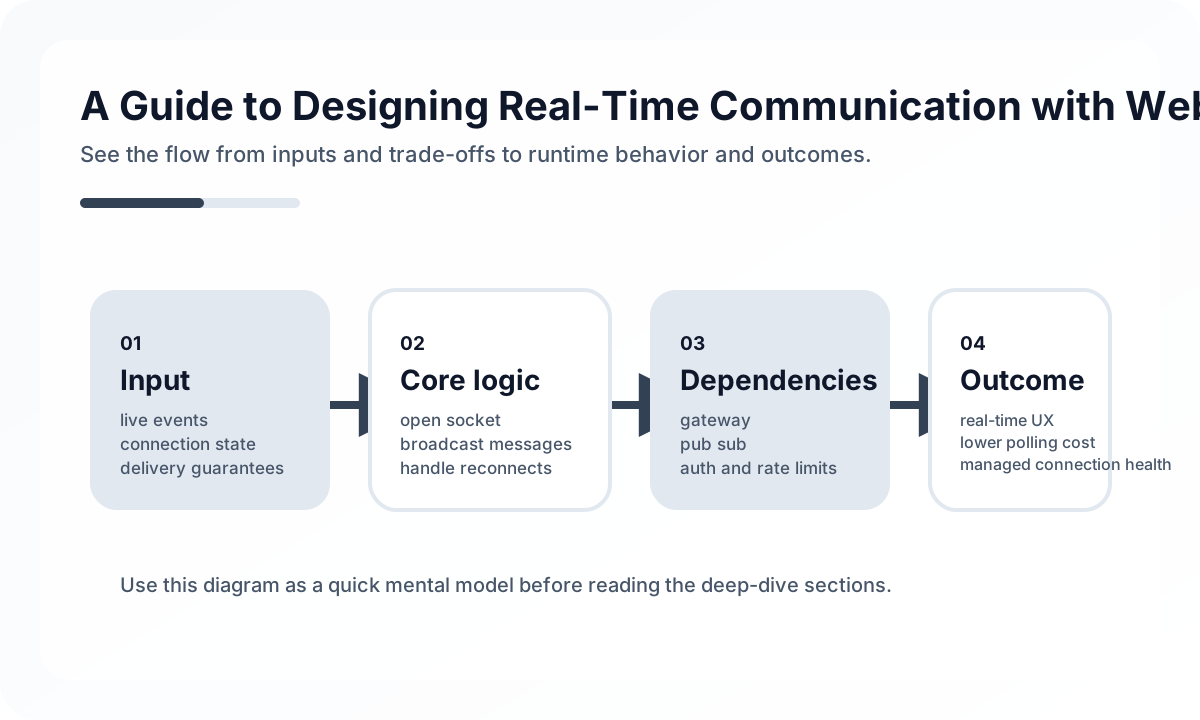
Good WebSocket architecture is defined by what happens when connections drop, reconnect, duplicate subscriptions appear, and the service scales across multiple instances.
Choose WebSocket only when continuous state push matters
WebSocket is strongest when the client benefits from low-latency server push and ongoing subscription semantics.
Good fits include:
- chat and collaborative editing
- live dashboards and monitoring
- notifications that must arrive quickly
- status streams that change frequently
It is a weaker fit when polling, SSE, or normal HTTP updates already satisfy the UX without persistent connection complexity.
Separate commands from events
One of the most useful design decisions is separating client-originated intent from server-originated state change.
In many systems this becomes:
- client sends commands to an application destination
- server publishes events to subscriptions
This separation makes permissions, validation, and audit trails much clearer than a generic “send message anywhere” model.
Model connection lifecycle explicitly
A real-time system should define what happens at:
- initial connect
- authentication
- heartbeat checks
- disconnect
- reconnect
- subscription restore
If reconnect behavior is not part of the design, clients tend to drift into inconsistent state after ordinary network interruptions.
Authentication is only the first layer
Authenticating the socket connection is important, but it is not sufficient.
Teams also need message-level authorization:
- can this user subscribe to this channel?
- can this user send this command?
- can this user view this private stream?
A connected socket should not be treated as globally trusted. Real-time systems often leak data when authorization is only checked during handshake.
Delivery guarantees must be chosen deliberately
Different products tolerate different levels of loss and reordering.
Teams should decide:
- is at-most-once acceptable?
- should messages be replayed after reconnect?
- does ordering matter per user, room, or stream?
- what acknowledgment or recovery mechanism is required?
Without explicit answers, “real time” often becomes a vague promise that breaks under actual reconnect and scale scenarios.
Reconnect and resubscribe behavior matters as much as initial delivery
Many systems work perfectly in a stable local network and fail in the real world where mobile clients sleep, browser tabs resume, and Wi-Fi drops.
A practical strategy usually defines:
- client-side reconnect backoff
- resubscription rules after reconnect
- replay windows for missed messages
- stale session cleanup
This is what keeps a real-time UX coherent under normal network instability.
Scale-out changes the architecture
A single instance can broadcast locally, but multiple instances require coordination.
Common scale-out questions include:
- how are messages routed across instances?
- is a broker used for fan-out?
- how is user-session presence tracked?
- what happens when one node dies with active connections?
Ignoring this early often leads to systems that work in development and fragment in production.
Watch the right operational signals
A healthy WebSocket system tracks more than successful connection count.
Watch:
- active connection count per node
- reconnect frequency
- subscription count and fan-out volume
- message latency
- dropped connection rate
- broker or relay lag in multi-node setups
These signals show whether the system is stable under churn, not just whether sockets can be opened.
Common mistakes
Watch for these patterns:
- treating WebSocket as a drop-in replacement for every API call
- skipping message-level authorization
- ignoring reconnect and replay design
- broadcasting too broadly instead of using scoped channels
- assuming single-node semantics will survive multi-node deployment
Most WebSocket failures are lifecycle and scaling failures, not transport failures.
Wrap-up
Good WebSocket design is not just “the socket connects.” It is a system where message flow stays predictable when networks fail, users reconnect, subscriptions recover, and servers scale horizontally.
That is what makes real-time communication reliable instead of merely live.
Continue Reading
Related posts
Designing a Spring Boot REST API That Holds Up in Production
A production-focused guide to Spring Boot REST APIs. Learn how to keep controllers thin, contracts stable, transactions honest, and operational behavior predictable as the system grows.
⚙️ BackendA Practical Guide to Spring Boot and Redis Caching Strategies
This guide goes beyond @Cacheable and focuses on TTL design, invalidation, hot keys, consistency tradeoffs, and the metrics needed to run Redis caching well in production.
💬 LanguagePython Service Layer Pattern in Practice
How to keep Python applications maintainable by separating transport, domain rules, and persistence responsibilities.
🧪 TestSpring Boot Test Slices: @WebMvcTest and @DataJpaTest
A practical guide to Spring Boot test slices from the perspective of test-pyramid design and execution cost. Covers when to use @WebMvcTest, @DataJpaTest, @JsonTest, @RestClientTest, and when @SpringBootTest is the better choice.
Next Path