A Guide to Spring Security and JWT Authentication Design
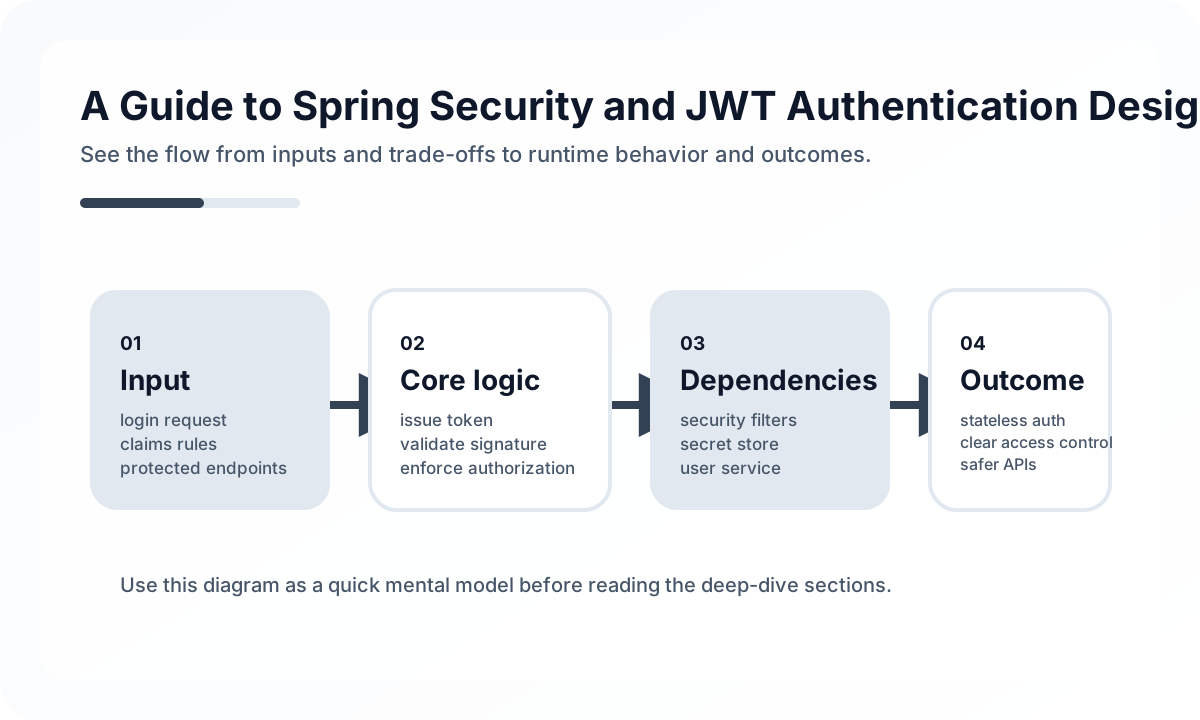
That is why a production JWT design is defined less by token format and more by policy.
Separate authentication from authorization
A common mistake is treating successful token parsing as if it solved the entire security design.
Authentication answers:
- who is this caller?
- is the presented credential valid?
Authorization answers:
- what may this caller do?
- what resources may they access?
- how do role, ownership, tenant boundary, and policy interact?
JWT can help transport authentication state, but it does not remove the need for a clear authorization model.
Keep access tokens short-lived
Access tokens should usually be treated as disposable proof for short request windows, not as semi-permanent sessions.
Short-lived access tokens reduce exposure when:
- tokens leak to logs or clients
- roles or permissions change
- suspicious usage is detected
The shorter the access token, the more important refresh-token policy becomes.
Refresh tokens deserve stricter policy than access tokens
Many systems secure access tokens carefully and treat refresh tokens casually. That is backwards.
Refresh-token policy should answer:
- where refresh tokens are stored
- whether rotation is required
- how reuse detection works
- how device/session binding works
- how forced logout invalidates them
A weak refresh strategy often turns JWT into a long-lived hidden session system without proper controls.
Filter-chain responsibilities should stay clean
In Spring Security, the filter chain becomes hard to maintain when one filter tries to parse tokens, load users, decide authorization, and format errors all at once.
A healthier design separates:
- login or credential exchange
- token extraction and validation
- authentication object creation
- authorization rules
- authentication and access-denied error handling
This keeps security behavior easier to debug and evolve.
Permission-change behavior must be explicit
JWT systems often fail not on login day, but on the day permissions change after login.
Teams should decide:
- do existing access tokens remain valid until expiry?
- are role changes reflected only after refresh?
- which events force refresh-token invalidation?
- how are disabled or compromised accounts handled immediately?
If these answers are vague, support and security incidents become much harder to manage.
Revocation strategy is a real design choice
Purely stateless JWT is attractive in theory, but many real systems still need some revocation control for:
- compromised accounts
- logout across devices
- admin-forced deactivation
- suspicious refresh-token reuse
That does not always require per-request server-side token lookup, but it does require a deliberate policy. “We use JWT so revocation is hard” is not a design.
Error responses should be consistent
Security failures are part of the public contract.
Clients need predictable distinction between:
- unauthenticated requests
- authenticated but unauthorized requests
- expired or malformed tokens
- blocked or disabled identities
If the filter chain and controller layer produce inconsistent error shapes, clients and operators both lose clarity.
Operational traps
Watch for these common mistakes:
- overly long access-token TTL
- refresh tokens treated like permanent sessions
- role changes not reflected clearly in policy
- mixing authentication parsing with business authorization checks
- lacking observability on token refresh, failure rate, and suspicious reuse
Most JWT problems are lifecycle problems, not signature problems.
Decision checklist
Before calling the setup production-ready, confirm:
- access-token TTL is intentionally short
- refresh-token storage and rotation policy are defined
- logout and forced revocation behavior are documented
- authorization rules are separate from token parsing
- security errors are consistent across the stack
Wrap-up
Good JWT design is defined less by token structure than by whether token lifecycle, permission change behavior, refresh policy, and revocation strategy are clear and enforceable.
That is what makes Spring Security plus JWT safe in production.
Continue Reading
Related posts
Designing a Spring Boot REST API That Holds Up in Production
A production-focused guide to Spring Boot REST APIs. Learn how to keep controllers thin, contracts stable, transactions honest, and operational behavior predictable as the system grows.
⚙️ BackendA Guide to Designing Real-Time Communication with WebSocket
This guide covers connection lifecycle, message modeling, authentication, delivery guarantees, and scale-out concerns when designing Spring Boot WebSocket systems.
💬 LanguagePython Service Layer Pattern in Practice
How to keep Python applications maintainable by separating transport, domain rules, and persistence responsibilities.
🧪 TestSpring Boot Test Slices: @WebMvcTest and @DataJpaTest
A practical guide to Spring Boot test slices from the perspective of test-pyramid design and execution cost. Covers when to use @WebMvcTest, @DataJpaTest, @JsonTest, @RestClientTest, and when @SpringBootTest is the better choice.
Next Path