A Guide to Spring Boot Testing Strategy
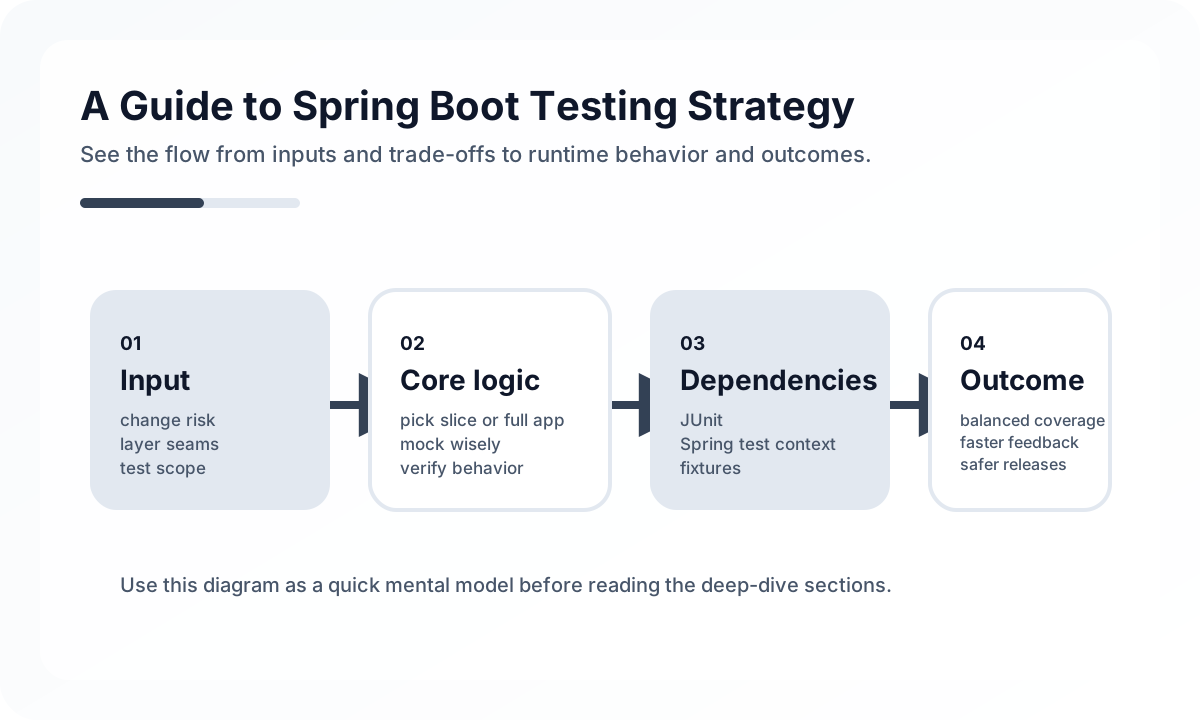
In Spring Boot, that usually means resisting the temptation to make every test look like @SpringBootTest.
Think in layers of risk
Different bugs should be caught at different layers:
- domain and service rule mistakes should fail quickly in unit tests
- HTTP contracts and serialization mistakes should fail in web slice tests
- query behavior and persistence mapping issues should fail in data slice tests
- a small number of high-value end-to-end flows should fail in integration tests
If every bug must wait for a full application context startup, the feedback loop becomes too slow and teams stop trusting tests during normal development.
Unit tests protect the core rules
Unit tests are strongest where business logic is dense and framework involvement is light.
Good unit test targets include:
- pure domain rules
- pricing and validation logic
- orchestration decisions in service classes
- mapping and transformation rules when they contain business meaning
Weak unit tests often overuse mocks to verify implementation details instead of observable behavior. When that happens, tests become brittle without increasing confidence.
Slice tests verify framework boundaries
Spring Boot provides test slices because many failures live at the framework boundary rather than in business logic.
Common examples:
@WebMvcTestfor request mapping, validation, JSON shape, and status codes@DataJpaTestfor query correctness, mapping behavior, and persistence edge cases- focused serialization or controller tests for contract stability
These tests are faster than full integration tests and more realistic than pure unit tests for boundary behavior.
Use @SpringBootTest selectively
@SpringBootTest is valuable, but it is also expensive in startup time, environment setup, and debugging complexity.
It should usually be reserved for:
- the most critical user journeys
- cross-layer wiring that test slices cannot validate
- configuration-sensitive behavior
- infrastructure integration paths that matter to production confidence
When teams use it everywhere, the suite becomes slower, noisier, and harder to maintain.
Persistence testing should reflect real query risk
Repository code often fails not because the method name looks wrong, but because real query behavior differs from expectation under joins, pagination, fetch strategies, or transaction boundaries.
That is why @DataJpaTest matters for:
- custom JPQL or native queries
- lazy loading assumptions
- N+1-sensitive paths
- database-specific mapping behavior
A repository without realistic data-access tests often looks safe in code review and fails only under staging or production data.
API testing should verify contracts, not just status codes
Web-layer tests are strongest when they check:
- request validation behavior
- response structure
- error payload consistency
- security and authorization rules at the HTTP boundary
If web tests only assert 200 OK, they provide much less value than their runtime cost suggests.
Test data strategy matters
Many Spring Boot test suites degrade over time because test data becomes hard to understand and harder to change safely.
A healthier approach usually includes:
- builders or fixtures that reveal intent
- minimal scenario data per test
- avoiding giant shared setup where possible
- explicit data for edge cases rather than inherited defaults
Good test data makes failures easier to read and refactors safer to perform.
Common strategy mistakes
Watch for these patterns:
- too many full-context tests for simple business logic
- too many mock-heavy unit tests for framework behavior
- repository queries left untested because “JPA will handle it”
- no contract checks for validation and error payloads
- flaky integration tests caused by unclear test data ownership
These mistakes create suites that are expensive without being trustworthy.
A practical distribution
There is no universal ratio, but many healthy projects show a pattern like this:
- most tests are unit tests
- a meaningful but smaller layer uses slice tests
- only a limited set of critical flows use full integration tests
The exact balance depends on domain and team maturity, but the principle stays the same: use the cheapest realistic test that can catch the class of failure you care about.
Decision checklist
Before calling the suite healthy, confirm:
- domain rules are tested without full Spring context
- API contracts are covered with web slice tests
- critical JPA queries are covered with data slice tests
- only high-value flows use
@SpringBootTest - test data is readable and scenario-focused
Wrap-up
A strong Spring Boot test suite is one where each test type has a clear role instead of all tests drifting toward the same shape.
That is how teams get both fast feedback and meaningful confidence.
Continue Reading
Related posts
Designing a Spring Boot REST API That Holds Up in Production
A production-focused guide to Spring Boot REST APIs. Learn how to keep controllers thin, contracts stable, transactions honest, and operational behavior predictable as the system grows.
⚙️ BackendA Guide to Designing Real-Time Communication with WebSocket
This guide covers connection lifecycle, message modeling, authentication, delivery guarantees, and scale-out concerns when designing Spring Boot WebSocket systems.
🧪 TestSpring Boot Test Slices: @WebMvcTest and @DataJpaTest
A practical guide to Spring Boot test slices from the perspective of test-pyramid design and execution cost. Covers when to use @WebMvcTest, @DataJpaTest, @JsonTest, @RestClientTest, and when @SpringBootTest is the better choice.
🔧 ToolsPostman Practical Guide: API Testing, Automation, and Team Collaboration
A practical guide to using Postman for API exploration, environment management, collection design, shared test flows, and Newman-based CI checks.
Next Path