A Practical Guide to Spring Boot JPA and Hibernate
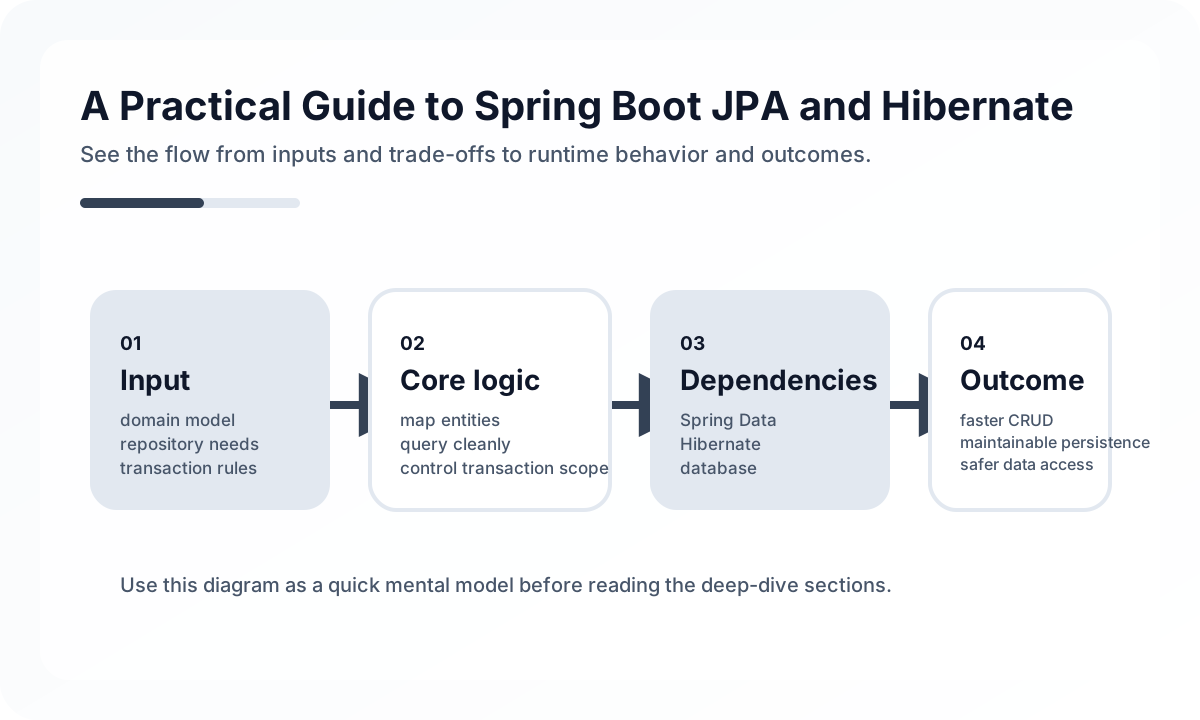
Teams get into trouble with JPA when they assume that a convenient object graph is automatically a good production query model. It rarely is.
Treat entities as write-side models first
Entities are strongest when they protect invariants, express state transitions, and keep transactional rules close to the data they govern.
That usually means:
- entities own state changes with business meaning
- constructors and methods protect valid transitions
- persistence annotations support the model instead of defining it entirely
- entities are not reused as API response contracts
When entities become transport models, search models, and serialization models at the same time, they stop being a useful domain boundary.
Design relationships by cost, not convenience
JPA makes relationships easy to express and expensive to ignore.
A practical rule is to design every association with query cost in mind:
- default relationships to
LAZY - avoid bidirectional mappings unless navigation is genuinely needed
- treat
ManyToManywith suspicion and prefer an explicit join entity - evaluate collection relationships carefully on list endpoints
The question is not whether a relationship looks elegant in code. The question is what SQL it encourages under real traffic.
N+1 is the default risk, not a rare bug
N+1 commonly appears when:
- list queries return entities
- response mapping touches lazy relationships
- template or serialization code navigates associations implicitly
That is why N+1 should be expected and actively managed through:
- fetch joins where appropriate
@EntityGraphfor targeted fetch behavior- DTO projections for read-heavy queries
- SQL logging and query counting in tests
Teams that rely on intuition instead of query observation usually discover N+1 too late.
Read and write paths should not be modeled the same way
Write flows often fit entities, transactions, and aggregate-style behavior. Read flows often fit dedicated DTO queries much better.
Typical examples:
- command use cases load an entity, validate rules, and persist a change
- list pages fetch a narrow DTO projection
- search endpoints optimize for filtering and pagination, not object navigation
Good JPA usage does not mean using entities everywhere. It means using them where their behavior is valuable.
Transaction boundaries should stay intentional
JPA makes it easy to rely on the surrounding transaction without deciding clearly what belongs inside it.
A stronger design asks:
- what state must be consistent in one transaction?
- where does lazy loading still happen?
- are external calls occurring inside the transaction?
- do writes and reads have different transaction requirements?
When transaction boundaries are vague, JPA can appear to work locally while creating lock duration, stale reads, or lazy-loading failures in production.
Avoid lazy-loading dependence outside the write flow
One of the most common production failures is code that accidentally depends on lazy initialization after the intended transaction boundary.
That often shows up as:
- controller serialization touching unloaded associations
- view-model mapping after the transaction is gone
- background or async code accessing detached entities
The safer strategy is to load what the use case needs explicitly and convert to DTOs before crossing boundaries.
Pagination and collection fetches need care
Collection fetch joins and pagination often interact poorly because one logical parent row can explode into many SQL result rows.
In practice:
- page root entities carefully
- avoid naive collection fetch joins on large lists
- prefer separate targeted queries or DTO projections for complex list screens
This is one of the places where “object-oriented elegance” and “query efficiency” diverge sharply.
Operational visibility matters
JPA problems are easier to fix when the team can see them clearly.
Useful signals include:
- executed SQL in development and test
- query count assertions for important endpoints
- slow query logs
- N+1 detection on high-value paths
- transaction duration visibility
Without this visibility, performance issues often get blamed on the database in general rather than on a specific loading pattern.
Common mistakes
Watch for these patterns:
- entities reused directly as API responses
- broad bidirectional associations added for convenience
- lazy loading relied on implicitly in controllers
- collection fetch joins mixed blindly with pagination
- DTO query models avoided even on read-heavy endpoints
These choices feel productive early and become expensive later.
Decision checklist
Before calling the JPA design healthy, confirm:
- entities focus on business state changes
- default fetch behavior is conservative
- list and search endpoints use read-optimized queries where needed
- N+1 is observed, not guessed
- transaction boundaries are explicit and small enough
Wrap-up
Good JPA design is not the one that looks most object-oriented. It is the one where query cost and change cost both stay under control.
That is what separates productive JPA usage from expensive ORM drift.
Continue Reading
Related posts
Designing a Spring Boot REST API That Holds Up in Production
A production-focused guide to Spring Boot REST APIs. Learn how to keep controllers thin, contracts stable, transactions honest, and operational behavior predictable as the system grows.
⚙️ BackendA Guide to Designing Real-Time Communication with WebSocket
This guide covers connection lifecycle, message modeling, authentication, delivery guarantees, and scale-out concerns when designing Spring Boot WebSocket systems.
🧪 TestSpring Boot Test Slices: @WebMvcTest and @DataJpaTest
A practical guide to Spring Boot test slices from the perspective of test-pyramid design and execution cost. Covers when to use @WebMvcTest, @DataJpaTest, @JsonTest, @RestClientTest, and when @SpringBootTest is the better choice.
🗄️ DatabaseA Complete Guide to Solving the JPA N+1 Problem
This post covers multiple ways to solve the N+1 problem, one of the most common JPA performance issues. It explains when to use Fetch Join, EntityGraph, Batch Size, and direct DTO queries.
Next Path