A Practical Guide to Spring Boot and Redis Caching Strategies
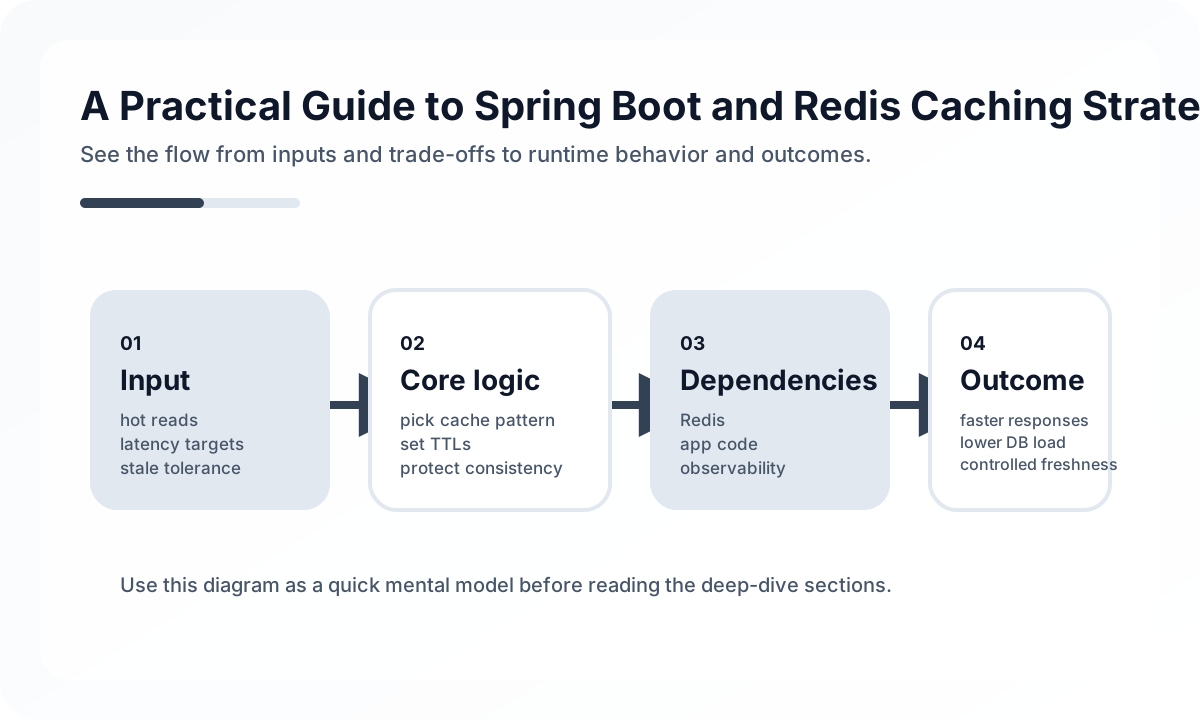
That is why good caching strategy is defined less by adding @Cacheable and more by deciding freshness, invalidation, and failure behavior up front.
Start with the bottleneck, not the tool
Before introducing Redis, a team should answer:
- which query or read path is actually expensive?
- is the problem latency, database load, fan-out cost, or repeated computation?
- how fresh does the answer need to be?
- what happens if the cache misses or fails entirely?
Caching the wrong path adds complexity without removing meaningful cost.
Cache-aside is still the practical baseline
For many Spring Boot services, cache-aside remains the most understandable pattern:
- read from cache
- on miss, load from the database or source system
- populate cache with TTL
- invalidate or refresh on write
Its value is simplicity. Its difficulty is keeping invalidation and freshness behavior honest under real write traffic.
TTL is a business decision
TTL should reflect how much staleness the product can tolerate, not what “feels reasonable” to developers.
Examples:
- product catalog metadata may tolerate longer TTL
- price, inventory, or entitlement data may require short TTL
- configuration or reference data may be cached aggressively
If TTL is chosen without product context, cache correctness becomes accidental.
Invalidation is harder than adding the cache
The hard part of caching is rarely the read path. It is deciding what happens after writes.
Teams should decide:
- do writes delete the cache key or update it directly?
- what related list or aggregate keys become stale?
- how quickly must downstream readers observe the change?
- can brief inconsistency be tolerated?
Single-item cache invalidation is manageable. List cache invalidation and derived aggregate cache invalidation are much harder and should be treated with more caution.
Hot keys and stampedes appear early
Caching problems are not limited to low hit ratio. Highly successful keys can create their own failure modes.
Watch for:
- hot keys receiving extreme traffic concentration
- many requests recomputing the same expired value
- synchronized expiration for popular keys
Practical mitigations often include:
- jittered TTL
- request coalescing or single-flight logic
- pre-warming important keys
- splitting over-broad cached payloads
Without these controls, Redis can shift load rather than reduce it.
Redis failure should not automatically become application failure
One of the most important design questions is what the service does when Redis is slow or unavailable.
Healthy designs decide explicitly:
- can the service fall back to the database safely?
- should some endpoints degrade instead of failing?
- how much extra source-of-truth load can the system absorb?
- are timeout and circuit-breaking rules applied to Redis access?
If Redis outage behavior is undefined, the cache can become a new critical dependency instead of a performance layer.
Spring Cache is useful, but not the whole strategy
@Cacheable, @CacheEvict, and related abstractions are helpful for expressing intent quickly. They are weaker when the design requires:
- complex multi-key invalidation
- list and aggregate cache coordination
- partial refresh strategies
- stampede protection
- detailed cache observability
Framework annotations can support the strategy, but they do not replace it.
Metrics that actually matter
A healthy Redis caching setup watches more than hit ratio alone.
Useful signals include:
- hit ratio by key space
- fallback rate to the database or source system
- memory usage
- eviction rate
- command latency
- hot-key concentration
- cache error rate
A single global hit ratio can hide that one expensive endpoint is still missing constantly.
Common mistakes
Watch for these patterns:
- caching everything without clear bottleneck analysis
- setting TTL without freshness requirements
- forgetting to invalidate related list or aggregate caches
- assuming Redis is always available and fast
- treating application annotations as a full cache strategy
These are the choices that make caching look successful in local testing and dangerous in production.
Decision checklist
Before calling the cache design healthy, confirm:
- the cached path is a proven bottleneck
- TTL matches tolerated staleness
- invalidation rules are explicit
- Redis failure behavior is defined
- hot keys and stampedes are monitored
- metrics exist per key group or endpoint
Wrap-up
Good Redis caching is less about a library choice and more about whether freshness, invalidation, and failure behavior are designed deliberately.
That is what makes a cache a performance tool instead of a hidden consistency risk.
Continue Reading
Related posts
Designing a Spring Boot REST API That Holds Up in Production
A production-focused guide to Spring Boot REST APIs. Learn how to keep controllers thin, contracts stable, transactions honest, and operational behavior predictable as the system grows.
⚙️ BackendA Guide to Designing Real-Time Communication with WebSocket
This guide covers connection lifecycle, message modeling, authentication, delivery guarantees, and scale-out concerns when designing Spring Boot WebSocket systems.
💬 LanguagePython Service Layer Pattern in Practice
How to keep Python applications maintainable by separating transport, domain rules, and persistence responsibilities.
🧪 TestSpring Boot Test Slices: @WebMvcTest and @DataJpaTest
A practical guide to Spring Boot test slices from the perspective of test-pyramid design and execution cost. Covers when to use @WebMvcTest, @DataJpaTest, @JsonTest, @RestClientTest, and when @SpringBootTest is the better choice.
Next Path