A Practical Guide to Building a REST API Server with Node.js and Express
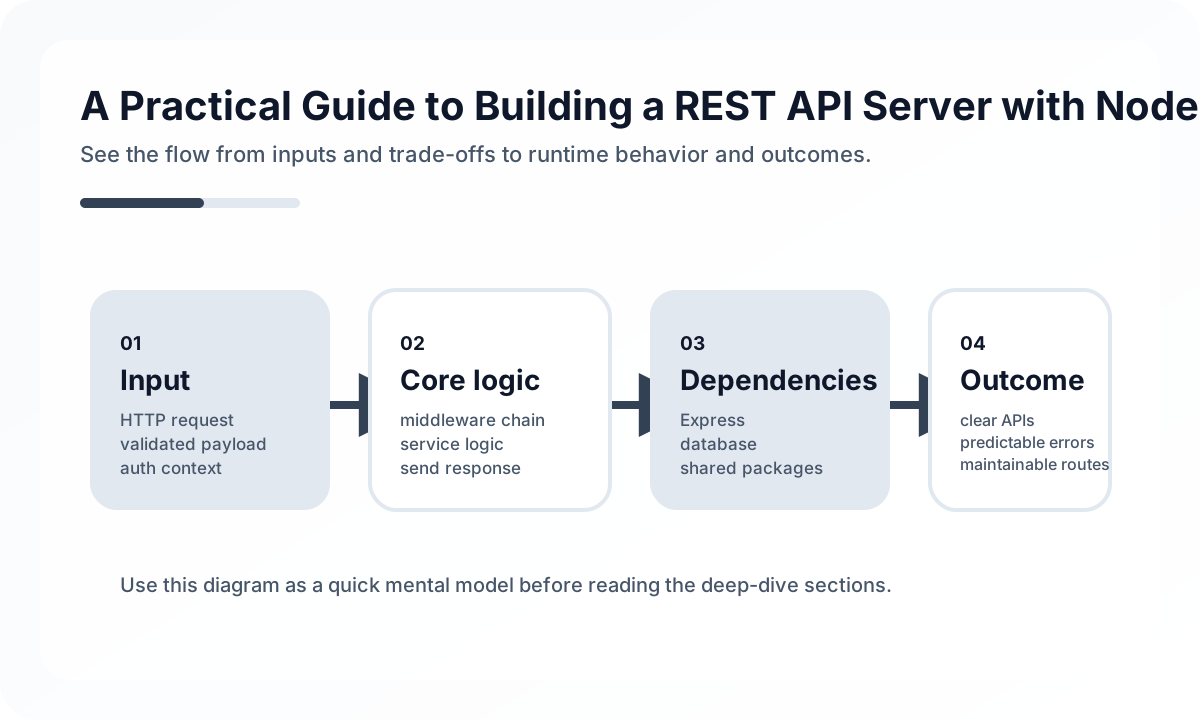
A good Express service is not good because the framework is lightweight. It is good because the team imposes the rules needed to control that lightness.
Define clear layer responsibilities
A practical baseline often looks like this:
- routes compose URL shape and middleware
- controllers translate HTTP requests and responses
- services own use cases and business rules
- repositories or gateways own persistence and external access
- middleware handles cross-cutting HTTP concerns
The exact folder names matter less than keeping each responsibility from leaking everywhere.
Keep controllers thin
Controllers are strongest when they do three things well:
- read validated input
- call the right use case
- translate the result to HTTP
Controllers become expensive to maintain when they also own SQL, transaction orchestration, authorization policy details, or downstream retry behavior.
Thin controllers make testing easier and keep HTTP concerns separate from domain decisions.
Use middleware carefully
Express middleware is powerful, which is why it is often overused.
Middleware is a strong fit for:
- request logging and request IDs
- authentication context extraction
- validation at the HTTP edge
- rate limiting
- standardized error handling
Middleware is a weak fit for business workflows that need domain context or multiple downstream dependencies. When too much logic lives in middleware, request flow becomes harder to trace.
Validation should stop bad input at the edge
Production APIs need clear separation between:
- input-shape validation
- authorization checks
- business rule validation
Input shape belongs at the boundary. Business rule failures belong in the service layer. Mixing them together usually creates inconsistent status codes and unclear error behavior.
Authentication is not authorization
Many Express codebases stop at JWT verification or session parsing and call the security layer complete. That only proves identity, not access rights.
Real applications still need:
- role checks
- ownership checks
- tenant boundaries
- policy decisions that are explicit and testable
When this is not separated cleanly, route handlers often end up mixing user identity, query logic, and business policy in one place.
Standardize the error model early
Clients and operators both benefit when errors follow a predictable structure.
A strong error policy usually includes:
- consistent error shape
- stable application error codes
- request IDs or correlation IDs
- separation between client-facing messages and internal details
If every controller formats errors differently, the API becomes harder to consume and much harder to debug.
Operational basics should not wait
Even a small Express service should establish:
- graceful shutdown behavior
- request timeout policy
- payload size limits
- health endpoints
- structured logging
These details are often skipped because Express makes local success easy. They become expensive later when traffic or incidents increase.
Common mistakes
Watch for these patterns:
- routes or controllers directly containing persistence logic
- middleware chains that hide business decisions
- inconsistent validation behavior across endpoints
- JWT verification used as a substitute for authorization policy
- no shared error model or observability baseline
These mistakes usually appear gradually, which is why teams often notice them only after the codebase already feels hard to change.
Wrap-up
A good Express service is not good because the framework is lightweight. It is good because the team imposed the rules needed to control that lightness.
Thin controllers, clear service boundaries, disciplined middleware, and consistent operational behavior are what keep Express productive over time.
Continue Reading
Related posts
Designing and Implementing a GraphQL API: How Is It Different from REST?
This guide covers schema design, resolver responsibility, N+1, mutation design, authorization, and operational tradeoffs when treating GraphQL as a contract model rather than just selective field fetching.
⚙️ BackendJob Status Patterns for Long-Running Bulk APIs
Treating long-running backend work as a synchronous API problem usually hurts both user experience and operational stability. Here is a practical job-status pattern.
💬 LanguageTypeScript Utility Types: A Practical Guide
A production-focused guide to TypeScript utility types. Learn how to model DTOs, update payloads, selectors, and derived types without making your type layer harder to read.
💬 LanguageModern JavaScript Syntax Through ES2024
A practical guide to modern JavaScript syntax through an engineering lens. Learn which ES2024-era features genuinely improve code quality and which ones still need restraint.
Next Path