Designing and Implementing a GraphQL API: How Is It Different from REST?
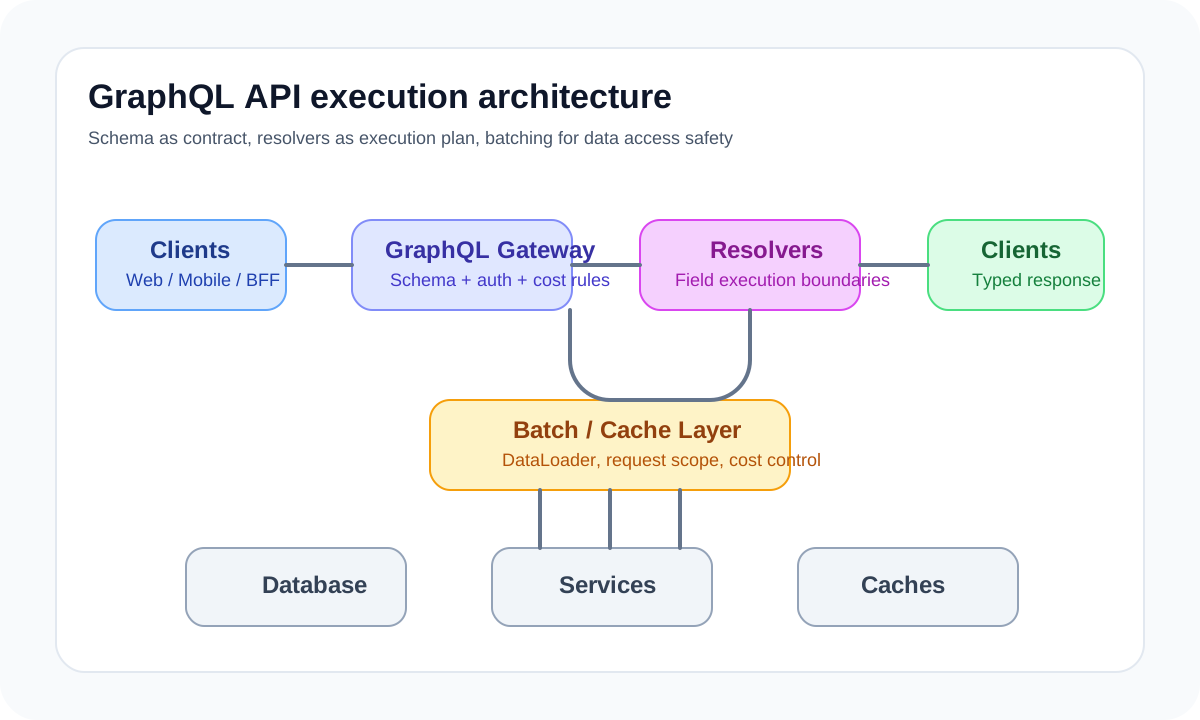
GraphQL is not valuable merely because it fetches fewer fields. Its real impact is that it gives clients much more control over response shape, which means the server must take much tighter control over execution cost, authorization, and contract design.
That is why a strong GraphQL API is rarely “REST with a single endpoint.” It is an execution platform with its own design rules.
What changes compared with REST
In REST, the server usually defines a resource shape and the client chooses among endpoints. In GraphQL, the server defines a schema and the client composes queries against that schema.
That shifts responsibility in important ways:
- schema design becomes product-facing API design
- resolver design becomes execution-path engineering
- authorization often needs field and relationship awareness
- performance work moves from endpoint tuning to query-shape control
The benefit is flexibility for web and mobile clients. The cost is that the server can no longer assume a fixed response shape or a predictable execution path unless it enforces one deliberately.
Treat the schema as a contract, not a table mirror
One of the fastest ways to create a fragile GraphQL API is to mirror database tables into types and expose them directly.
A good schema should reflect business concepts and client use cases:
Order,Shipment, andInvoiceare better than generic persistence models- field names should match product language
- relationships should reflect what clients need to navigate
- deprecated fields should be managed like contract changes, not silent refactors
If the schema simply mirrors persistence, teams usually end up leaking internal joins, naming accidents, and migration details into the public API.
Resolver design is execution design
Resolvers are not just convenience functions. Together they form the execution plan for the request.
That means each resolver should be designed with clear expectations about:
- what data it needs
- whether it triggers downstream network or database calls
- how it participates in batching
- how errors should surface to the client
When teams ignore this, GraphQL looks elegant in the schema and chaotic in production.
N+1 is the first practical performance problem
The most common GraphQL performance regression is not CPU. It is resolver-by-resolver data fetching that explodes into repeated queries.
Typical example:
- load 50 orders
- each order resolver loads its customer separately
- each order resolver loads line items separately
That can turn one logical request into hundreds of database calls.
A practical mitigation strategy usually includes:
- request-scoped batching with DataLoader or an equivalent pattern
- designing repository APIs for set-based fetching
- avoiding resolver code that hides blocking I/O behind innocent field access
- measuring query cost and field latency, not just endpoint latency
If N+1 is not actively managed, GraphQL will often lose its productivity advantage under real traffic.
Mutations should be verb-oriented and business-specific
GraphQL mutations are often stronger when they model business actions instead of generic object patching.
Better examples:
placeOrdercancelSubscriptionapproveExpenseReport
Weaker examples:
updateOrdersaveUserpatchEntity
Verb-oriented mutations make validation, authorization, audit trails, and client expectations much clearer. They also reduce the temptation to turn GraphQL into a thin wrapper around ORM update operations.
Authorization needs more than endpoint-level thinking
In REST, route-level authorization is often enough for many cases. In GraphQL, clients can ask for different fields, nested relationships, and connection paths in the same request.
That means teams often need layered authorization:
- operation-level checks
- object-level access validation
- field-level restrictions for sensitive data
- tenant or ownership filtering in resolvers and repositories
If authorization is only checked at the top-level resolver, nested fields can easily leak information that the team did not intend to expose.
Query depth and complexity must be controlled
GraphQL gives clients expressive power. Without limits, expressive power turns into operational risk.
Practical controls usually include:
- maximum query depth
- maximum field complexity or weighted cost
- persisted queries for trusted clients
- body size limits
- timeouts and cancellation
These controls are not optional polish. They are part of making the API safe to expose in production.
Error handling should be predictable
GraphQL allows partial success, which is useful but easy to misuse.
Teams should decide explicitly:
- which failures should null a field
- which failures should fail the entire operation
- which business errors should return typed error payloads
- how internal failures should be masked while remaining diagnosable
If every failure becomes a generic GraphQL error array entry, clients lose clarity and support teams lose context.
Caching is different from REST
GraphQL can reduce over-fetching, but it also weakens the default caching advantages of REST because multiple operations share the same endpoint.
That means caching often shifts toward:
- normalized client-side caches
- persisted query keys
- server-side resolver caching for reference data
- upstream caching for federated or downstream services
Teams should not assume GraphQL automatically improves performance. It changes where optimization work happens.
A practical server checklist
Before calling a GraphQL API production-ready, verify that you can answer these questions:
- Do we know the most expensive fields and query patterns?
- Do we batch cross-entity loads consistently?
- Do we have depth and complexity controls?
- Are sensitive fields protected below the top-level resolver?
- Do our mutations represent business actions rather than generic writes?
- Can we observe per-field latency and error rates?
When GraphQL is a strong fit
GraphQL is often a strong choice when:
- multiple clients need different views of the same domain
- frontend teams iterate quickly on UI composition
- nested data traversal is central to the product
- API evolution without constant versioning is valuable
It is less compelling when:
- the domain is simple and resource-oriented
- caching around stable endpoints is more important than query flexibility
- the team lacks the tooling or discipline to manage execution complexity
Wrap-up
The important question is not whether GraphQL is more modern than REST. The important question is whether client flexibility is worth the added execution, authorization, and observability discipline on the server.
When the answer is yes, GraphQL can be a powerful contract model. When the answer is no, a well-designed REST API is usually simpler to operate and easier to reason about.
Continue Reading
Related posts
Job Status Patterns for Long-Running Bulk APIs
Treating long-running backend work as a synchronous API problem usually hurts both user experience and operational stability. Here is a practical job-status pattern.
⚙️ BackendOperating Consumer-Driven Contract Versioning
API versioning is less about bumping numbers and more about moving consumers safely without breaking real dependencies.
🔧 ToolsPostman Practical Guide: API Testing, Automation, and Team Collaboration
A practical guide to using Postman for API exploration, environment management, collection design, shared test flows, and Newman-based CI checks.
💬 LanguagePython Service Layer Pattern in Practice
How to keep Python applications maintainable by separating transport, domain rules, and persistence responsibilities.
Next Path