Building a REST API Quickly with Python FastAPI
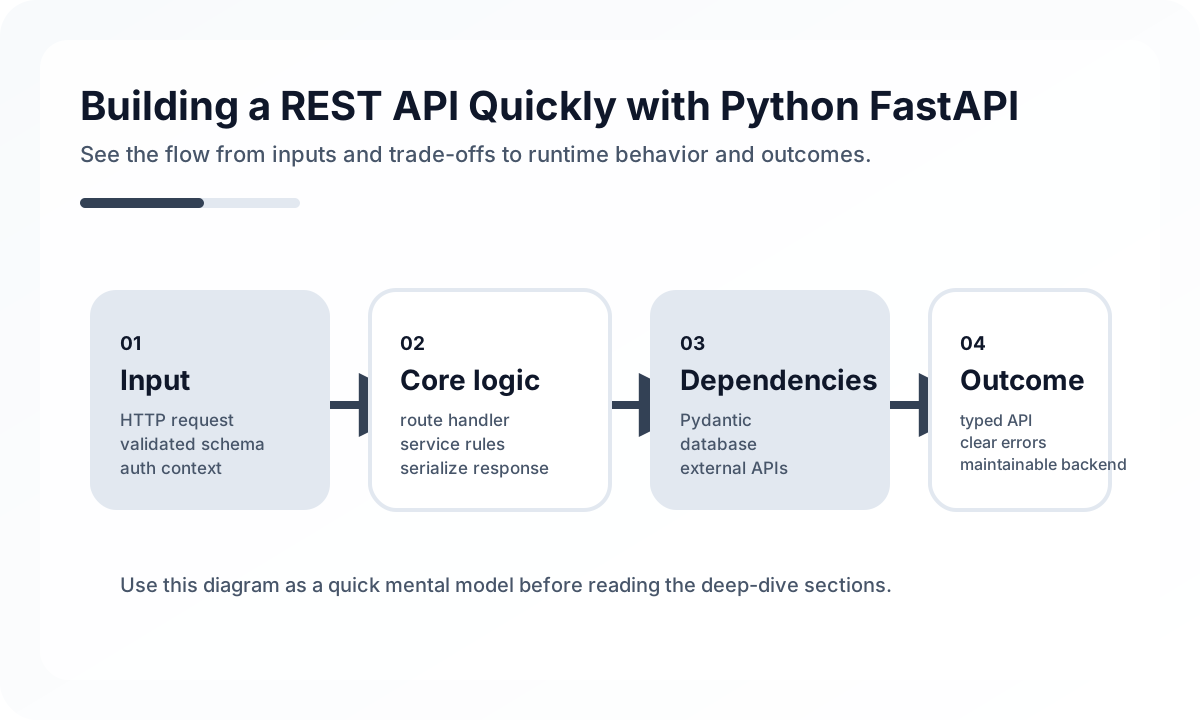
The mistake is assuming that concise demo code naturally scales into maintainable production code. It usually does not unless boundaries are made deliberate early.
Keep request and response schemas separate
One of the most important production habits in FastAPI is separating external API contracts from internal persistence models.
That usually means:
- request schemas validate what clients may send
- response schemas define what the API promises to expose
- ORM models stay internal
- service-layer objects or domain models are not leaked accidentally
If teams reuse one model everywhere, contract evolution becomes risky and internal schema changes start breaking public APIs.
Dependency injection should express boundaries
FastAPI’s dependency system is powerful, but it becomes dangerous when it turns into a dumping ground for business logic.
Dependencies are strongest when they handle boundary concerns such as:
- authenticated user extraction
- tenant resolution
- database session provisioning
- request-scoped policy checks
- shared infrastructure concerns like rate limits or feature flags
Business decisions and use-case orchestration should still live in services or domain logic, not in deeply nested dependency chains.
Structure can stay small, but responsibilities should stay clear
A practical FastAPI service often works well with a structure like:
- routers for HTTP composition
- schemas for request and response contracts
- services for use cases
- repositories or gateways for persistence and external access
- dependencies for shared boundary wiring
This is not about creating a giant enterprise layout. It is about ensuring the code can grow without route handlers becoming the place where every concern accumulates.
Validation should finish at the edge
FastAPI makes it easy to validate incoming data with Pydantic models. That is useful, but teams still need to separate:
- input shape validation
- business rule validation
- authorization validation
Input shape problems belong at the API edge. Business rule failures belong in the service or domain layer. Mixing them together makes error handling inconsistent and harder to test.
Authentication and authorization need explicit policy
FastAPI projects often get authentication working quickly and delay authorization design too long.
A more reliable approach is to decide early:
- how authentication state enters the request context
- where role or ownership checks happen
- how unauthorized vs forbidden responses are represented
- whether token parsing, user loading, and policy checks are distinct steps
This separation keeps security logic readable and avoids route handlers that silently mix identity, data access, and policy decisions.
Error handling should be consistent
As services grow, clients need predictable error shapes more than they need framework-default trace output.
A strong error policy usually includes:
- consistent error response structure
- mapping domain errors to stable HTTP status codes
- correlation or request IDs in logs
- internal details hidden from clients but preserved for operators
Without this, FastAPI services stay pleasant to write but become harder to operate.
Async is useful, not magical
FastAPI works well with asynchronous I/O, but “async” should not be treated as a free performance upgrade.
Teams still need to understand:
- which libraries are truly async
- where blocking calls exist
- how worker count and concurrency limits behave in deployment
- what happens under slow downstream dependency conditions
An async framework with blocking database or HTTP calls can still bottleneck badly under load.
Operational checkpoints matter early
A production-ready FastAPI service should have clear answers for:
- request timeout policy
- payload size limits
- request ID and latency tracing
- health/readiness behavior
- dependency timeout budgets
- OpenAPI contract accuracy
These are much easier to establish early than to retrofit after clients depend on the API.
Common mistakes
Watch for these patterns:
- returning ORM objects directly
- putting business logic into dependencies
- mixing validation, authorization, and business rules in route handlers
- assuming async automatically solves throughput
- relying on default exception behavior in production
These are common because FastAPI makes it easy to get a demo working quickly. The real work is keeping the design disciplined after the first success.
Wrap-up
Good FastAPI services stay concise, but their boundaries and operational rules are much stricter than typical demo code.
That is what lets a fast-starting codebase stay maintainable as traffic, features, and team size grow.
Continue Reading
Related posts
Designing a Spring Boot REST API That Holds Up in Production
A production-focused guide to Spring Boot REST APIs. Learn how to keep controllers thin, contracts stable, transactions honest, and operational behavior predictable as the system grows.
⚙️ BackendJob Status Patterns for Long-Running Bulk APIs
Treating long-running backend work as a synchronous API problem usually hurts both user experience and operational stability. Here is a practical job-status pattern.
💬 LanguagePython Service Layer Pattern in Practice
How to keep Python applications maintainable by separating transport, domain rules, and persistence responsibilities.
💬 LanguagePython Decorators: A Practical Guide
A production-focused guide to Python decorators. Learn when decorators clarify cross-cutting policy, when they hide behavior, and how to keep them diagnosable in real codebases.
Next Path