Implementing Circuit Breakers and Failure Isolation with Resilience4j
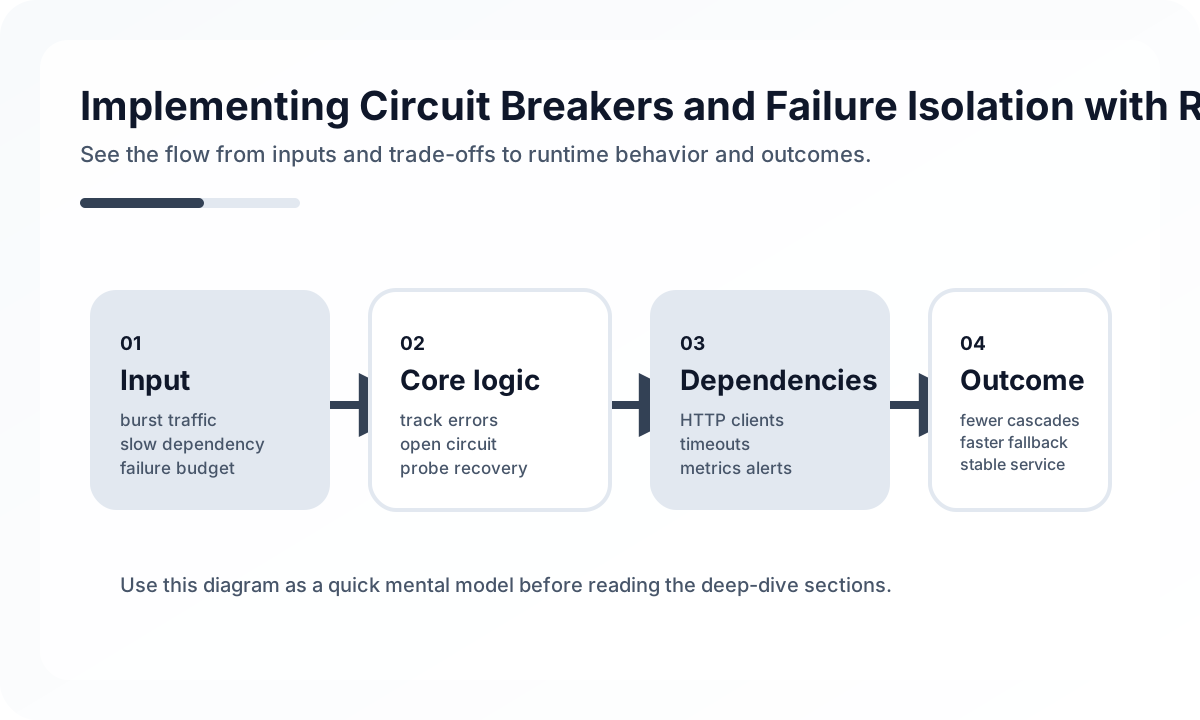
That is why good Resilience4j usage is not about adding annotations everywhere. It is about designing failure behavior deliberately for each dependency and traffic path.
Start with failure modes, not libraries
Before configuring any pattern, teams should classify the dependency they are protecting:
- is the failure transient or persistent?
- is the call read-heavy or write-heavy?
- is the operation idempotent?
- what happens to user experience if the dependency is unavailable?
- does failure consume threads, connection pools, or queue capacity?
Without that thinking, Retry, Circuit Breaker, and Bulkhead often get combined in unsafe ways.
Circuit Breaker is a protection boundary
The circuit breaker tracks failure and slow-call behavior, then opens when the dependency becomes too unhealthy.
Its value is practical:
- stop burning resources on obviously failing paths
- reduce queue buildup and thread exhaustion
- fail fast when the downstream is degraded
- give recovering systems space to recover
The breaker should be tuned to dependency behavior, not copied from generic defaults.
Timeout usually matters before retry
Many services add retries first and discover later that they are retrying requests that are already hanging too long.
A practical order of design is often:
- define the latency budget
- enforce timeout or time limit
- decide whether retry is safe
- apply circuit breaking
- isolate capacity with bulkheads if needed
If timeout is missing, retries and circuit breakers often react too late to protect the system.
Retry can help or make overload worse
Retry is useful for transient failures such as short-lived network issues, temporary throttling, or leader re-election events. It is dangerous for:
- non-idempotent writes
- already overloaded dependencies
- long-running operations that consume scarce resources
A retry policy should always answer:
- what errors are retryable?
- how many attempts are allowed?
- what backoff strategy is used?
- what is the total latency budget after retries?
If those answers are unclear, retry usually adds noise instead of resilience.
Bulkhead provides real isolation
Circuit breakers fail fast based on health signals, but they do not isolate resource consumption on their own.
Bulkheads are useful when one dependency can monopolize:
- servlet threads
- worker pools
- connection pools
- async execution capacity
Without bulkheads, one slow integration can still cause wider service degradation even if a breaker eventually opens.
Fallbacks must stay honest
Fallbacks are often abused as a way to hide failure. That usually creates worse product and data problems later.
Strong fallbacks are explicit about degraded behavior:
- cached or stale data for read scenarios
- reduced recommendations or optional enrichments removed
- partial feature availability with clear client signaling
Weak fallbacks pretend success for write operations or silently drop critical work. That may reduce visible errors while increasing inconsistency.
Observe state transitions and slow calls
Resilience without observability is mostly wishful thinking.
At minimum, watch:
- breaker state transitions
- failure rate
- slow-call rate
- retry volume
- timeout rate
- bulkhead saturation
The most useful signals are often not the absolute error count, but the trend showing that a dependency is getting slower before it fully fails.
A practical Spring Boot policy
In many Spring Boot systems, a healthy baseline looks like this:
- outbound calls have explicit timeout budgets
- retries are limited to idempotent or clearly safe operations
- circuit breakers protect unstable dependencies
- bulkheads isolate scarce execution resources
- fallbacks are defined only where degraded behavior is genuinely acceptable
This is stronger than treating Resilience4j as a cosmetic annotation layer.
Common mistakes
Watch for these patterns:
- retrying non-idempotent operations
- using fallback logic that hides failed writes
- copying the same breaker configuration to every dependency
- measuring only errors but not slow-call trends
- protecting calls with a circuit breaker while leaving thread pools unbounded
These mistakes make the service appear resilient in code while remaining fragile in production.
Decision checklist
Before considering the setup production-ready, confirm:
- each external dependency has a defined latency budget
- retry rules match business safety and idempotency
- bulkheads exist where resource isolation matters
- fallback behavior is explicit and product-approved
- dashboards show breaker transitions, slow calls, retries, and saturation
Wrap-up
Good Resilience4j usage is not a matter of adding annotations. It is a matter of designing dependency failure behavior so that one bad path cannot consume the health of the whole service.
That is what failure isolation looks like in practice.
Continue Reading
Related posts
A Practical Guide to CQRS and Event Sourcing
This guide explains CQRS and Event Sourcing in terms of domain boundaries, projections, consistency tradeoffs, snapshots, and operational complexity.
⚙️ BackendImplementing Event-Driven Architecture with Apache Kafka
This guide covers event contracts, partition meaning, idempotency, replay, DLT, and operational metrics when using Kafka as a foundation for event-driven design.
🧪 TestSpring Boot Test Slices: @WebMvcTest and @DataJpaTest
A practical guide to Spring Boot test slices from the perspective of test-pyramid design and execution cost. Covers when to use @WebMvcTest, @DataJpaTest, @JsonTest, @RestClientTest, and when @SpringBootTest is the better choice.
🧪 TestREST Assured API Testing Strategy Guide
A practical guide to testing Java-based APIs with REST Assured. Focuses on contract validation, authentication flows, test data, and integration-test boundaries rather than just request examples.
Next Path