RAG Evaluation Playbook: How to Measure Retrieval Before Users Lose Trust
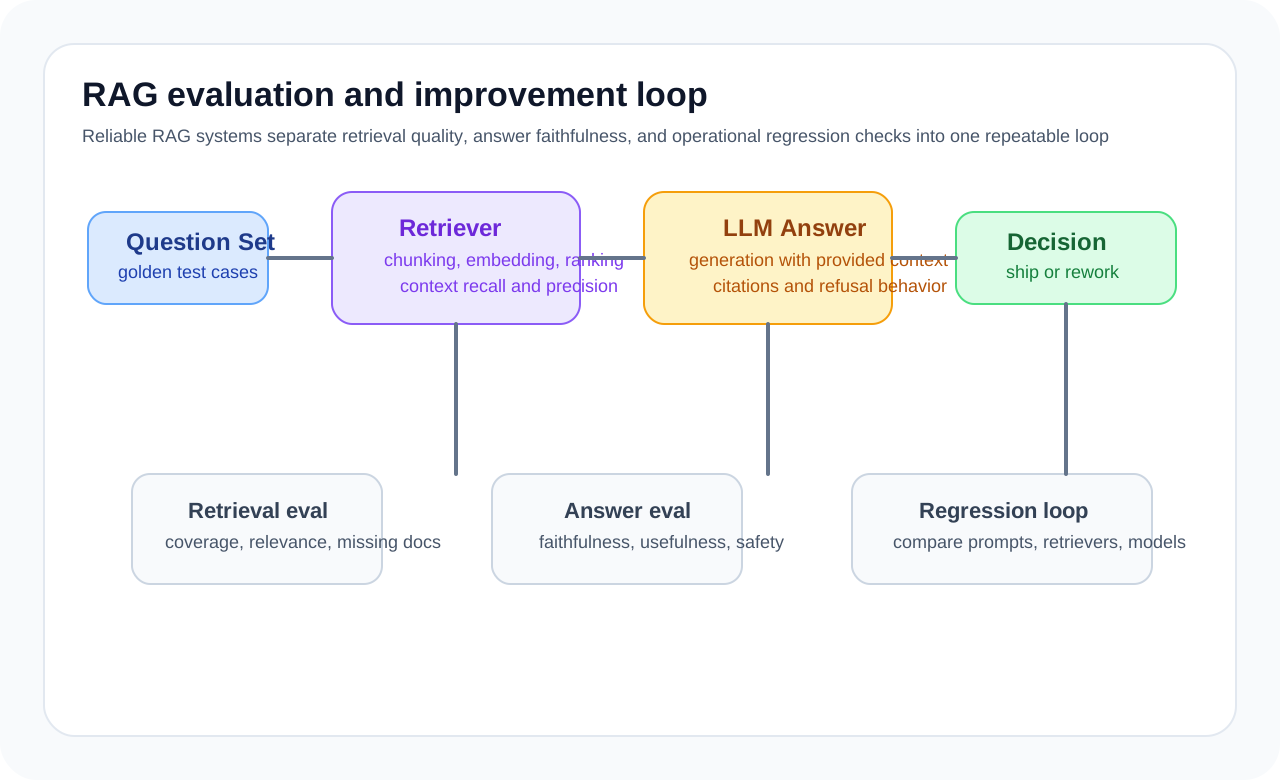
Evaluate the Retrieval Layer First
Before scoring answer quality, test whether the system retrieved the right evidence at all.
Useful checks include:
- whether the expected source appears in top-k results
- whether ranking order favors the most useful chunk
- whether chunk size hides or splits critical facts
- whether metadata filters exclude the right documents
If the right evidence is missing, answer-level evaluation is mostly noise.
Build a Realistic Evaluation Set
A strong RAG test set should include more than easy factual questions. Production traffic usually contains:
- underspecified requests
- multi-hop questions
- stale-document traps
- conflicting documents
- queries where the correct answer is “not enough information”
Those are the cases that determine whether users trust the system.
Measure Grounding, Not Just Helpfulness
Teams often over-focus on whether the answer “sounds good.” In RAG, the more important question is whether the answer is supported by the retrieved evidence.
Practical evaluation dimensions:
- retrieval hit rate
- answer grounding rate
- unsupported claim rate
- citation usefulness
- refusal quality when evidence is weak
Failure Analysis Needs Categories
When quality drops, classify the failure:
- retrieval missed the right document
- chunking damaged the evidence
- reranking favored weak context
- prompt instructions encouraged overconfident synthesis
- the model ignored useful evidence
This classification matters because each failure belongs to a different fix path.
Use Release Gates
Do not promote a new RAG pipeline only because a few sample queries look better. Define gates such as:
- minimum retrieval hit rate
- maximum unsupported-claim rate
- stable latency and cost at target traffic
- no regression on high-value business questions
RAG quality becomes manageable when teams stop treating evaluation as a one-time benchmark and start treating it as a release discipline.
Continue Reading
Related posts
AI Evaluation Rubric for Production Teams
A practical way to define quality rubrics, failure classes, and release gates for production AI features.
🤖 AI / LLMOpsPrompt Engineering in Production: Versioning, Testing, and Failure Recovery
A production-focused guide to prompt engineering covering prompt contracts, structured outputs, versioning, evaluation, rollback, and team workflow.
📈 TrendsHow Small Models Are Changing Product Architecture
An important AI product trend is not only bigger models, but better decisions about where smaller models belong in the system.
📈 TrendsThe Next Stage of AI Coding Agents Is Bounded Execution
Coding agents are moving beyond autocomplete toward execution environments with explicit limits, permissions, and safety rails.
Next Path