LLMOps Platform Architecture: How to Run LLM Features in Production
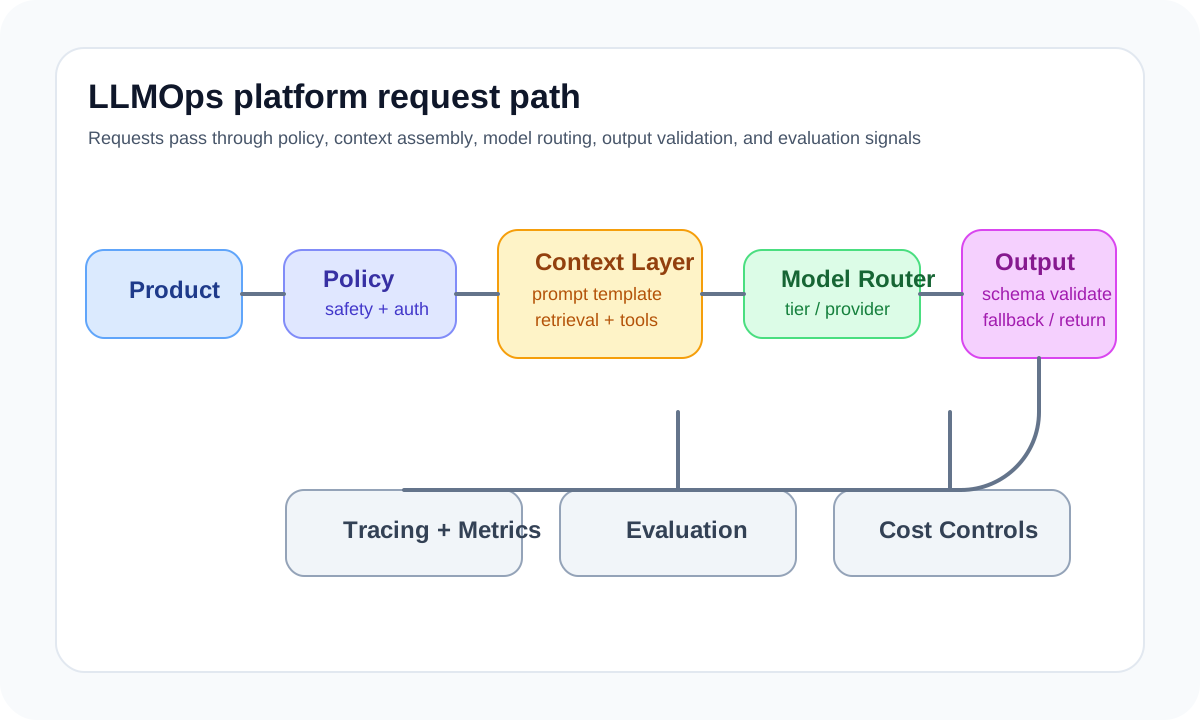
An LLM feature stops being a demo the moment traffic, cost, latency, and model change start affecting real users. At that point, teams need an LLMOps platform, not just a prompt file and a model API key. The platform job is to make model-backed behavior observable, governable, and replaceable without turning every product change into a fire drill.
What an LLMOps Platform Actually Owns
In production, the platform is usually responsible for:
- request routing across providers or model tiers
- prompt and configuration versioning
- trace collection for each model interaction
- evaluation datasets and regression detection
- cost and latency controls
- safety and policy enforcement
If those concerns are spread across product services ad hoc, debugging becomes slow and every team reinvents the same failure handling badly.
A Practical Request Flow
A healthy LLM feature path often looks like this:
product request
-> policy checks
-> retrieval or context assembly
-> prompt template + version
-> model routing
-> structured output validation
-> trace + metrics + feedback capture
This is useful because each boundary has a different owner. Application teams own product intent. Platform teams own routing, controls, and observability. Evaluation owners decide whether quality is actually improving.
Version More Than the Prompt
Many teams version only prompt text. In practice, the behavior of an LLM feature also depends on:
- system instructions
- retrieval strategy
- document chunking rules
- tool availability
- output schema
- fallback logic
If these move independently without a clear release record, incidents become impossible to reproduce.
Observability Needs Business Context
Tracing token counts and latency is necessary but insufficient. Production AI traces should also capture:
- feature name and user journey
- prompt or workflow version
- retrieval sources used
- validation failures
- user correction or dissatisfaction signals
Without that context, teams can see slow calls but still fail to explain why answers became worse after a rollout.
Cost Control Is a Product Constraint
Cost spikes usually come from long contexts, repeated retries, high-end model overuse, or evaluation traffic that quietly scales with production. Strong teams define budgets early:
- which use cases deserve premium models
- when to summarize or compress context
- when cached results are acceptable
- what quality threshold justifies more expensive inference
Good LLMOps architecture makes AI behavior easier to change safely. It does not remove uncertainty from models, but it does make uncertainty visible, measurable, and governable. That is the difference between a flashy feature and a sustainable platform.
Continue Reading
Related posts
Designing a Memory Window Budget for Agents
Agents do not get better just because they remember more. In production, memory budgets and summarization rules drive quality.
🤖 AI / LLMOpsResponses API and Remote MCP Adoption Notes
Model APIs are shifting from text generators to tool orchestration surfaces. Here is how to think about Responses API and Remote MCP in production.
🚀 DevOpsControlling Preview Environment Costs
Preview environments accelerate feedback, but without lifecycle rules they can quickly become an expensive form of shadow production.
📈 TrendsHow Small Models Are Changing Product Architecture
An important AI product trend is not only bigger models, but better decisions about where smaller models belong in the system.
Next Path